October 23, 2026 · By RestoFlo · Water Damage Restoration / Leak Detection
Quick answer: If water is collecting around a water softener, keep clear of wet outlets and equipment. If the unit appears to be the source and its labeled bypass is dry and safely reachable, follow your model’s instructions to put it in bypass; do not force an unfamiliar valve. If water continues or the source is uncertain, seek help with the supply shutoff from a plumber or authorized building contact. A bypass is not a repair, and stopping the leak does not dry wet flooring or walls. Have the source and affected materials assessed separately. [1][2][3]
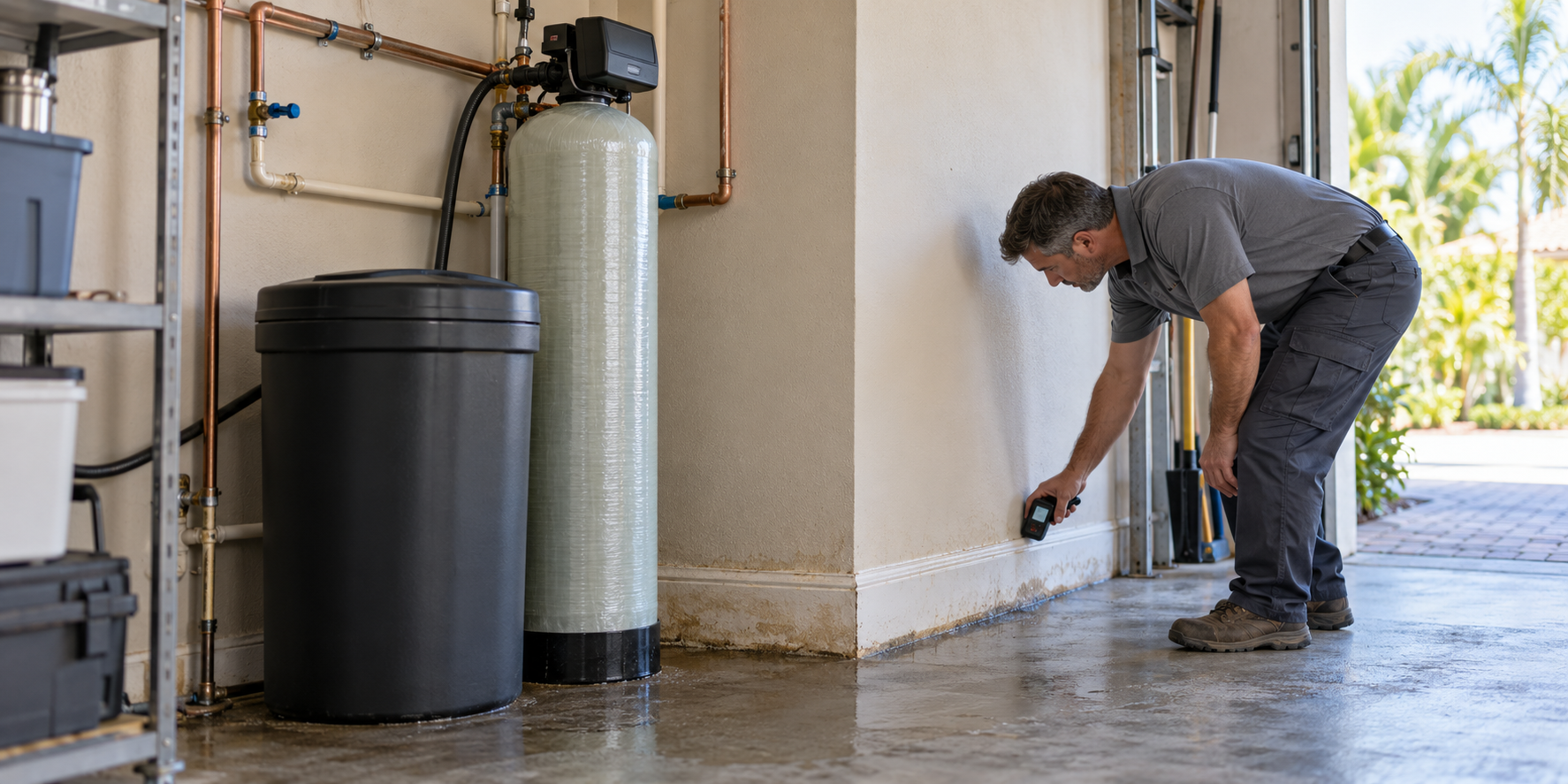
A puddle at the base is not proof that the resin tank cracked. Water may run down from a control-valve connection, escape a brine tank or drain hose, back up from a nearby floor drain, or condense on a cold surface. In a South Florida garage or utility closet, humid air can make condensation plausible—but an expanding puddle or wet building material should not be dismissed as humidity. [1]
What should you do in the first few minutes?
- Protect people first. Keep children and pets away from the wet area. Do not touch a wet plug, outlet, pump, electrical panel, or appliance, or step through water to reach a switch. If electricity can be isolated from a dry, safe location, use an appropriate qualified person; otherwise leave the area and seek help. Call emergency services for sparking, fire, injury, or another immediate life-safety threat. Ready.gov advises against touching wet electrical equipment or doing so while standing in water. [2]
- Stop additional flow only if safe. If the softener appears to be leaking, use a known, safely accessible bypass according to the installed model’s instructions. Culligan describes bypass as a temporary way to route water around a softener, not a fix. If the bypass is inaccessible, unlabeled, stuck, or water keeps spreading, do not improvise or disconnect piping. Contact the installer, a qualified plumber, or building management to isolate the correct supply. [1]
- Leave the appliance off for service. Do not initiate another regeneration cycle, disconnect or reroute the drain line, open the pressurized valve assembly, or patch a tank as a test. A service professional should trace the leak and inspect the installation. [1]
- Document what you can see without entering a hazard. Photograph the water path, valve and tank exterior, brine tank, hose, nearby drain, floor, baseboard, and adjacent room from safe positions. Record when it began and whether it coincided with a regeneration cycle. If this is a condo or shared utility space, notify the authorized building contact if other units or common areas may be affected.
If water has reached flooring, drywall, cabinetry, or a neighboring space, call RestoFlo for a South Florida water-damage assessment at (754) 289-4815. Source repair and restoration may need to proceed in coordination, but they are not the same scope. [4]
Where might the water actually be coming from?
| Safe, visible clue | Possible source—not a diagnosis | Appropriate next step |
|---|
| Water tracks down from the control head, fittings, or nearby plumbing | Connection or valve-area leak | Use a safely accessible bypass if the system is implicated; request installer/plumber inspection. [1] |
| Water or white salt residue appears by the separate salt/brine tank | Brine-tank, float, or connection problem | Do not open fittings or assume the resin tank failed; arrange softener service. [1] |
| Water appears around a hose or floor drain, especially around regeneration | Loose or obstructed drain path, or a backed-up building drain | Avoid another cycle and ask the appropriate softener/plumbing professional to inspect the drain. [1] |
| The tank or adjacent cold pipe is damp, without a traceable active drip | Condensation is possible in a humid space | Monitor from a safe location; get it checked if pooling recurs or materials stay wet. [1] |
| Water continues after the softener is put in bypass | The bypass may not isolate this source; a nearby supply, drain, or appliance may be involved | Seek plumbing/installer help with proper isolation; do not assume the source is solved. [1] |
These observations can guide a service call, not establish a water category, a repair scope, or which unit is at fault. Water can travel across a sloped floor before it collects beside the softener. Culligan specifically cautions that a nearby drain or appliance can mimic a softener-bottom leak. [1]
Does putting the softener in bypass stop all the water?
Not necessarily. Bypass diverts flow around the softener on a compatible installation, but it does not remove water already on the floor, repair a failed hose or tank, or rule out an adjacent plumbing or drain source. Confirm from a dry position whether the visible flow actually stops; if it does not, have an authorized person isolate the correct line. Use the exact installed model’s instructions rather than a universal valve-turning rule. [1]
A drain backup and a supply-side leak call for different repairs. A plumber or softener installer diagnoses the equipment, connection, and drain route. If the source remains unclear after safe isolation, leak detection can help investigate the water path; a water-damage assessment addresses what the water contacted. RestoFlo’s service pages describe leak detection and restoration—not a blanket promise that it repairs every softener. [4]
When is a water-damage assessment warranted?
Request one when water has moved beyond a small, contained, readily dried surface; the event may have lasted overnight; the floor, baseboard, wall, cabinet, or adjacent room is wet; water may have reached an electrical area; or the source or water condition is uncertain. A supply leak, salty brine release, drain discharge, and water that has crossed dirty building materials should not be treated as interchangeable from appearance alone. If sewage or another contaminated source may be involved, keep people away and obtain experienced professional help. EPA’s clean-water drying guidance does not automatically apply to contaminated water. [3][5]
Moisture can remain behind a baseboard, in drywall, or under flooring after the puddle is removed. EPA emphasizes prompt drying of water-damaged areas—typically within 24–48 hours as a prevention goal—and special attention to hidden wet areas. This is not a countdown that diagnoses mold or guarantees a material can be saved. An on-site evaluation determines extraction, drying access, monitoring, cleaning, or selective removal based on what actually got wet. [3][5]
For the broader question of source-finding versus mitigation, read leak detection or water-damage restoration?. If water reached tile, see water under tile after a leak. A wet water-heater pan nearby is a separate diagnostic possibility covered in our heater-pan guide.
Get the source fixed—and check the building materials
Have the softener installer or qualified plumber confirm and repair the source. For water that has spread into a South Florida home or business, RestoFlo can assess affected materials through its water-damage restoration service. Call (754) 289-4815 or request a free assessment. The scope depends on the source, safety conditions, duration, materials, and on-site findings; no dispatch time or coverage outcome is promised. [4]
Frequently asked questions
Does water at the bottom of a softener mean the tank is cracked?
No. Water can travel downward from a valve or fitting, collect from the brine tank or drain, come from a nearby appliance, or condense on a cold surface. A tank fault is possible, but a professional should identify the source before deciding on repair or replacement. [1]
Should I put a leaking water softener in bypass?
If the softener appears to be leaking and the labeled bypass is dry, accessible, and familiar, follow the installed model’s instructions to use it, then arrange service. Do not cross water, force a valve, or assume bypass has stopped every source. It is a temporary isolation step, not a repair. [1][2]
Why is water appearing near the softener during regeneration?
The softener sends water through a drain line during regeneration. A loose, kinked, blocked, or incorrectly placed line—or a nearby drain backing up—can produce water near the unit. The timing is a clue, not proof. Stop using the system and ask a softener technician or plumber to inspect the drain path. [1]
If the leak stops, do I still need water-damage restoration?
Not every small, contained spill requires professional restoration. But if water reached flooring, baseboards, walls, cabinets, another room, or a lower unit—or you cannot tell how long it was wet—have the materials assessed. A dry-looking floor does not verify hidden layers are dry. [3][4]
Is water from a softener leak always clean?
No. The origin and what the water contacted matter. Brine or drain discharge is not the same as a newly escaped supply-line release, and water can acquire contamination along its path. Avoid declaring its condition by color alone; if a drain backup or other contaminated source is suspected, keep clear and seek experienced help. [1][5]
Sources
- Culligan, “What to do if your water softener is leaking from the bottom”, updated June 11, 2026 — possible sources, bypass as temporary measure, drain/valve/brine distinctions, professional service. Manufacturer advice is generalized here; installed-model instructions prevail.
- Ready.gov, “Floods” — electrical safety around wet equipment, applied conservatively to indoor leaks.
- U.S. EPA, “A Brief Guide to Mold, Moisture and Your Home” and Mold Course, Chapter 9 — prompt drying and hidden wet areas; 24–48 hours is a prevention goal, not a guarantee.
- RestoFlo, water-damage restoration, leak detection, and contact — currently displayed services and phone, not proof of a specific site’s dispatch or softener repair scope.
- U.S. EPA, “Mold Cleanup in Your Home” and EPA water-damage table — seek experienced help for sewage/other contaminated-water damage; table addresses clean-water response and should not be applied blindly to uncertain water.