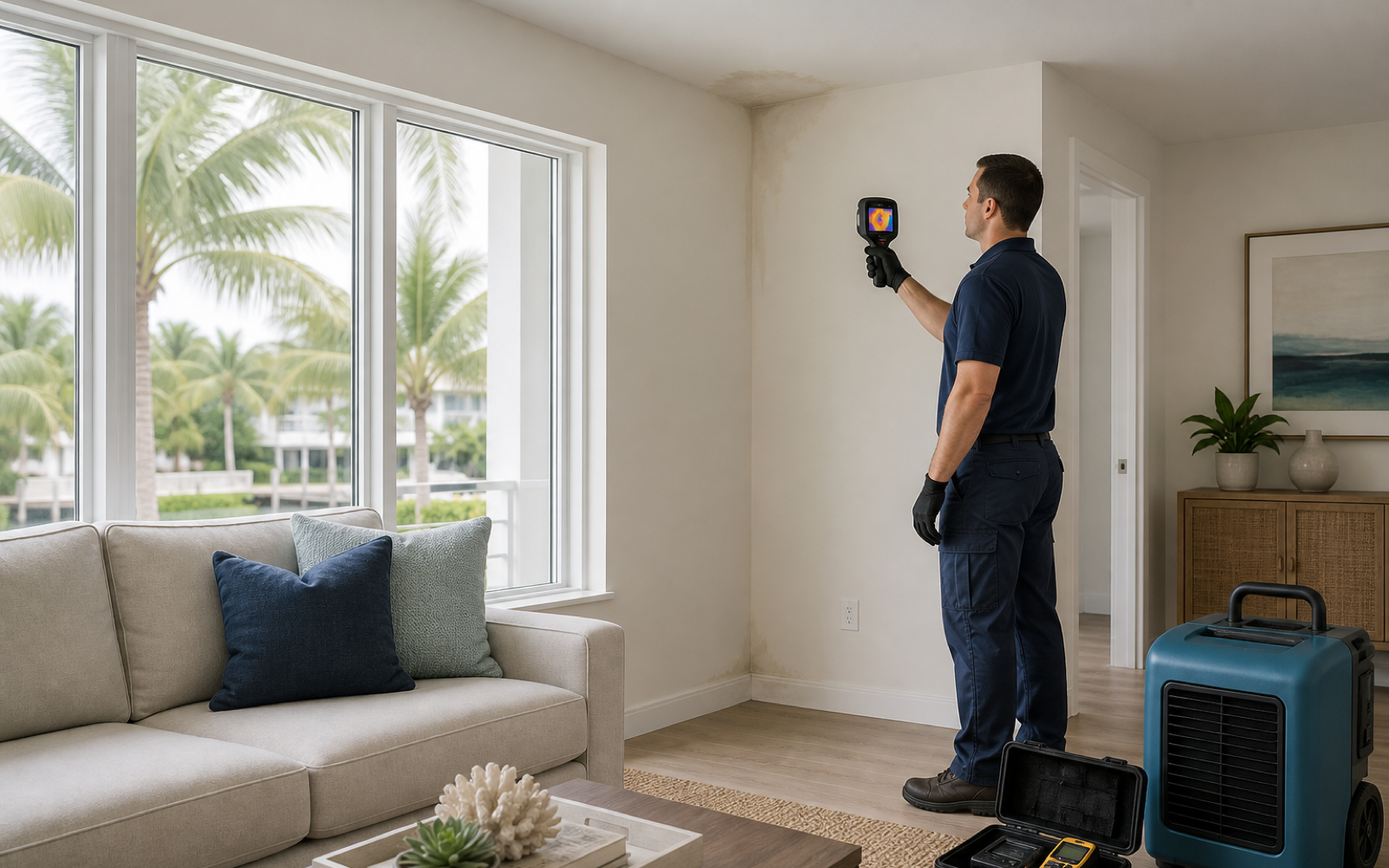
Published August 10, 2026 • By RestoFlo
Quick answer: Choose leak detection when the water source is unknown—for example, you hear running water, see one unexplained stain, or notice a sudden water-bill change without standing water. Choose water damage restoration when water has already soaked floors, drywall, cabinets, ceilings, or contents. Many losses need both: first control and locate the source, then extract water, measure hidden moisture, dry affected materials, and document the work.
A leak and water damage are connected, but they are not the same problem. Leak detection answers “Where is the water coming from?” Water damage restoration answers “What is wet, what can be dried, and what must be cleaned, removed, or repaired?”
For a South Florida homeowner, choosing the right first call depends less on the size of the visible stain and more on three questions:
- Is the source known and controlled?
- Is water still entering the property?
- Have building materials or contents become wet?
If the answer is unclear, a professional assessment can determine whether you need one service or a coordinated response.
The fastest way to choose the right service
Start with leak detection when the source is unknown
Leak detection is usually the right starting point when you have a clue but not a confirmed source. Common examples include:
- A water bill that rose without an obvious change in use
- The sound of running or dripping water when fixtures are off
- One damp cabinet, wall, ceiling, or baseboard with no visible plumbing failure
- A recurring stain that returns after drying or repainting
- Warm, cool, or discolored spots on a floor or wall
- Musty odor in one area without visible standing water
- Water appearing far from the likely source
RestoFlo’s leak-detection service page describes using specialized tools to find hidden leaks and reduce unnecessary damage during the search. The inspection may focus on plumbing lines, fixtures, appliances, walls, ceilings, floors, or other likely paths based on the evidence at the property.
Leak detection does not automatically mean the surrounding materials are dry. A small concealed leak can affect insulation, drywall, flooring, cabinets, or framing before water becomes obvious in the room.
Start with water damage restoration when materials are already wet
Water damage restoration should move to the front of the response when water has escaped into the building and affected materials or contents. Common signs include:
- Standing water or active spreading
- Wet carpet, padding, flooring, drywall, insulation, or cabinets
- Swollen baseboards, warped flooring, bubbling paint, or a sagging ceiling
- Water dripping through a ceiling or light opening
- Wet contents or stored items
- A musty odor after a recent leak, storm, appliance failure, or overflow
- Water from a contaminated source, including sewage or outdoor floodwater
RestoFlo’s water-damage service page describes assessment, water extraction, drying and dehumidification, cleaning, and restoration as parts of the process. The exact scope depends on the water source, how far moisture traveled, the materials involved, access, and how long the area remained wet.
The U.S. Environmental Protection Agency says it is important to dry water-damaged areas and items within 24 to 48 hours to help prevent mold growth. That window is a reason to act promptly—not a promise that every assembly can be dried in two days.
Many water losses need leak detection and restoration
The most common real-world answer is not “either/or.” It is often both, in the right sequence.
Consider a slow supply-line leak behind a bathroom vanity:
- Leak detection or targeted inspection confirms the source and extent.
- The water source is stopped or controlled.
- Restoration technicians map moisture beyond the visible stain.
- Standing water is extracted if present.
- Drying and dehumidification are designed for the affected materials.
- Unsalvageable or contaminated materials are removed when necessary.
- Cleaning, repairs, and documentation follow the approved scope.
Now consider a washing-machine hose that releases visible water across a floor. The source may already be obvious, so restoration can begin immediately while the hose or connection is repaired. The sequence changes because the source is known, but the need to check for hidden moisture does not disappear.
What to do before the first call
Safety comes first. If water is near electrical equipment, outlets, a panel, or energized appliances, do not enter the wet area or touch the equipment. Ready.gov warns of electrocution risk and says not to touch wet electrical equipment or equipment while standing in water. Turn off electricity only if it is safe to do so.
If there is no immediate electrical, structural, fire, or contamination hazard:
- Stop the water at a local shutoff or main valve if you can do so safely.
- Do not puncture a sagging ceiling or open a wet wall on your own.
- Photograph the source, affected rooms, and visible damage before moving items when practical.
- Move dry, unaffected contents away from the wet area without crossing contaminated water.
- Avoid applying bleach, fragrance, paint, or sealant before the source and moisture extent are understood.
- Record when the problem was discovered and what changed.
- Contact RestoFlo at (754) 289-4815 or request a free assessment.
Call 911 for an active fire, medical emergency, immediate structural danger, or other life-safety emergency.
What leak detection should answer
A useful leak-detection assessment should narrow the problem enough to guide the next action. Depending on the property and evidence, the assessment may help determine:
- Whether water is actively entering the property
- The likely source area and access point
- Whether the source is plumbing-related, appliance-related, roof- or envelope-related, or still unconfirmed
- Whether a plumber, roofer, appliance technician, utility, or other trade is needed
- Whether nearby materials should be checked for moisture
- Whether water damage restoration should begin immediately
Leak detection is not a substitute for every repair trade. A source may require a licensed plumber, roofer, electrician, appliance technician, or other specialist. The goal is to make the next step more targeted and reduce guesswork.
Learn more about RestoFlo’s leak detection services.
What water damage restoration should answer
A water damage assessment should define the affected area and the work required to stabilize it. Depending on the loss, that may include:
- Locating visible and hidden moisture
- Identifying affected materials and rooms
- Evaluating water-source and contamination concerns
- Extracting standing water
- Establishing drying and dehumidification equipment
- Monitoring moisture conditions over time
- Cleaning or removing affected materials based on condition and scope
- Documenting the work and recommending repairs
Visible dryness is not the same as verified dryness. Moisture can remain under flooring, behind baseboards, inside wall cavities, beneath cabinets, or in insulation after the surface looks normal.
Learn more about RestoFlo’s water damage restoration services and the first 24 hours after water damage.
Plumber, leak detector, or restoration company: who comes first?
Use the condition at the property to decide:
- Known active plumbing failure, little or no escaped water: stop the source and arrange the appropriate plumbing repair.
- Unknown source, no standing water: begin with leak detection or targeted source confirmation.
- Known source, wet materials or standing water: begin restoration promptly while source repair is completed.
- Unknown source and wet materials: coordinate leak detection/source control and restoration without waiting for one entire project to finish before the other begins.
- Sewage, floodwater, electrical risk, or structural concern: keep people away from the area and request professional emergency guidance.
No single rule fits every property. Scope, access, contamination, weather, materials, permitting, and trade availability can change the order.
What to document for the assessment
Good documentation helps technicians understand what changed and may also support later conversations with an insurer. Coverage and claim decisions remain the insurer’s responsibility.
Record:
- The date and approximate time the problem was discovered
- Photos and video of the source and affected areas
- Meter readings or utility notices if a bill changed
- The appliance, fixture, roof area, or room connected to the event
- Shutoff actions and repair invoices
- Previous leaks or repairs in the same area
- Any odor, staining, swelling, or visible changes over time
Do not delay safety or urgent water control to create perfect documentation.
Frequently asked questions
Can leak detection find moisture behind a wall?
Leak-detection and moisture-assessment tools can help identify suspicious patterns and guide targeted inspection, but no single tool proves every hidden condition. Access, materials, insulation, temperature, and the leak’s location can affect what is detectable. A professional may combine several observations and tools before recommending an opening or repair.
Does finding the leak mean the water damage is fixed?
No. Finding or stopping the source prevents additional water from entering, but wet building materials may still need extraction, drying, cleaning, removal, or repair. The affected area should be assessed separately rather than assumed dry.
Can a water damage company repair the leak too?
It depends on the source, scope, and required trade. Some sources can be addressed within a restoration project; others require a plumber, roofer, electrician, appliance technician, utility, or another specialist. RestoFlo can assess the loss and explain the appropriate next step for the property.
Should I wait for a plumber before calling restoration?
Not when water has already affected floors, walls, ceilings, cabinets, or contents. Source control and water mitigation can often be coordinated. Waiting for one trade to complete every repair before checking the wet area may allow moisture to remain in hidden materials.
How quickly should water damage be assessed?
As soon as it is safe. EPA guidance emphasizes drying water-damaged areas and items within 24 to 48 hours to help prevent mold growth. Actual drying time depends on the materials, amount of water, access, weather, contamination, and drying plan.
What if the water came from sewage or outdoor flooding?
Keep people and pets away from the area and avoid direct contact. Contaminated water requires different protective, cleaning, and material-handling decisions than a clean supply-line release. Do not use ordinary household cleaning alone as proof that the area is safe.
Get the right first step for your property
If you are unsure whether the problem calls for leak detection, water damage restoration, or both, RestoFlo can assess the visible evidence and recommend the next step. Call (754) 289-4815 or request a free assessment through RestoFlo.com.
Service scope, sequence, drying time, and repair needs depend on the water source, contamination, materials, access, weather, permitting, and conditions at the property. Insurance coverage and claim decisions are made by the insurer.