Published August 3, 2026 • By RestoFlo
Professionals confirm an unexplained moisture source by matching when and where materials become wet with controlled system-isolation tests and corroborating evidence. A changing water meter may support a pressurized-water hypothesis. Dampness tied to cooling cycles may indicate HVAC condensate. Wetting tied to wind-driven rain may indicate exterior entry. Drain use, floor-level moisture, and water left from an earlier event require different tests. Thermal images and moisture readings help guide the investigation, but neither proves by itself that a concealed pipe is leaking.
The goal is not to pick the most familiar explanation. It is to separate active sources from residual moisture, document what the evidence supports, and route the property to the right next professional.
Why the source is easy to misidentify in South Florida
Water rarely stays directly below its entry point. It can travel along framing, piping, fasteners, insulation, flooring, or the top of a ceiling before appearing at a joint or low point. A ceiling stain beneath an air-conditioning unit may come from condensate, a nearby supply line, a drain connection, roof or wall entry, or water remaining from an older event.
South Florida’s hot-humid conditions also make condensation and indoor humidity legitimate parts of the differential diagnosis, although climate alone cannot identify a particular stain (PNNL hot-humid climate guidance). Storms add another complication: wind can drive rain through a vulnerable exterior assembly, and the visible interior symptom may appear after the weather has passed.
That is why useful source confirmation relies on timing, location, isolation, and repeatability—not appearance alone.
Source, evidence, and next-trade decision matrix
Possible source: Pressurized plumbing
Evidence: Moisture continues or returns without drain or HVAC use; known water uses are off and the meter still changes; isolating a plumbing branch or supply changes the condition. Irrigation, pool autofill, appliances, treatment systems, and fixtures must be excluded.
Typical next trade: A qualified plumber for access and plumbing repair; a restoration team if materials are wet or damaged.
Possible source: Drain or waste line
Evidence: Wetting follows use of a specific sink, shower, tub, toilet, or appliance but may stop when that fixture is not used. A controlled drain test reproduces the symptom without implicating the supply side.
Typical next trade: A qualified plumber or appropriate drain specialist; restoration if moisture has spread into materials.
Possible source: HVAC condensate
Evidence: Dampness tracks cooling runtime or humid conditions and relates spatially to an air handler, drain pan, condensate line, or termination. Inspection or controlled operation reveals overflow, blockage, disconnection, or unwanted condensation.
Typical next trade: A qualified HVAC contractor for the mechanical cause; restoration for affected materials.
Possible source: Storm-driven exterior entry
Evidence: Wetting appears during or after rain, especially with a particular wind direction; exterior defects and interior patterns align; plumbing and HVAC testing do not reproduce it.
Typical next trade: An appropriate roofing or exterior-envelope contractor, depending on the confirmed entry path; restoration for wet materials.
Possible source: Slab or ground-related moisture
Evidence: Moisture is concentrated at flooring or lower walls, may persist independently of fixture and HVAC use, and remains after plumbing causes are reasonably excluded. Floor system, vapor conditions, drainage, and site factors require evaluation.
Typical next trade: A flooring, building-envelope, drainage, or other qualified specialist matched to the finding; restoration where materials are affected.
Possible source: Residual spread from an earlier event
Evidence: Materials remain damp after the initiating source has stopped; the wet footprint does not expand or rewet during controlled tests; repeated readings trend downward with drying.
Typical next trade: A restoration team to map, dry, and monitor affected materials; the repair trade only if the original source remains unresolved.
A meter check is useful but limited. With known water uses off, a changing reading may indicate continued water use, but it does not locate or conclusively prove a hidden pipe leak (EPA WaterSense).
How professionals confirm the source, step by step
1. Make the area safe
Investigation stops if water may contact energized wiring or wet electrical equipment. Do not touch wet electrical equipment or enter standing water when energized components may be present. Life safety comes first; call emergency services, the utility, or a qualified electrician when the area cannot be approached safely (Ready.gov flood safety guidance).
2. Build a timeline
The investigator asks when the symptom first appeared and what was happening before it: fixture use, laundry, dishwasher operation, cooling cycles, rain intensity, wind direction, roof work, plumbing work, or a previous water event. Photos taken during active wetting can be more informative than a dry stain observed days later.
3. Establish a moisture baseline
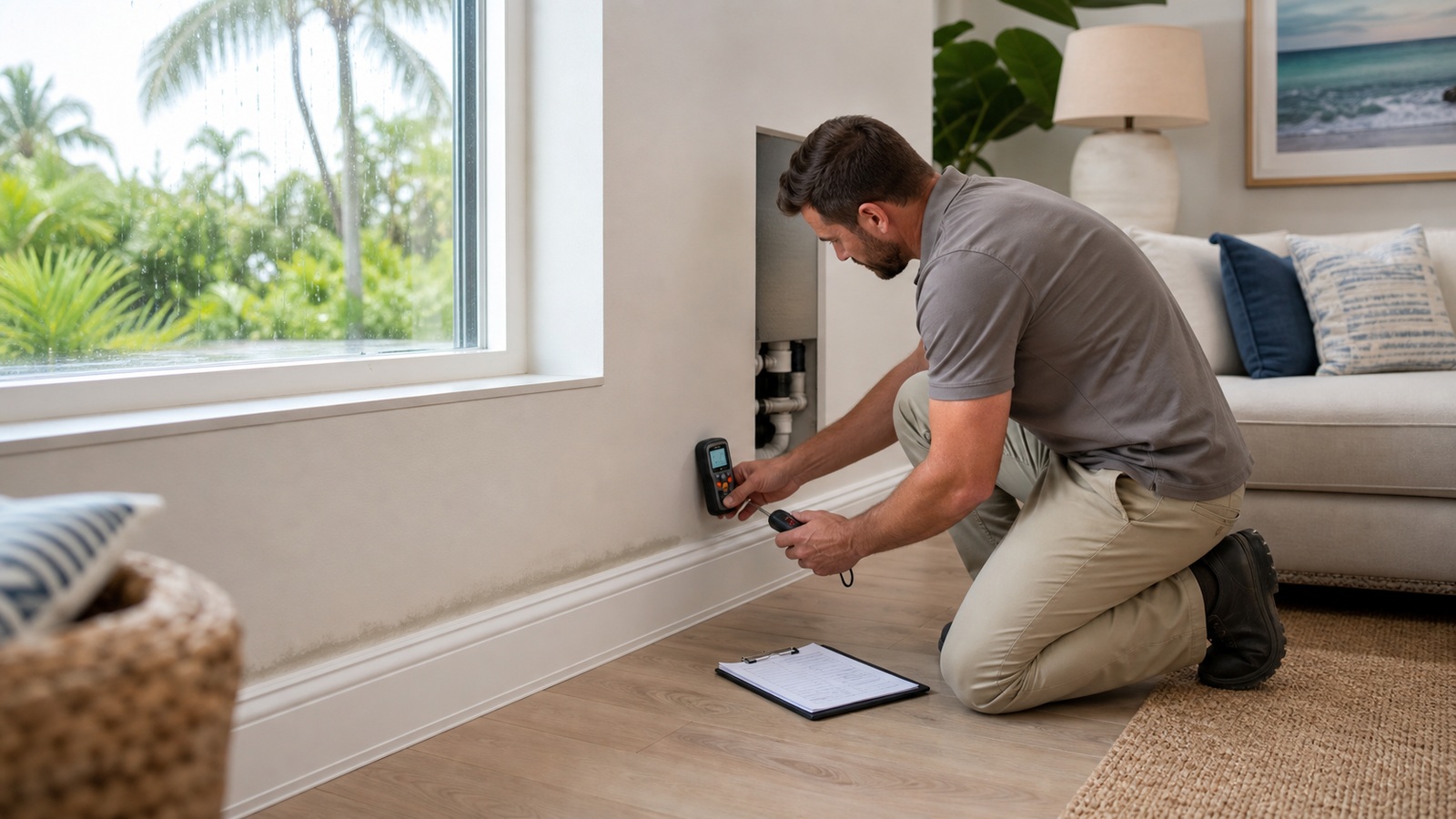
Visible conditions are documented, then suspect materials are compared with nearby reference areas. The initial map shows the current extent; it does not yet identify the cause. Location, material type, staining, swelling, odor, and accessible conditions all matter.
4. Account for ordinary water use
Before interpreting a water meter, known uses must be stopped or documented. Toilets, irrigation, pool autofill, ice makers, appliances, and water-treatment equipment can create meter movement. A simple toilet dye test may reveal tank leakage. The result supports or weakens a hypothesis; it is not a final source location.
5. Isolate systems one at a time
The investigation separates the pressurized supply, drains, HVAC condensate, exterior exposure, and other plausible sources instead of testing everything at once. If stopping a system changes the moisture behavior, that relationship becomes evidence. If nothing changes, the hypothesis must be reconsidered rather than forced.
6. Reproduce the condition carefully
A drain may be tested with controlled fixture use. HVAC-related dampness may be observed during operation. Exterior entry may require a systematic evaluation of history, assemblies, defects, and controlled testing where appropriate. ASTM describes wall-leakage evaluation as a process of inspection, hypothesis development, and testing—not a single-device verdict (ASTM E2128-20). Any controlled water test must suit the assembly and avoid causing additional damage.
7. Require corroboration
A defensible conclusion normally combines more than one clue: timing plus location, isolation plus reproduction, or an observed defect plus a matching moisture response. When evidence conflicts, the report should state uncertainty and recommend the next targeted step rather than overstate confidence.
8. Separate source confirmation from damage mapping
Once the likely source is confirmed, the team determines how far moisture spread and whether materials are still wet. This second question affects drying and restoration even when the leak repair itself is small.
Why thermal imaging alone is not proof
Infrared imaging displays surface-temperature patterns. It can quickly identify an area that deserves closer inspection, but it does not “see through walls,” identify water directly, or distinguish a plumbing leak from every other cause. HVAC operation, missing insulation, airflow, sun exposure, reflections, construction differences, and evaporative cooling can all produce thermal anomalies. The U.S. Department of Energy describes infrared imaging as part of a broader assessment process, not a stand-alone leak verdict (DOE home energy assessment guide).
A thermal pattern becomes useful when it aligns with moisture readings, physical inspection, timing, and a system test. If those findings do not agree, more investigation is needed.
Moisture meters map conditions; they do not name the source
Hand-held moisture meters can compare suspect materials with dry reference areas and help map the spread. Their readings depend on the material and the instrument. Fasteners, salts, coatings, temperature, meter type, settings, and material density can affect results. A high reading means “investigate this condition,” not “a pipe is leaking here.” ASTM’s moisture-meter practice emphasizes appropriate use and interpretation for the material being evaluated (ASTM D7438-20).
Repeated readings are often more informative than one number. An expanding or rewetting pattern during a controlled test may support an active source. A shrinking pattern after the source is stopped may support residual moisture and drying progress.
Source location is different from moisture-damage mapping
Source confirmation asks where water entered and what system or assembly released it. Moisture mapping asks which materials became wet and where water traveled. Those answers may be separated by several feet—or by a floor, wall cavity, or ceiling assembly.
Stopping at the first wet spot can miss spread. Conversely, opening every damp-looking area before isolating the source can create unnecessary disruption. A disciplined process identifies the most likely origin, maps affected materials, and explains what remains concealed or uncertain.
For broader signs of concealed moisture, see RestoFlo’s guide to hidden water leaks in South Florida. For source-specific context, review AC condensation leaks, stucco cracks and water intrusion, and concrete slab moisture and vapor intrusion.
Detection, repair, and restoration are three different scopes
• Detection and source confirmation determine the most supportable origin and document the evidence and limitations.
• Repair corrects the plumbing, HVAC, roofing, exterior-envelope, drainage, or other defect that released or admitted water.
• Water-damage restoration addresses wet building materials through assessment, moisture mapping, drying, monitoring, and appropriate material handling.
One company or trade should not be assumed to cover every scope. A plumber may repair a pressurized line but not diagnose an exterior wall assembly. An HVAC contractor may clear a condensate problem but not dry a wet ceiling cavity. A restoration team may document and address the moisture damage while a separate trade corrects the source.
RestoFlo publicly offers leak detection and water-damage restoration. The findings should determine which repair professional is needed next.
What a useful source-confirmation report should document
A useful report should be understandable to the property owner and actionable for the next trade. It should include:
• the reported timeline, weather, system use, and prior events;
• observed stains, damage, odors, and accessible conditions;
• moisture-reference locations and the extent identified at inspection;
• systems isolated, controls used, and tests performed;
• meter, moisture, thermal, visual, and reproduction findings, when applicable;
• photographs or a clear location map;
• the evidence supporting and contradicting each leading hypothesis;
• the likely source, confidence limits, and concealed areas not evaluated;
• immediate safety or mitigation concerns; and
• the recommended repair trade and restoration next step.
The report should distinguish observations from conclusions. “Elevated reading at the wall base” is an observation. “The supply pipe is leaking” is a conclusion that requires supporting isolation or other corroborating evidence.
Immediate safety and damage-limitation steps
Safety first: Keep people away from standing water, sagging ceilings, and any area where water may contact electrical wiring, panels, outlets, appliances, or equipment. Do not enter or touch wet electrical components when energization is possible. Escalate unsafe conditions to emergency services, the utility, or a qualified electrician.
If it is safe, stop the known source without dismantling building systems, note what was running, photograph active dripping or wetting, and avoid covering the area with finishes. Arrange professional assessment promptly. EPA guidance recommends drying wet materials and areas within about 24–48 hours when possible to help prevent mold growth; this is a prevention goal, not a claim that mold always begins at an exact hour (EPA mold and moisture guide).
Frequently asked questions
1. Can a moving water meter prove there is a hidden plumbing leak?
No. It may indicate continued water use after known uses are off, but irrigation, pool autofill, appliances, toilets, and other systems must be excluded. It neither locates nor conclusively proves a concealed pipe leak.
2. Does a ceiling stain under an AC unit mean the AC is leaking?
Not necessarily. The location raises an HVAC-condensate hypothesis, but supply plumbing, drains, exterior entry, and residual water may overlap. Cooling-cycle timing and controlled inspection are needed.
3. Can thermal imaging find a pipe leak through a wall?
Thermal imaging shows surface-temperature differences, not pipes or water through walls. It guides inspection and must be corroborated with moisture measurements, physical evidence, and system testing.
4. How can rain intrusion be distinguished from plumbing leakage?
Professionals compare wetting with rainfall and wind, inspect the relevant exterior assembly, exclude indoor systems, and use controlled testing when appropriate. Repeatable weather-linked entry supports the exterior hypothesis.
5. Why is the area still wet after the leak was repaired?
Water may remain in porous or concealed materials and spread away from the source. Moisture mapping and repeat readings help distinguish residual drying from continuing or renewed water entry.
6. Who should be called first: a plumber, HVAC contractor, exterior contractor, or restoration company?
Start with the trade supported by the strongest evidence. When the source is uncertain or materials are already wet, source confirmation and moisture mapping can prevent routing the problem to the wrong repair trade.
7. Is leak detection the same as water-damage restoration?
No. Detection identifies the likely source; repair corrects the failed system or assembly; restoration addresses wet or damaged materials. A property may need all three scopes from different professionals.
Get the source confirmed before choosing the repair
An unexplained stain should not become a sequence of guesses. RestoFlo can assess the moisture condition, help distinguish likely sources, document affected areas, and clarify the next step. Call (754) 289-4815 or request a free assessment at RestoFlo.com.