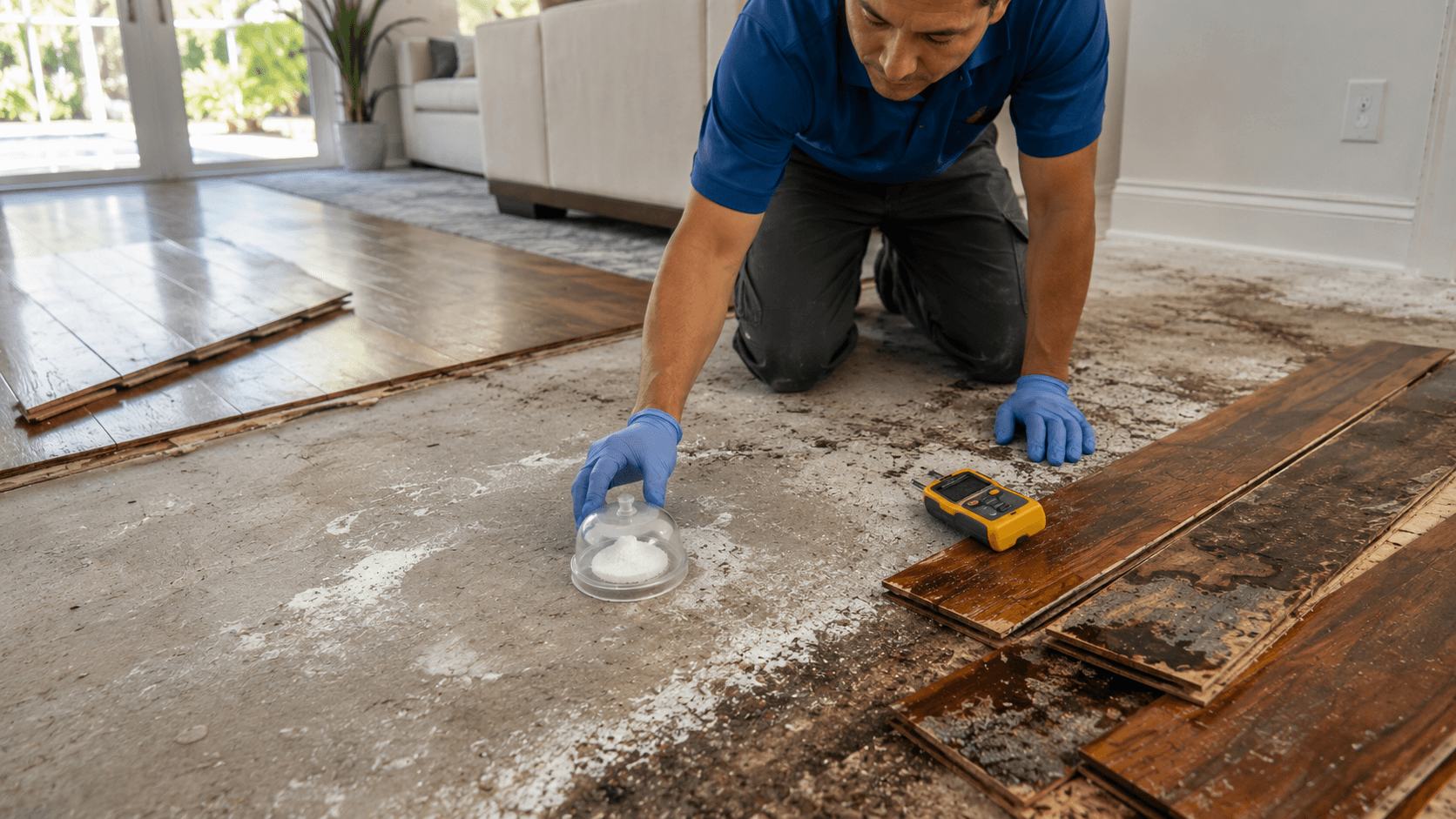
A homeowner installs new hardwood flooring in the family room. Six months later, the boards start cupping. Twelve months later, the finish is failing. The homeowner assumes the flooring was defective, or the installer did something wrong. Neither is right. The moisture is coming from below — from the concrete slab itself.
South Florida's high water table, seasonal groundwater fluctuations, and clay soil composition all conspire to push moisture up through the concrete slab and into the flooring, cabinets, and walls above. When homes were built without proper vapor barriers below the slab, or when those barriers have degraded, moisture continuously wicks upward. It's not a leak. It's not a flood. It's ongoing vapor transmission that damages everything on top of it.
This guide is for Miami, Fort Lauderdale, Boca Raton, and Palm Beach homeowners who suspect their concrete slab is a moisture source, and for those who've had unexplained flooring failures they want to understand.
Why South Florida slabs have moisture problems
Three regional factors: 1. High water table. Groundwater in South Florida sits 3–8 feet below grade in most areas. Seasonal fluctuations bring it closer to slab elevation. 2. Sandy, porous soil. Sand doesn't hold water back the way clay does. Water moves freely from groundwater up into slab-adjacent soil. 3. Clay layers below the sand. Some areas have clay layers that trap water and force it laterally along the slab bottom.
Combined with the fact that many older South Florida homes were built without proper vapor barriers below the slab, these conditions produce chronic slab moisture that keeps rising and causing damage.
The 6 signs of slab moisture problems
1. Flooring failures. Cupping hardwood, delaminating luxury vinyl plank, lifting tile grout, mold growth on carpet backing. 2. Efflorescence on concrete surfaces. White powdery deposits on unfinished concrete indicate moisture is bringing minerals to the surface as it evaporates. 3. Wet or discolored baseboards. 4. Mold on lower walls or in wall cavities. 5. Musty smell in the home without visible leaks. 6. High indoor humidity even with AC running properly.
If you see two or more of these, professional slab moisture testing is warranted.
The 4 categories of slab moisture damage
Level 1: Elevated humidity only. Slab is releasing moisture, but no visible damage yet. Interior humidity is high. Fixing the source is straightforward but essential.
Level 2: Surface flooring damage. Flooring shows moisture damage — cupping, discoloration, delamination. Structure is sound but flooring needs replacement plus source correction.
Level 3: Mold growth in adjacent walls. Moisture has migrated up walls, into cavity spaces, and mold has established. Includes remediation scope plus flooring replacement.
Level 4: Structural damage. Long-term slab moisture has weakened floor structure, damaged concrete slab (cracking), or affected foundation. Major restoration scope.
How professional testing works
A qualified assessment includes: calcium chloride test (moisture emission rate: less than 3 lbs/1000 sqft acceptable; 3–5 lbs marginal; 5+ lbs problematic); in-slab relative humidity probe (more definitive than surface test); moisture meter surface readings; visual inspection of slab, foundation, undersides; vapor barrier evaluation where accessible; building envelope inspection of grading and drainage.
Costs run $500–$2K for comprehensive testing.
The 5 sources of slab moisture
1. No vapor barrier below the slab. Very common in South Florida homes built pre-1990. 2. Damaged vapor barrier. Original barrier has degraded, torn, or been penetrated. 3. Poor drainage around the foundation. Water pooling near the slab pushes moisture inward. 4. High groundwater table. Underlying groundwater rises seasonally. 5. Slab cracks. Concrete cracks allow moisture to move directly through the slab.
Remediation scope
For elevated humidity only (Level 1): improve drainage; dehumidification; interior sealer on slab; HVAC dehumidification enhancement.
For flooring damage (Level 2): everything in Level 1, plus remove damaged flooring; apply proper slab moisture seal (epoxy-based moisture mitigation for hard flooring); reinstall flooring with vapor-permeable underlayment.
For mold in adjacent walls (Level 3): everything in Level 2, plus remove and remediate wall damage; fix moisture source at wall interface; rebuild with mold-resistant materials.
For structural damage (Level 4): full assessment by structural engineer; foundation/slab repair; full restoration scope.
Costs: Level 1 = $2K–$5K. Level 2 = $5K–$20K. Level 3 = $15K–$40K. Level 4 = $30K+.
The vapor barrier fix
For homes with no or damaged vapor barrier below the slab: Option A: Above-slab moisture mitigation. Apply epoxy-based moisture barrier to slab surface before installing new flooring. $3–$8 per square foot. Effective for most homes. Option B: Perimeter drainage. French drain or similar around foundation. $3K–$15K. Option C: Interior dehumidification. Whole-home dehumidifier that removes moisture as it enters. $1K–$5K. Option D: Below-slab vapor barrier retrofit. Rarely done because it requires excavation.
Most South Florida homes use Option A combined with Option C.
Insurance considerations
Florida homeowners insurance on slab moisture: damage from a sudden covered event that caused slab moisture (burst pipe, hurricane flooding) typically covered for resulting damage; damage from long-term slab moisture (no visible cause, gradual) typically not covered (maintenance); mold from slab moisture typically not covered unless from a covered water event; slab repair itself typically not covered.
Chronic slab moisture is treated as a homeowner-maintenance issue.
When to call RestoFlo
If you've discovered evidence of slab moisture in your South Florida home — flooring failures, mold in adjacent walls, unexplained musty odor — call us. We coordinate slab moisture testing with certified professionals, perform mold remediation under the IICRC S520 standard, coordinate flooring and slab-treatment specialists on the source repair, and work directly with your insurance carrier without AOBs. 24/7 emergency line: (754) 289-4815.