Published August 4, 2026 • By RestoFlo
There is no universal hour when mold starts growing after water damage. Mold may begin when spores land on wet materials and conditions support growth. The EPA's commonly cited 24–48-hour guidance is a prevention target: dry wet or damp materials within that window when possible. Actual risk depends on moisture, temperature, materials, airflow, contamination, and access.
That means the right question is not only, “How many hours have passed?” It is also, “Is every affected material—including hidden layers—actually drying?” A surface can look dry while drywall paper, insulation, carpet pad, cabinetry, subflooring, or a wall cavity remains damp.
If water is active, materials are wet, or the source is uncertain, start with safety and arrange an assessment promptly. RestoFlo provides water damage restoration in South Florida. Call (754) 289-4815 or request a free assessment at RestoFlo.com.
What does the EPA's 24–48-hour mold guidance actually mean?
The EPA's homeowner mold guide says that if wet or damp materials and areas are dried within 24–48 hours after a leak or spill, mold will not grow in most cases. The CDC similarly advises cleaning up and fully drying a flooded home quickly, within 24–48 hours.
The key word is dried. Turning off a supply valve, removing visible water, or waiting 48 hours does not prove that a floor, wall, ceiling, cabinet, or HVAC-adjacent cavity is dry. The guidance is best understood as a rapid-drying goal that can reduce the chance of mold growth—not a stopwatch that predicts the exact first moment of growth in every property.
Use the 24–48-hour window this way:
- Start drying as soon as it is safe. Do not wait for visible mold.
- Address the moisture source. Drying cannot succeed if a leak, condensate overflow, rain entry, or other source continues.
- Check the full wet area. Water often moves beyond the stain or puddle you can see.
- Verify progress. A dry-looking or dry-feeling surface may conceal damp material underneath.
- Escalate when the scope is unsafe, contaminated, extensive, hidden, or not drying.
Why isn't there one mold-growth clock for every water loss?
A water event creates conditions, not a universal schedule. These variables change the risk and the drying challenge:
1. How much moisture remains, and for how long?
Mold requires moisture. A small clean-water splash dried completely is different from water that soaked through carpet pad, drywall, insulation, cabinets, or a layered floor. Continuing leaks and repeated condensation can keep resetting the drying problem even when one surface appears improved.
2. Temperature and condensation conditions
Temperature interacts with humidity and surface conditions. In humid air, cooler surfaces can collect condensation; changing surface temperature, insulation, air circulation, and dehumidification can all affect whether materials stay damp. A thermostat reading by itself cannot establish when mold did or did not begin.
3. What materials became wet?
Porous and absorbent materials can hold water internally. The CDC lists paper, cardboard, ceiling tile, wood, drywall, carpet, fabric, upholstery, insulation, and other common indoor materials as potential growth surfaces when moisture is present. Material type, thickness, coatings, layers, and prior condition all influence drying and whether an item can be cleaned, dried, or may require removal after assessment.
4. Humidity, airflow, and dehumidification
Air movement alone is not the same as moisture removal. The EPA advises reducing indoor moisture and using dehumidification when outdoor air is warm and humid. In South Florida, simply opening windows may bring in humid air and may not help a wet assembly dry. Airflow also should not be improvised across sewage, contaminated water, or visible/suspected mold.
5. Water contamination
A supply-line leak, rainwater entry, floodwater, and a sewage backup do not have the same safety or material-handling requirements. Mold is not the only concern when water may contain sewage, chemicals, microorganisms, or debris. EPA guidance says to use an experienced professional when water or mold damage involves sewage or other contaminated water.
6. Access to hidden wet areas
Water may be trapped behind baseboards, under flooring, inside cabinets, above ceilings, around pipes, behind wallpaper, or within wall and roof assemblies. EPA notes that hidden mold investigations require caution because disturbing concealed growth can release spores. Do not open suspect cavities just to “check the clock.”
Why South Florida homes can be harder to dry
South Florida's outdoor air is often warm and humid, while air-conditioned interiors create cool surfaces where condensation can develop. Roof and wall rain entry, AC drain or pan problems, appliance leaks, plumbing failures, and storm-related power or access delays can all leave materials wet longer than the visible event suggests.
These conditions do not prove that mold is present, and they do not create a different universal start time. They do mean that drying should be based on the condition of the materials and indoor environment—not the passage of time alone.
A few South Florida-specific cautions:
- Do not assume outdoor ventilation will dry the property when outside air is warm and humid.
- Check whether the water source has truly stopped; intermittent AC condensate or rain entry may return.
- Treat loss of power or safe access as a drying barrier, not a reason to enter an unsafe property.
- Pay attention to wall bases, cabinetry, closets, carpet pad, and other places with limited airflow.
- In condos and multi-unit buildings, the visible wet area may not identify the unit or system where the water originated.
What should you do immediately after water damage?
1. Keep people away from electrical and structural hazards
Do not touch wet electrical equipment or enter standing water when wiring, outlets, panels, appliances, or equipment may be energized. Ready.gov warns that floodwater may also be contaminated and can become electrically charged by downed or underground power lines. Stay out and call emergency services, the utility, or a qualified electrician when the area cannot be approached safely.
Also avoid sagging ceilings, unstable materials, sewage, strong chemical odors, and visibly contaminated floodwater.
2. Stop the source only if it is safe and obvious
Shut off a known fixture or accessible water valve only when you can reach it without entering water or touching electrical hazards. Roof, plumbing, appliance, HVAC, and building-envelope repairs may require the appropriate qualified trade. Do not dismantle equipment or open walls to search for the source.
3. Document what you can see
Take photos or video from a safe location. Record when the water was noticed, what was operating, recent weather, and any source-control step taken. Documentation creates a useful timeline for the restoration and repair teams. It does not guarantee insurance coverage or payment.
4. Begin safe water removal and drying promptly
Remove accessible standing water and start drying only when the water source, contamination level, electrical conditions, and work area are safe. For a larger, hidden, or uncertain loss, arrange professional water damage restoration rather than guessing which materials are dry.
For a related action list, see RestoFlo's guide to the first 24 hours after water damage.
5. Watch for signs that the scope is larger than it looks
Musty odor, visible growth, swelling, peeling finishes, stained ceiling or wall areas, lifting flooring, wet cabinet bases, or moisture returning after drying are reasons to reassess the source and extent. Visible conditions cannot show everything behind a finish.
When is water or mold cleanup not a DIY job?
Stop and seek qualified help when any of these boundaries applies:
- water may contact energized electrical equipment or wiring;
- the ceiling, floor, or structure may be unstable;
- the water contains or may contain sewage, floodwater, chemicals, or other contamination;
- a large area or multiple rooms are wet;
- materials inside walls, floors, ceilings, cabinets, or HVAC components may be affected;
- visible or suspected mold would need to be disturbed;
- the area is not drying or becomes wet again;
- a person in the home has health concerns related to exposure.
The CDC says people with allergies, immune suppression, underlying lung disease, asthma, or COPD should not take part in mold cleanup. It also says people with asthma, COPD, or immune compromise should not stay in a moldy home or be present during cleanup. For personal health questions, consult a qualified healthcare professional.
If mold cleanup is performed, CDC identifies at least a NIOSH-approved N95 respirator, protective gloves, and goggles with complete eye protection. PPE does not turn sewage, a large loss, hidden growth, or an unsafe building into an appropriate DIY project.
What a professional water-damage and mold-risk assessment may include
The exact scope should follow the source, water condition, materials, access, and findings. A professional process may include:
- Safety and source review: identify electrical, structural, contamination, and occupancy concerns; determine whether another trade must stop or repair the water source.
- Damage and moisture assessment: document visible conditions and evaluate how far moisture may have traveled beyond the obvious stain or puddle.
- Standing-water removal: remove accessible water using methods appropriate to the water condition and affected materials.
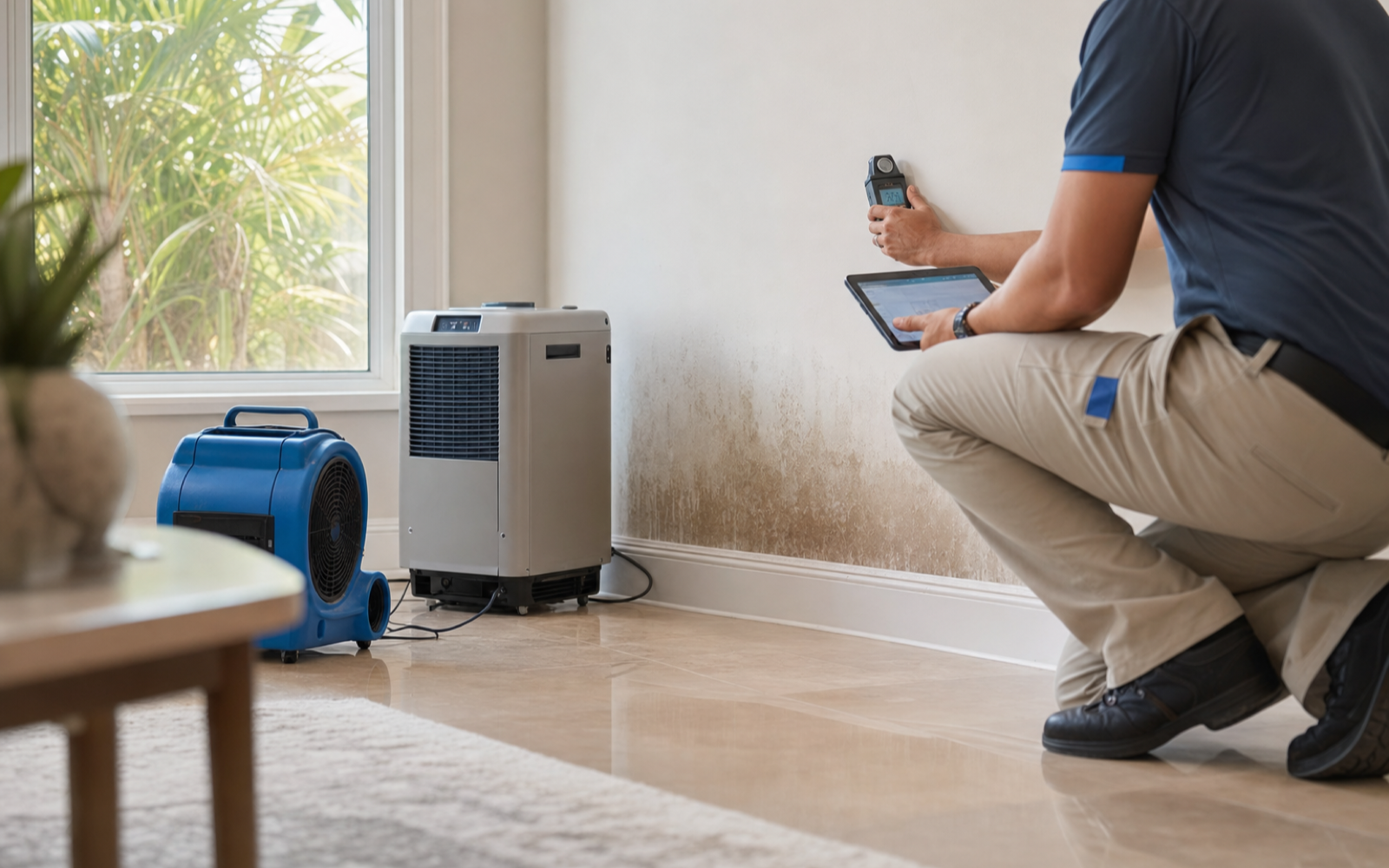
- Drying plan: establish controlled air movement, dehumidification, and material access appropriate to the space rather than relying on open windows or time alone.
- Monitoring and adjustment: compare conditions over time to determine whether materials are drying, staying wet, or being rewetted.
- Material and mold-scope decisions: determine which materials may remain and dry, which require cleaning, and which may require controlled removal. If visible or suspected mold is involved, the moisture problem and the remediation scope both need attention.
- Cleanup and repairs: complete the approved cleaning and repair scope after moisture and contamination conditions are addressed.
RestoFlo's guide to what water damage restoration includes explains these stages in more detail. If mold is visible or suspected, review RestoFlo's mold remediation service and its guide to when moldy drywall may need removal.
How do you know the area is actually dry?
Elapsed time is not enough. A defensible drying decision considers the affected material, comparison areas, indoor humidity, the source condition, accessible measurements, and whether readings are trending toward an appropriate dry condition. Concealed areas and layered materials may need additional evaluation.
Do not use smell, touch, or one visible surface as the only test. A musty odor can be a warning sign, but the absence of odor does not prove every hidden material is dry. Likewise, one moisture reading needs context about the material and location.
If visible mold is already present, routine DIY testing is usually not the priority. CDC does not recommend routine home mold testing; the moisture problem still has to be fixed and the mold addressed safely. Professionally designed testing may have a role in specific investigations, but a test result does not replace source correction, drying, or remediation.
Frequently asked questions
1. How soon can mold grow after water damage?
There is no precise start time that applies to every property. Mold may begin growing when spores land on wet material and conditions support growth. EPA's 24–48-hour guidance is a rapid-drying target intended to help prevent growth, not a guarantee that mold starts at a particular hour.
2. Does the 24–48-hour guidance mean everything is safe before 48 hours?
No. The key question is whether all affected materials are actually drying. Hidden drywall paper, insulation, carpet pad, cabinetry, subflooring, or wall cavities can stay damp after a visible surface looks dry. Contamination and electrical or structural hazards also require attention immediately.
3. What makes mold risk change after a South Florida water loss?
Risk changes with the amount and duration of moisture, temperature and condensation conditions, material porosity, indoor humidity, airflow and dehumidification, water contamination, and access to hidden wet areas. Warm, humid outdoor air can also make open-window drying ineffective.
4. Is opening windows enough to prevent mold in South Florida?
Not necessarily. EPA guidance recommends dehumidification when outdoor air is warm and humid. Opening windows can bring more moisture indoors, and ordinary airflow should not be directed across sewage, contaminated water, or visible or suspected mold.
5. What should I do first after finding water damage?
Keep away from electrical, structural, and contaminated-water hazards. Stop an obvious source only if it is safely accessible, document the condition, and begin safe water removal and drying promptly. Arrange professional assessment when the loss is large, hidden, contaminated, unsafe, or not drying.
6. When should I call a water-restoration or mold-remediation professional?
Call when water affects multiple materials or rooms, may be contaminated, enters hidden cavities, involves HVAC or electrical concerns, cannot be dried promptly, returns after source control, or has already produced visible growth or musty odor. The source may also require a plumber, HVAC contractor, roofer, electrician, or other qualified trade.
7. Do I need a mold test after water damage?
Not always. CDC does not recommend routine home mold testing, and EPA says sampling is usually unnecessary when visible mold is present. Fixing the moisture problem and addressing mold safely remain the priorities. Professionally designed testing may be useful in specific investigations.
Get the wet area assessed before hidden moisture becomes a larger problem
The 24–48-hour guidance is a reason to act—not a reason to panic and not a promise tied to an exact hour. If a South Florida property has active water, damp materials, a musty odor, visible growth, or an uncertain source, RestoFlo can assess the condition and explain the next restoration step.
Call (754) 289-4815 or request a free assessment at RestoFlo.com.
Sources