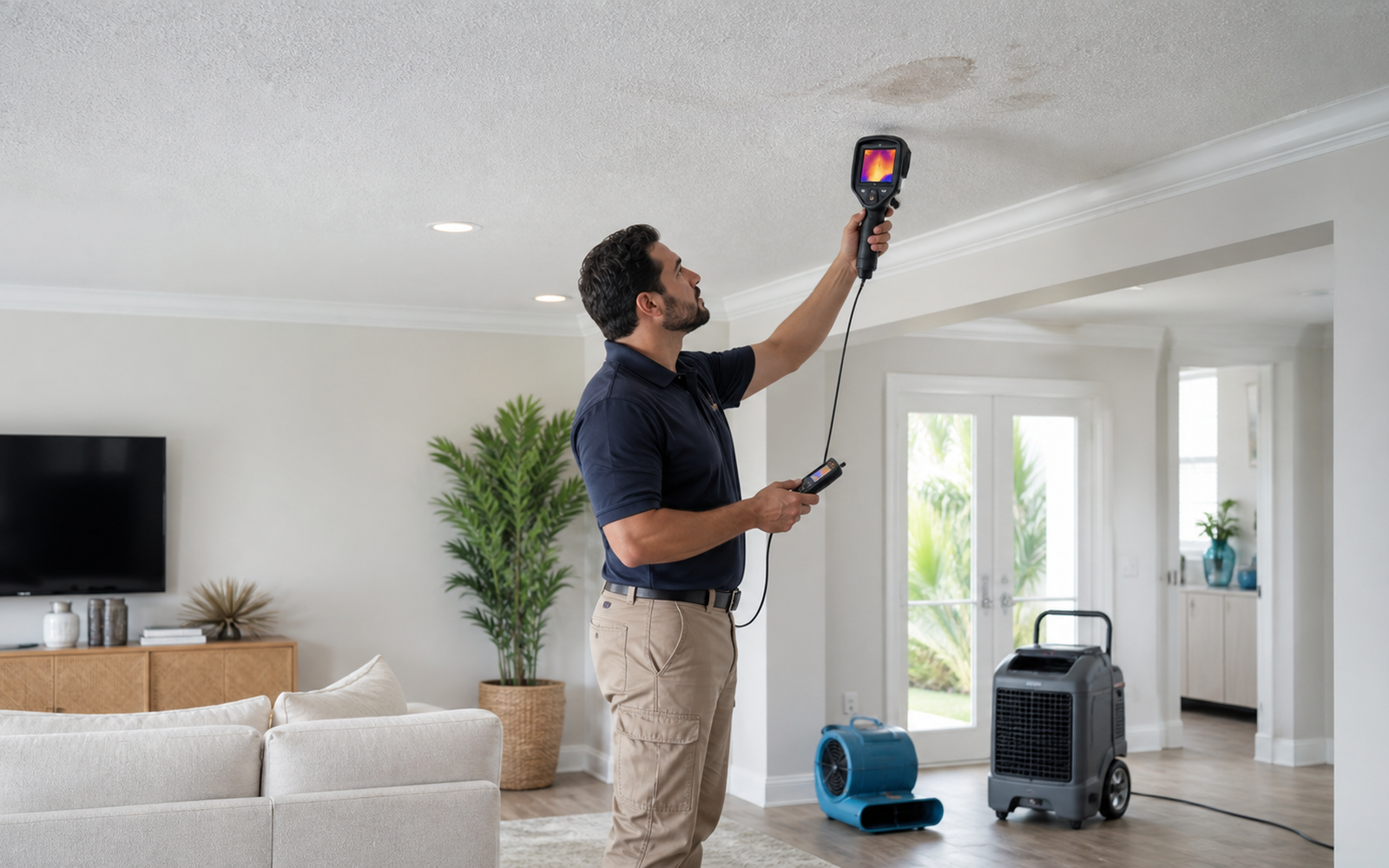
Answer first: Sometimes. A wet ceiling may dry without removal when the source is known and stopped quickly, the affected water does not create a contamination concern, the drywall remains firm and flat, insulation and framing above the ceiling can be evaluated, and repeat moisture readings confirm steady drying. Selective removal is more likely when the ceiling is sagging, soft, cracked or delaminated; when wet insulation traps moisture; when electrical fixtures are affected; when the source or duration is uncertain; or when the assembly cannot be dried and verified. The decision should be based on the entire ceiling system—not the visible stain alone.
When may a wet ceiling dry in place?
Drying in place may be considered when all of these conditions are present:
The leak or moisture source has been identified and stopped.
The water source and site conditions do not indicate a contamination concern.
The drywall or plaster remains firm, flat and well attached.
There is no active dripping, bulging, sagging, cracking or crumbling.
The space above the ceiling can be inspected directly or evaluated with appropriate tools.
Wet insulation is absent, limited and accessible, or addressed as part of the drying plan.
Air movement and dehumidification can be used safely without spreading contaminants.
Repeat measurements show the affected materials are moving toward an appropriate dry target.
A small stain does not prove the affected area is small. Water can travel along framing, seams, pipes, ducts and the back of the ceiling before it becomes visible. That is why moisture mapping is more useful than tracing the stain with your finger.
Why the decision is about the ceiling system—not the stain
Ceiling drywall or plaster
Ceiling materials work against gravity. A board that might remain flat on a wall can sag when its gypsum core and paper facing absorb water overhead. Firmness, fastener holding, seam condition, texture and visible deformation all matter.
Insulation above the ceiling
Insulation can hold water against the back of the ceiling and slow evaporation. Fiberglass, cellulose and foam products respond differently, and saturation or questionable water can change the material decision. Read Does Wet Insulation Need to Be Replaced After Water Damage?
Framing, roof deck, ducts and plumbing
A roof leak, air-conditioning condensate problem, supply-line leak and drain backup do not create the same path or repair plan. Framing, roof components, duct insulation and nearby finishes should be checked when they are part of the affected assembly.
Paint and ceiling texture
Multiple paint layers and textured finishes may slow drying at the surface. A dry-looking texture can also hide staining, weakened paper or moisture above. Cosmetic repair should wait until the source and dry condition are verified.
Lights, fans and electrical components
Water near a ceiling light, fan, smoke alarm or wiring adds an electrical concern. Do not touch or energize a wet fixture. If water is dripping through a light, follow the safety steps in Water Dripping Through a Ceiling Light? and use a qualified electrical professional where appropriate.
Quick decision table
Observed condition
What it may suggest
Known source, brief exposure, firm flat ceiling, accessible space above
Drying in place may be possible with monitoring
Wet insulation or moisture trapped above painted drywall
Selective access or material removal may be needed
Sagging, bulging, cracking, softness or crumbling
Keep clear; weakened material is more likely to require removal
Water source or cleanliness is uncertain
Avoid contact and obtain a professional safety/material assessment
Repeated roof or plumbing leak
Broader moisture mapping and source repair are important
Musty odor, visible growth or unexplained recurring stain
Investigate the moisture condition; do not simply paint over it
Readings are not declining
The drying plan, access or equipment setup may need to change
Why South Florida humidity complicates ceiling drying
South Florida’s humid outdoor air can slow evaporation when doors or windows are open or indoor humidity is not controlled. Warm roof spaces and air-conditioning cycles can also create temperature differences that make condensation and moisture patterns harder to interpret.
Effective structural drying coordinates air movement, dehumidification, temperature, containment and access. Household fans alone do not control humidity or prove that insulation, framing and the back of the ceiling are dry. They also should not be used to spread contaminants from a questionable source. See Do Fans Help Dry Wet Walls and Floors?
Important: A ceiling that is bulging or sagging should not be pushed, drilled or punctured by a homeowner. Keep the area clear and obtain help.
When is selective ceiling removal usually the safer path?
A controlled opening or selective removal may be appropriate when one or more of these conditions exists:
The ceiling is sagging, bulging, soft, cracked, crumbling, delaminated or pulling away at seams or fasteners.
The source may involve sewage, stormwater, drain water or another questionable source.
Wet insulation is holding moisture above the ceiling or cannot be evaluated and dried effectively.
The leak duration is unknown, the assembly has been repeatedly wet, or the stain keeps returning.
Visible microbial growth is present or conditions warrant a mold assessment.
Water has reached a ceiling light, fan, smoke alarm, wiring or other powered component.
Moisture readings stop improving despite an appropriate drying setup.
Safe access to the cavity is required to repair the source or verify hidden conditions.
Selective removal does not mean demolishing the entire ceiling. The goal is to remove material that is damaged or unsafe to retain, create access where evidence supports it, and preserve unaffected finishes when practical.
What a professional ceiling moisture assessment checks
Find and stop the source. Roof, plumbing, drain and HVAC-related moisture require different repairs.
Evaluate immediate hazards. Sagging materials, electrical fixtures, access conditions and water-source concerns are considered first.
Map the moisture. Non-invasive readings can guide the initial map; other tools or controlled access may be needed to verify depth and materials.
Inspect above the ceiling. Insulation, framing, ducts, roof components and adjoining rooms are evaluated when accessible.
Choose the least-destructive effective path. Dry intact material when the evidence supports it; create selective access or remove damaged material when it does not.
Control the environment. Drying equipment is placed and adjusted for the assembly and room conditions.
Document progress. Repeat measurements and a defined dry target are used instead of surface feel alone.
Keep people and pets away from a sagging, bulging or actively dripping ceiling.
Do not press, drill or puncture a ceiling bulge.
Do not touch wet lights, fans, alarms, wiring or powered equipment.
Photograph visible conditions and the apparent source from a safe location.
Move dry contents out of the drip path when it is safe.
Do not repaint or patch until the source is repaired and drying is verified.
Request an assessment when the source, extent, contamination level or cavity condition is uncertain.
Documentation and insurance considerations
Coverage and claim decisions depend on the policy, cause, timing, exclusions and insurer. RestoFlo cannot promise approval or payment. Keep photos, source-repair records, moisture documentation, invoices and a list of affected materials. Before discarding materials, ask the insurer or assigned adjuster what documentation they require when it is practical and safe to do so.
Frequently asked questions
Can a small ceiling water stain dry without cutting the ceiling?
Sometimes. Drying in place may be possible when the source is known and stopped, the water did not introduce a contamination concern, the ceiling remains firm and flat, insulation and framing above can be evaluated, and repeat moisture readings show the assembly is drying.
Does a wet ceiling always need to be replaced?
No. Some intact ceiling drywall can remain after a controlled drying process. Removal is more likely when the board is sagging, soft, crumbling, delaminated, repeatedly wet, exposed to questionable water, or unable to dry because moisture is trapped above it.
How long does a wet ceiling take to dry?
There is no universal timetable. Drying depends on the source, duration, ceiling material, paint, insulation, framing, humidity, temperature, airflow, dehumidification and access above the ceiling. Use measurements and material condition rather than a fixed number of days.
What if insulation above the ceiling is wet?
Wet insulation can hold moisture against the ceiling and framing. Its type, saturation, contamination and accessibility affect whether it can dry or needs selective removal. The ceiling face may feel dry while insulation above remains wet.
Is a sagging wet ceiling dangerous?
A sagging, bulging or cracking ceiling can indicate loss of material strength or pooled water above. Keep people and pets away, do not press or puncture the bulge, and obtain professional help. Avoid any wet electrical fixture or wiring.
Can I paint over a ceiling stain after it feels dry?
Not yet. First confirm the source is repaired and the ceiling assembly has reached an appropriate dry condition. Painting too soon can hide ongoing moisture, staining or material damage without correcting the cause.
Our clients gush about us (but don’t worry, we fixed their leaks first).
quick, professional, and thorough
“RestoFlo came through when we had a major water damage issue at our home. They were quick, professional, and thorough. Their team not only resolved the problem but also worked with our insurance, making the entire process seamless. I highly recommend RestoFlo for any restoration needs!” -John M.
I was incredibly impressed
“I was incredibly impressed with RestoFlo’s leak detection services. They pinpointed the exact location of a hidden leak in my house that had been causing issues for weeks. Their expertise saved us from a much bigger repair job down the line. I’ll definitely use them again.” -Lisa H.
Their team was prompt
“From the moment I called RestoFlo, I knew I was in good hands. Their team was prompt, efficient, and explained every step of the restoration process. They went above and beyond to ensure our home was fully restored after a water pipe burst. Excellent service!” -Mark S.
Contact Information
Contact Information
Contact InformationPhone: (754) 289-4815 Email: info@restoflo.com Office Address: 4811 Lyons Technology Pkwy, Suite 19, Coconut Creek, FL, 33073 Service Hours: 24/7 Emergency Services Available