Published August 11, 2026 • By RestoFlo
Quick answer: If water is dripping through or around a ceiling light, stay out of the wet area and do not touch the switch, fixture, ceiling, water, or any wet electrical equipment. Turn off electricity only if you can reach a dry, safe panel without crossing water. Call 911 for smoke, sparks, fire, or immediate danger. Then arrange electrical safety, source control, and water-damage assessment.
Water around a ceiling light is not just a ceiling stain. The water may have reached wiring, a junction box, insulation, drywall, framing, or other materials above the room. The visible drip also may be several feet away from the actual source because water can travel along pipes, joists, ducts, wiring, or the back of drywall before it finds an opening.
In South Florida, common sources include a roof or flashing leak, AC condensate problem, upstairs plumbing fixture, supply or drain line, appliance connection, or rain intrusion. The correct response is a safety-first sequence—not a guess based on the shape of the stain.
The first five steps
1. Keep people and pets out of the affected area
Do not stand under the wet ceiling or walk through pooled water to inspect the light. Keep children and pets away. If the ceiling is bulging, sagging, cracking, or shedding material, increase the distance and avoid the room.
Ready.gov warns about electrocution risk and says not to touch electrical equipment if it is wet or if you are standing in water. A ceiling fixture may still be energized even when the light is off, and the wall switch is not proof that the surrounding wiring is safe.
2. Do not touch the switch, fixture, water, or wet ceiling
Do not flip the light switch to “test” it. Do not remove the bulb, trim, cover, fan grille, or fixture. Do not place a bucket by walking into a wet area beneath electrical equipment. Do not puncture a sagging ceiling or open drywall to release water.
These actions can bring you closer to energized components or release accumulated water and ceiling material without warning.
3. Turn off electricity only if the shutoff is safely reachable
If the electrical panel and the complete route to it are dry, accessible, and away from the affected area, you may be able to turn off the appropriate circuit or main power. If the panel is wet, warm, damaged, buzzing, sparking, blocked by water, or you are uncertain which circuit is involved, do not touch it.
Call 911 for an active fire, smoke, visible sparking or arcing, or another immediate life-safety emergency. Depending on the condition, a licensed electrician, the electric utility, or emergency responders may need to make the area electrically safe.
Turning a wall switch off is not the same as isolating the circuit, and this article cannot determine remotely whether a panel or circuit is safe to operate.
4. Stop the water source only when it can be done safely
If the source is an obvious plumbing release and a dry, accessible shutoff can be operated without entering the affected area, shut off the local valve or main water supply. If the water is connected to roof damage, rain intrusion, an AC system, an upstairs room, or an unknown source, do not climb onto a wet roof, enter a flooded attic, or dismantle equipment.
The source may require a plumber, roofer, HVAC technician, appliance technician, building maintenance team, or another qualified trade. Leak detection can help when the source is not obvious.
5. Arrange electrical evaluation and water-damage assessment
Once the area can be approached safely, the next work typically has two separate questions:
- Electrical question: Has water affected the fixture, wiring, junction box, circuit, panel, or connected equipment, and what must be inspected or replaced before re-energizing?
- Water-damage question: Where did the water travel, which materials are wet, what can be dried, and what needs cleaning, controlled removal, or repair?
A licensed electrician addresses electrical safety and electrical repairs. A restoration team assesses moisture migration, extraction, drying, material condition, and restoration scope. Source-repair trades stop the underlying leak. These roles may need to coordinate rather than wait on one another in a rigid order.
What can cause water to drip through a ceiling light?
The fixture opening is often the exit point, not the source. Common causes include:
- Roof, flashing, vent, or exterior-envelope leakage after wind-driven rain
- AC condensate pan, drain, line, or air-handler leakage
- An upstairs toilet, shower, tub, sink, or supply-line leak
- A concealed plumbing line or drain failure
- A refrigerator, dishwasher, washing machine, or water-heater connection on the floor above
- Fire-sprinkler or building-piping leakage in a condo or commercial property
- Water traveling from another room or roof section along framing or utility pathways
The timing provides clues but not a diagnosis. Water that appears only during rain may point toward the roof or exterior envelope. Water that appears when an upstairs fixture runs may point toward plumbing. A recurring drip during AC operation may point toward condensate. Professional inspection is still needed because several sources can produce similar symptoms.
Learn more about RestoFlo leak detection services, AC condensation leaks, and roof leaks after a Florida storm.
Why the ceiling can look better while materials remain wet
A drip may slow or stop after rain ends, a fixture is no longer used, or the water supply is shut off. That does not prove the ceiling cavity is dry. Moisture can remain in:
- Drywall and joint compound
- Ceiling texture or paint layers
- Insulation
- Wood framing
- Electrical boxes and fixture components
- Ductwork or nearby mechanical assemblies
- Wall cavities and flooring below
Surface appearance alone cannot show the full moisture path. Water may spread laterally before becoming visible, and porous materials can hold moisture after the exposed surface feels dry.
RestoFlo's water-damage service page describes inspection, water extraction, drying and dehumidification, cleaning, and repairs as parts of the restoration process. The exact scope depends on the source, amount of water, contamination, materials, access, and how long they remained wet.
What a water-damage assessment should document
After the electrical hazard is controlled, a useful assessment should answer:
- Where is the likely source, and has it stopped?
- Which rooms, ceiling bays, walls, floors, cabinets, insulation, or contents are affected?
- Is water still actively entering?
- Is there standing water or a sagging ceiling condition?
- What moisture readings or thermal patterns require confirmation?
- Can materials be dried in place, or is controlled access/removal needed?
- What drying and dehumidification plan fits the affected assembly?
- Which repairs require an electrician, plumber, roofer, HVAC contractor, or other trade?
- What photos, readings, and work records should be preserved?
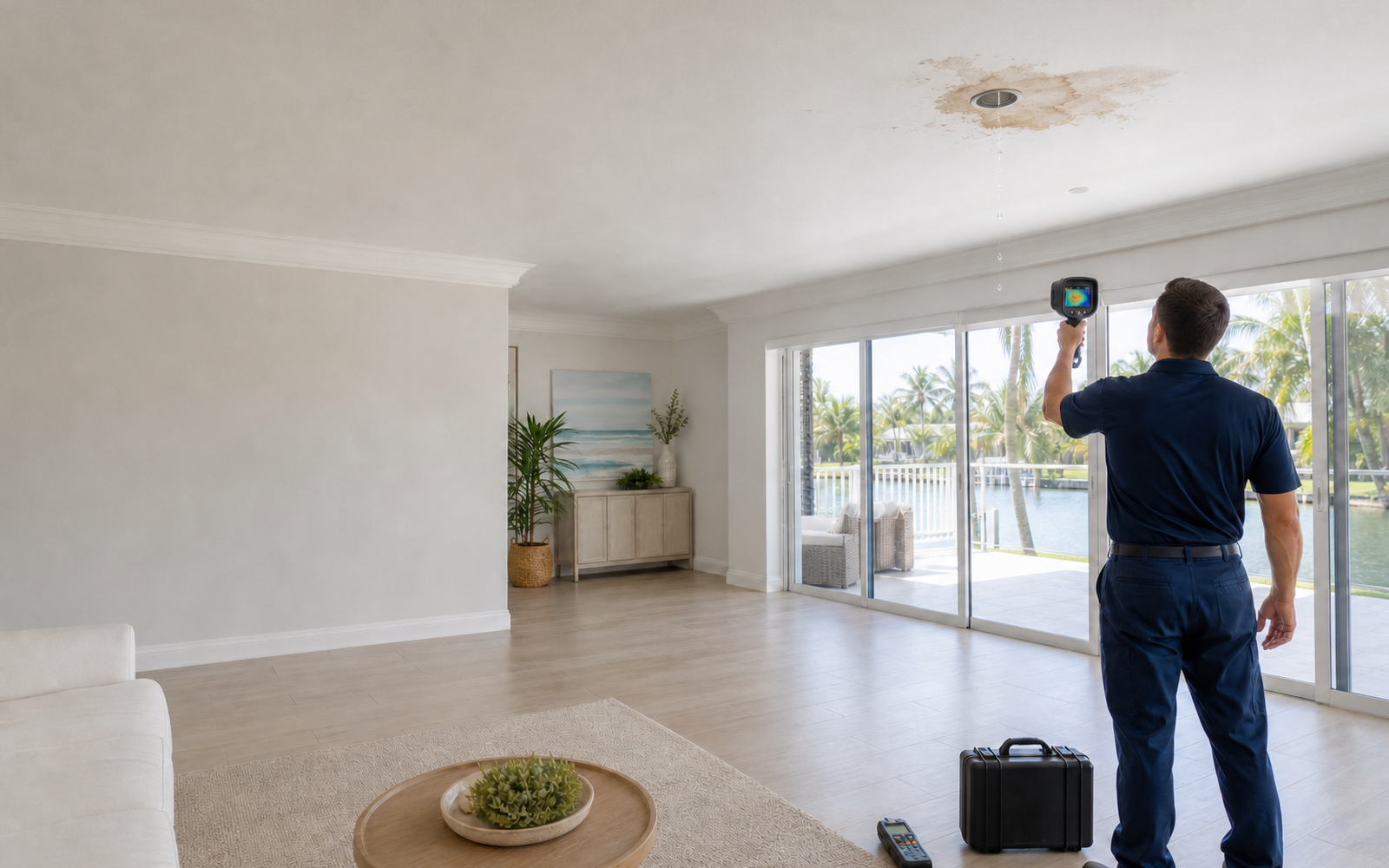
Infrared imaging can help identify temperature patterns, while moisture meters and targeted inspection help confirm conditions. No single tool proves every hidden condition, so results should be interpreted in context.
Should you put a bucket under the dripping light?
Not if doing so requires entering the wet area or standing beneath the fixture. A bucket controls floor water only; it does not make energized equipment, a saturated ceiling, or a hidden cavity safe.
If a container can be positioned from a dry, safe location without approaching the fixture or a sagging ceiling, it may reduce secondary floor damage. When there is doubt, keep clear and wait for the area to be made safe.
Do not remove the fixture to create a drain path. Do not use a metal tool, ladder, or improvised pole near the wet opening.
Should you use a fan or dehumidifier right away?
Do not plug in or operate equipment in the affected area until electrical safety and the water source are addressed. Household fans also do not show whether a ceiling cavity, insulation, wiring area, or wall is dry.
Professional drying equipment is placed as part of a designed drying plan after the affected materials, electrical condition, water source, and contamination concerns are evaluated. Learn more in Should You Use Fans After Water Damage in South Florida?.
When should you call 911?
Call 911 for:
- Active fire or visible flames
- Smoke, arcing, or visible sparking
- An immediate electrical or structural danger
- A ceiling collapse with possible injuries
- A medical emergency
- Any condition in which emergency responders are needed to protect life
Leave the area when instructed by emergency responders. Do not re-enter to collect photos, shut off equipment, or move belongings.
What to photograph and record when it is safe
Documentation should never delay evacuation, electrical safety, or water control. From a dry, safe location, record:
- The date and approximate time the drip was discovered
- Weather conditions and whether rain was occurring
- Which fixtures, appliances, or upstairs rooms were in use
- The visible stain, drip path, and affected floor area
- Any shutoff actions taken
- Photos or video of affected rooms without entering the hazard area
- Contractor, electrician, plumbing, roofing, or HVAC findings
- Moisture readings, drying logs, and repair invoices when supplied
Insurance coverage and claim decisions depend on the policy, cause, exclusions, deductible, documentation, and insurer. Do not delay urgent safety work while waiting for a coverage decision.
Frequently asked questions
Is a ceiling light safe if the switch is off?
Not necessarily. A wall switch does not prove that the fixture, junction box, circuit, or surrounding wiring is de-energized. Do not touch the fixture or wet area. A licensed electrician or other appropriate electrical authority should determine when the equipment is safe to inspect and re-energize.
Can I turn off the breaker myself?
Only if the panel and the complete route to it are dry, accessible, and safe, and you can operate it without entering the affected area. Do not touch a wet, damaged, warm, buzzing, or sparking panel. If you are uncertain, keep away and contact emergency responders, the utility, or a licensed electrician as the condition requires.
Does water dripping from a light mean the roof is leaking?
It can, but not always. Roof and flashing leaks, AC condensate, upstairs plumbing, appliances, and concealed pipes can all send water toward a ceiling opening. The visible drip is often not directly below the source, so timing and professional inspection matter.
Should an electrician or a restoration company come first?
Life safety comes first. Electrical hazards must be controlled before anyone works in the affected wet area. Source repair, electrical evaluation, and water-damage assessment may then proceed in a coordinated sequence. A licensed electrician handles electrical work; a restoration company handles moisture assessment, drying, cleaning, and affected-material scope.
Can the ceiling be dried without removing it?
Sometimes, but not always. The decision depends on the water source, contamination, ceiling condition, insulation, access, moisture extent, and whether the assembly can be monitored and dried effectively. Sagging, damaged, contaminated, or inaccessible materials may require controlled removal after electrical and structural safety are addressed.
How long does a wet ceiling take to dry?
There is no reliable universal timeline. Drying depends on the amount and source of water, materials, insulation, humidity, temperature, access, contamination, and drying plan. The ceiling should be evaluated with measurements rather than assumed dry because the visible stain has lightened.
Can water near a ceiling light cause mold?
Moisture can support indoor mold growth, but elapsed time or appearance alone cannot diagnose mold. EPA guidance emphasizes correcting water problems and drying wet materials completely. If visible growth or a musty odor is present, avoid disturbing the area and include that condition in the professional assessment.
Get a safety-first water-damage assessment
If water is dripping through or around a ceiling light, keep clear of the wet area and address immediate electrical danger first. Once the area can be approached safely, RestoFlo can assess the water source evidence, map affected materials, and explain the restoration scope.
Call (754) 289-4815 or request a free assessment through RestoFlo.com.
Electrical safety, source control, material salvage, drying time, repair scope, and trade sequence depend on conditions at the property. RestoFlo is not represented in this guide as the electrical authority. Insurance coverage and claim decisions are made by the insurer.