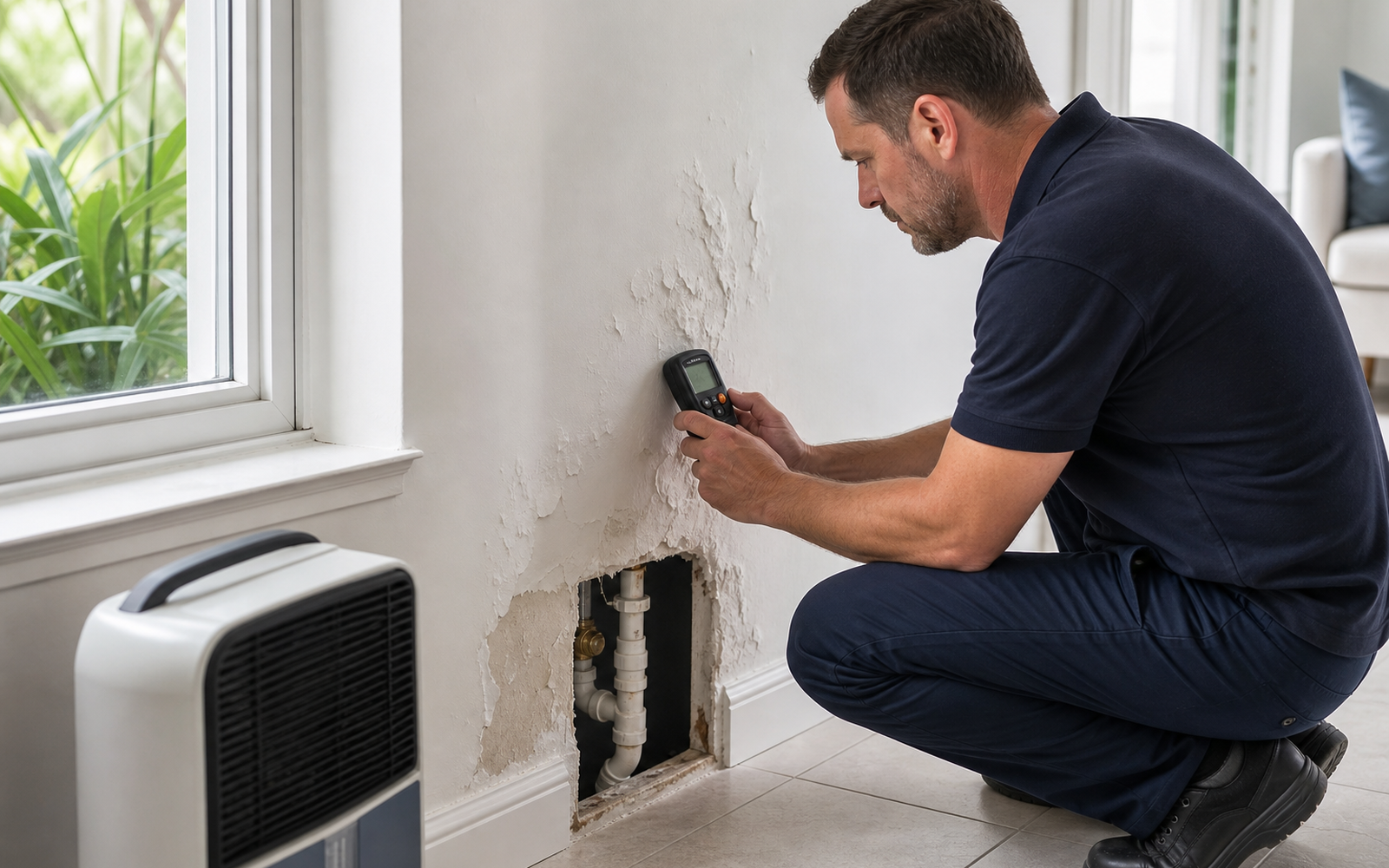
Answer first: Bubbling or peeling paint after a leak usually means moisture has disrupted the bond between the paint and the surface below. It may point to current moisture, a recently wet wall or a finish that has already failed—but the bubble alone cannot prove whether the drywall, insulation or framing is dry. Stop the source when safe, avoid puncturing or scraping unstable material, document the area and verify hidden moisture before repainting.
What causes paint to bubble after water damage?
Paint stays attached when the coating, primer and wall surface form a stable bond. Water can move through drywall paper, plaster, joint compound, wood, masonry or the back of a painted surface. As moisture and vapor pressure affect those layers, the paint film may lift, blister, wrinkle, peel or separate.
A leak is not the only possible cause. Poor surface preparation, incompatible coatings, heat, condensation and high indoor humidity can also cause paint failure. The timing and location matter: a new bubble below a bathroom, beside an exterior opening, under an AC line or near a known plumbing leak deserves a moisture investigation rather than a cosmetic assumption.
South Florida conditions add another variable. Humid outdoor air can slow evaporation and raise indoor moisture when windows or doors are opened during drying. Air-conditioning may improve indoor conditions when the system is safe and unaffected, but it does not prove that a wall cavity or finish layer is dry.
Does a bubble prove the wall is still wet?
No. The shape and size of a paint bubble do not measure moisture. A blister can remain after the water source stops, while a wall that looks almost normal can still contain moisture behind the visible surface. Paint, drywall paper, insulation, framing and the bottom wall plate may all dry at different rates.
The practical question is not simply whether the bubble feels dry. It is whether the source has been corrected, the true affected area has been mapped, hidden layers have been evaluated where needed and material conditions support the next repair step. Read How Do You Know When Water Damage Is Fully Dry? for a closer look at drying verification.
What should you do first?
Protect people first. Keep away from sagging ceilings, wet electrical components, sewage, floodwater and unstable materials. Use emergency services when there is immediate danger.
Control the source when safe. Shut off the appropriate water supply only if you can reach it safely. A plumber, roofer or HVAC contractor may be needed for a known source; leak detection can help when the source is uncertain.
Document the condition. Photograph the bubble, staining, nearby floors and likely source before moving items or opening materials when practical.
Move dry belongings away. Protect unaffected items without carrying wet or contaminated debris through the property.
Check more than the visible spot. Water can travel along framing, seams, fasteners, baseboards and flooring transitions.
Verify before repair. Evaluate moisture, contamination and material condition before scraping, patching or repainting.
Do not puncture a sagging ceiling or paint bubble just to release water. The material may be unstable, close to wiring or holding contaminated water. Controlled access should follow a safety and source assessment.
What should you avoid?
Do not paint over the bubble before the source and moisture are resolved.
Do not assume a dry-feeling surface means the wall cavity is dry.
Do not aim fans at visible mold or potentially contaminated water.
Do not drill or cut into walls where electrical, plumbing or structural conditions are uncertain.
Do not use bleach or fragrance to mask a musty odor and call the problem solved.
Do not make coverage decisions based on online advice; insurance depends on the policy, cause, timing, exclusions and insurer.
A useful assessment connects the visible paint damage to the most likely water path. The affected boundary may extend above, below or sideways from the bubble. Adjacent walls, baseboards, flooring, cabinets and rooms may need comparison.
Use material-appropriate readings
Moisture meters can help compare areas and track conditions, but one number does not apply to every material or meter. Drywall, wood, concrete and other assemblies require different interpretation. Readings make more sense when recorded with the material, exact location, instrument mode, date and a suitable comparison condition.
Treat thermal imaging as a screening tool
An infrared camera can reveal temperature patterns that deserve closer inspection. It does not see water. Sunlight, insulation gaps, AC supply air and reflective surfaces can create similar patterns, so suspected areas should be confirmed with direct measurements or appropriate access.
Use limited access only when justified
When surface checks cannot answer what is happening inside an assembly, a professional may remove a baseboard, open a small inspection area or use another controlled-access method. The goal is not unnecessary demolition; it is enough information and access to dry, clean or selectively remove affected materials safely.
What does the paint pattern suggest?
Visible condition
What it may suggest
Next practical check
Bubble below a bathroom or pipe
Plumbing or fixture leak, current or recent
Confirm source repair and map wall/floor moisture
Peeling around a window or exterior wall
Rain entry, sealant or condensation issue
Inspect during/after weather and compare interior conditions
Blistering near an AC line or air handler
Condensate, insulation or drain issue
Check HVAC source and surrounding materials
Old bubble with no known event
Historic leak or coating failure
Check for active source and compare material readings
Soft drywall, sagging or spreading stain
More significant saturation or deterioration
Keep clear and request prompt professional assessment
When can you scrape and repaint?
Finish repair belongs near the end of the sequence, not the beginning. Before repainting, confirm the leak has been corrected, the affected assembly has been evaluated, unsafe or unsalvageable material has been removed as appropriate, retained material has reached a suitable dry condition and the remaining surface is sound.
Preparation may include removing loose paint, repairing or replacing damaged drywall, treating the cause of staining, allowing compatible primers or compounds to cure and following the coating manufacturer’s instructions. If moisture remains or the underlying paper and compound have lost integrity, a fresh topcoat can fail again.
When is drywall removal more likely?
The drywall is soft, crumbling, swollen, delaminated or sagging.
Water was contaminated, or the material cannot be cleaned safely.
Visible mold affects the material or hidden growth is confirmed.
Insulation or framing behind the wall remains wet and cannot be accessed effectively.
The assembly is structurally unsound or blocks safe drying.
Repeated readings do not show an appropriate drying trend.
Selective removal may be enough in some situations. Other losses require broader access. The decision should follow the source, water category, extent, material condition and drying feasibility—not a rule that every bubbled wall must be demolished.
Why acting promptly matters
The U.S. Environmental Protection Agency advises controlling moisture, correcting leaks and drying wet or damp areas quickly—generally within 24 to 48 hours when possible—to help prevent mold growth. Hidden areas such as walls and ceilings need particular attention. That timing is a prevention target, not a promise that every assembly will be dry within two days.
Prompt assessment can also preserve clearer documentation of the source and extent. RestoFlo’s water-damage restoration service can help map affected materials and explain practical drying or removal options. If visible or suspected microbial growth is involved, learn about mold remediation.
Frequently asked questions
Does bubbling paint mean water is still behind the wall?
Not necessarily, but it is a reason to investigate. Bubbling can remain after a wall begins to dry, and it can also appear while moisture is still affecting paint, drywall, insulation or framing. The paint bubble alone cannot show whether the assembly is dry; the source, surrounding materials and moisture conditions must be checked.
Should you pop a paint bubble after a leak?
Do not puncture a bubble or sagging ceiling just to release water. The material may be unstable, contaminated or close to electrical wiring, and opening it can spread debris or water. Keep people away from unsafe areas, stop the source when safe, document the condition and have the assembly assessed before controlled access or removal.
Can you paint over bubbling paint after a leak?
Painting over the bubble before the source and moisture are resolved can hide continuing damage and often leads to another finish failure. Repainting should come after the leak is corrected, affected materials are evaluated, damaged finishes are prepared or replaced as appropriate, and the assembly is verified ready for repair.
How long should a wall dry before repainting?
There is no single number of days for every wall. Drying depends on the water source, drywall, insulation, framing, coatings, access, humidity and equipment. In South Florida, the repair decision should be based on the condition of the full assembly and documented moisture readings—not a calendar alone.
When does water-damaged drywall need to be removed?
Removal becomes more likely when drywall is soft, crumbling, swollen, delaminated, contaminated, affected by visible mold, structurally unsound or blocking access to wet materials. Limited removal may be enough in some losses; the decision depends on the water category, material condition, extent and ability to dry safely.
Who should you call first for bubbling paint after a leak?
If water is actively entering, address the source first when it is safe. A plumber, roofer or HVAC professional may be needed for a known source. If the source is uncertain, leak detection can help. A water-damage restoration professional can map affected materials, document conditions and explain drying or removal options. Call emergency services for electrical danger, collapse risk or other immediate hazards.
Our clients gush about us (but don’t worry, we fixed their leaks first).
quick, professional, and thorough
“RestoFlo came through when we had a major water damage issue at our home. They were quick, professional, and thorough. Their team not only resolved the problem but also worked with our insurance, making the entire process seamless. I highly recommend RestoFlo for any restoration needs!” -John M.
I was incredibly impressed
“I was incredibly impressed with RestoFlo’s leak detection services. They pinpointed the exact location of a hidden leak in my house that had been causing issues for weeks. Their expertise saved us from a much bigger repair job down the line. I’ll definitely use them again.” -Lisa H.
Their team was prompt
“From the moment I called RestoFlo, I knew I was in good hands. Their team was prompt, efficient, and explained every step of the restoration process. They went above and beyond to ensure our home was fully restored after a water pipe burst. Excellent service!” -Mark S.
Contact Information
Contact Information
Contact InformationPhone: (754) 289-4815 Email: info@restoflo.com Office Address: 4811 Lyons Technology Pkwy, Suite 19, Coconut Creek, FL, 33073 Service Hours: 24/7 Emergency Services Available