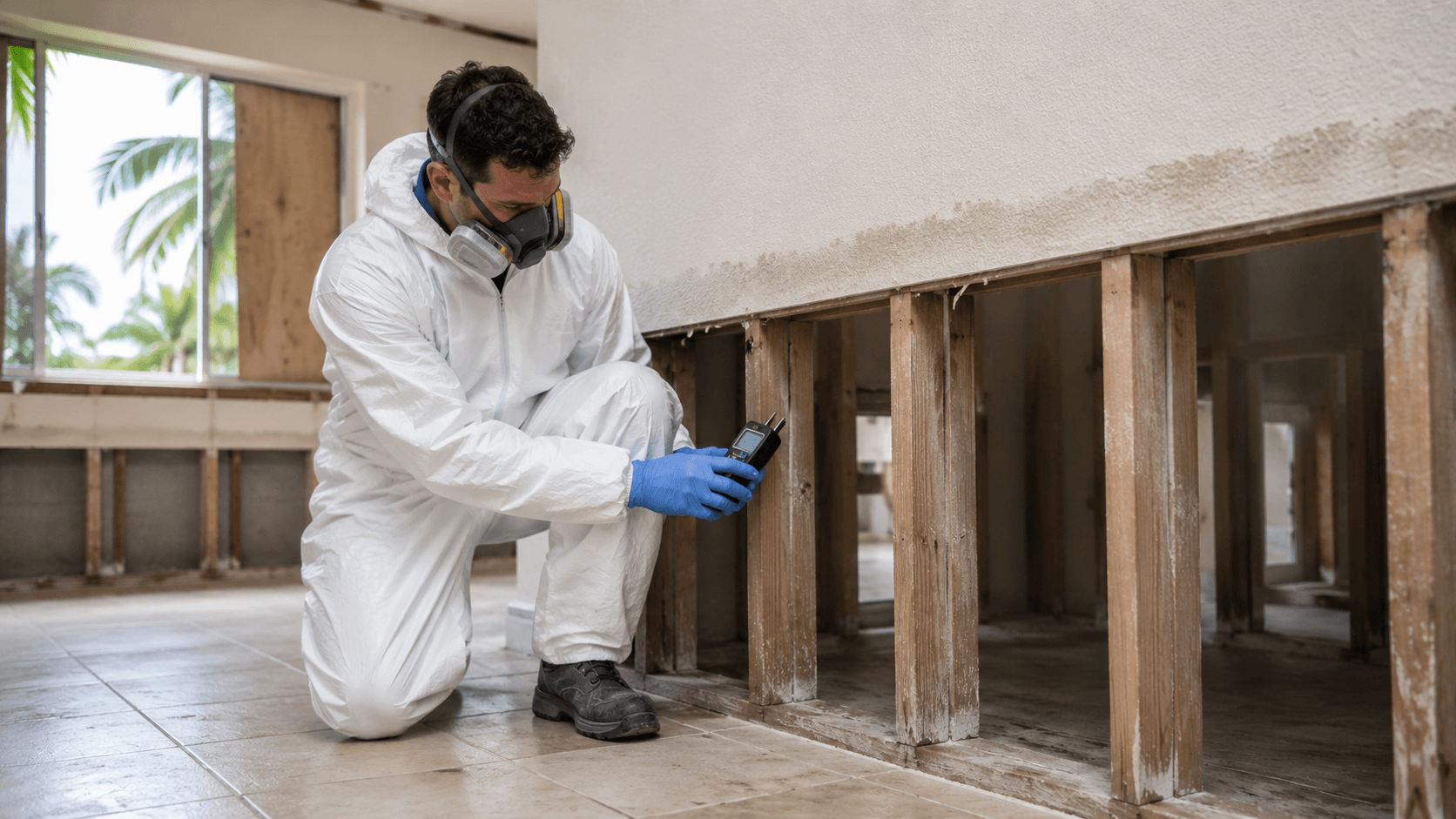
A storm surge looks like a flood, smells like a flood, and ruins your home like a flood. But for insurance and restoration purposes, it's a very specific kind of event with its own rules. South Florida homeowners who treat post-surge cleanup the same way they'd treat a burst pipe end up under-insured, under-mitigated, and with chronic problems they didn't expect.
This guide is for Miami, Fort Lauderdale, Boca Raton, and Palm Beach homeowners after a hurricane or tropical storm pushes salt water into their home — what it actually does to your house, why it's a Category 3 (black water) event, what your homeowners insurance does and doesn't cover, and what the cleanup actually involves.
Storm surge vs. flood vs. wind-driven rain
Three different events that look similar but are very different for an adjuster:
- Wind-driven rain — water entering through a roof, window, or door opening that the wind compromised. Usually covered under standard homeowners hurricane coverage.
- Storm surge — ocean water pushed up onto land by a storm system. NOT covered by standard homeowners insurance. Covered only by separate flood insurance (NFIP or private flood policies).
- Flood — rising surface water from any source: river overflow, stormwater drainage failure, surge. Same NFIP/private flood territory.
Most South Florida homes within a few miles of the coast or in a low-lying area have flood insurance through NFIP. Many inland homes don't, even though they should — flooding is increasingly happening in areas that historically didn't see it.
The first conversation after a surge event is figuring out which kind of water you had. The answer determines who pays.
Why saltwater is worse than fresh water
A saltwater event isn't just water damage — it's a chemical event:
- Salt corrodes electrical and metal. Wires, panels, breakers, conduit, HVAC components, appliances, and fasteners all corrode at an accelerated rate after saltwater exposure. Equipment that looks fine right after the surge often fails 6 months later.
- Salt residue holds moisture. Even after surfaces look dry, deposited salt is hygroscopic — it pulls humidity out of the air and re-wets the surface, feeding ongoing mold and corrosion.
- Saltwater is Category 3 (black water). It contains sewage, chemicals, fuel, and biological contamination from whatever the surge picked up along the way. By IICRC S500 standard, surge water is treated the same as a sewage backup.
- Saltwater wicks higher. Salt-contaminated drywall and insulation wicks moisture up the wall higher than fresh-water flooding does — sometimes 6+ inches above the visible water line.
These properties change what gets cleaned versus replaced and how long the cleanup actually takes.
What the cleanup actually involves
A real Category 3 surge cleanup follows the IICRC S500 standard:
Phase 1: Emergency response
- Secure the home if structurally compromised.
- Document the high-water mark before any cleanup with photos and timestamps.
- Cut power if water is anywhere near electrical (which after a surge is everywhere).
- Pump out standing water with high-volume trash pumps.
Phase 2: Demolition
Because surge water is Cat-3 and salt-contaminated, the following materials must come out:
- Drywall to at least 2 feet above the high-water mark (often 4 feet for safety).
- All wet insulation in walls and attic if the attic was breached.
- Carpet and pad — no exceptions.
- Vinyl, laminate, and any porous flooring that was wet for more than 24 hours.
- Lower kitchen and bathroom cabinets if water reached them.
- Baseboards, door casings, and any porous trim that was wet.
- Subfloor if OSB or particleboard was saturated for more than 24 hours.
A common surge mistake is leaving drywall up because it dried. Salt-contaminated drywall continues to release moisture and feed mold for the life of the building.
Phase 3: Cleaning and decontamination
- Remaining structure (framing, slab, masonry) cleaned with EPA-registered Cat-3 disinfectants.
- HEPA vacuuming of all hard surfaces.
- Salt removal — fresh-water flooding requires extensive rinsing of structural members to remove deposited salt. Without this step, corrosion continues for years.
- Antimicrobial treatment.
Phase 4: Drying
- Commercial-grade dehumidifiers and air movers.
- Daily moisture monitoring of framing, slab, and any retained materials.
- Drying continues until structure is below dry standard, verified by meter — typically 7–14 days for a serious surge event.
Phase 5: Electrical and HVAC assessment
- Licensed electrician inspects the panel, wiring, and devices that were submerged. In serious surge events, the panel and any submerged wiring are replaced.
- HVAC inspection — submerged condensers and air handlers are typically replaced rather than rebuilt; ductwork that was submerged is replaced.
Phase 6: Reconstruction
- New drywall, insulation, baseboards, flooring, cabinets.
- Painting — typically a stain-blocking primer to prevent any residual contamination from bleeding through.
Phase 7: Mold clearance
- Many adjusters or homeowners want a third-party clearance test before move-back. Worth doing on a serious surge event.
The whole process for a moderate surge in a single-family home runs 8–16 weeks.
Insurance: NFIP, private flood, and homeowners
A few important distinctions:
- Standard homeowners doesn't cover surge or flood. This is the #1 most painful surprise after a hurricane. If your home took surge and you don't have flood insurance, your homeowners carrier will deny the claim.
- NFIP flood insurance is the federal program. It covers building and contents up to specific limits ($250K building / $100K contents for residential). Limits are sometimes inadequate for higher-value coastal homes.
- Private flood insurance is sometimes available for higher coverage limits.
- Wind-driven rain is covered by homeowners, so a surge event with wind damage to the roof has two separate claims running in parallel — one with the homeowners carrier (wind damage and resulting interior water from the wind) and one with the flood carrier (surge water).
After a surge event, both carriers will dispute which damage came from which source. Documentation of the high-water mark, the time the wind damage occurred versus when the water arrived, and photos taken during the event are critical.
What never to do after a surge
Don't move back in before clearance. A house that smells fine to your nose after surface cleanup can have salt residue in the framing that will keep growing mold for months.
Don't try to clean drywall with bleach. Bleach doesn't penetrate to the back of the drywall where the contamination is. Cat-3 protocol requires removal, not surface cleaning, of porous materials.
Don't run the HVAC before professional assessment. Submerged blowers, coils, and ductwork distribute contamination through the home if powered on.
Don't use a generator inside or in a garage. Carbon monoxide kills more people after hurricanes than the storms themselves. Every year.
Don't sign an Assignment of Benefits. Florida had abuse problems where contractors took over claims after disasters. A reputable restoration company works directly with your carrier without an AOB.
When to call RestoFlo
If your home took storm surge or flooding from a hurricane, tropical storm, or stormwater event, call us. We're IICRC-certified for Cat-3 work, we coordinate with both your flood carrier and your homeowners carrier, and we handle demolition through reconstruction.
24/7 emergency line: (754) 289-4815.