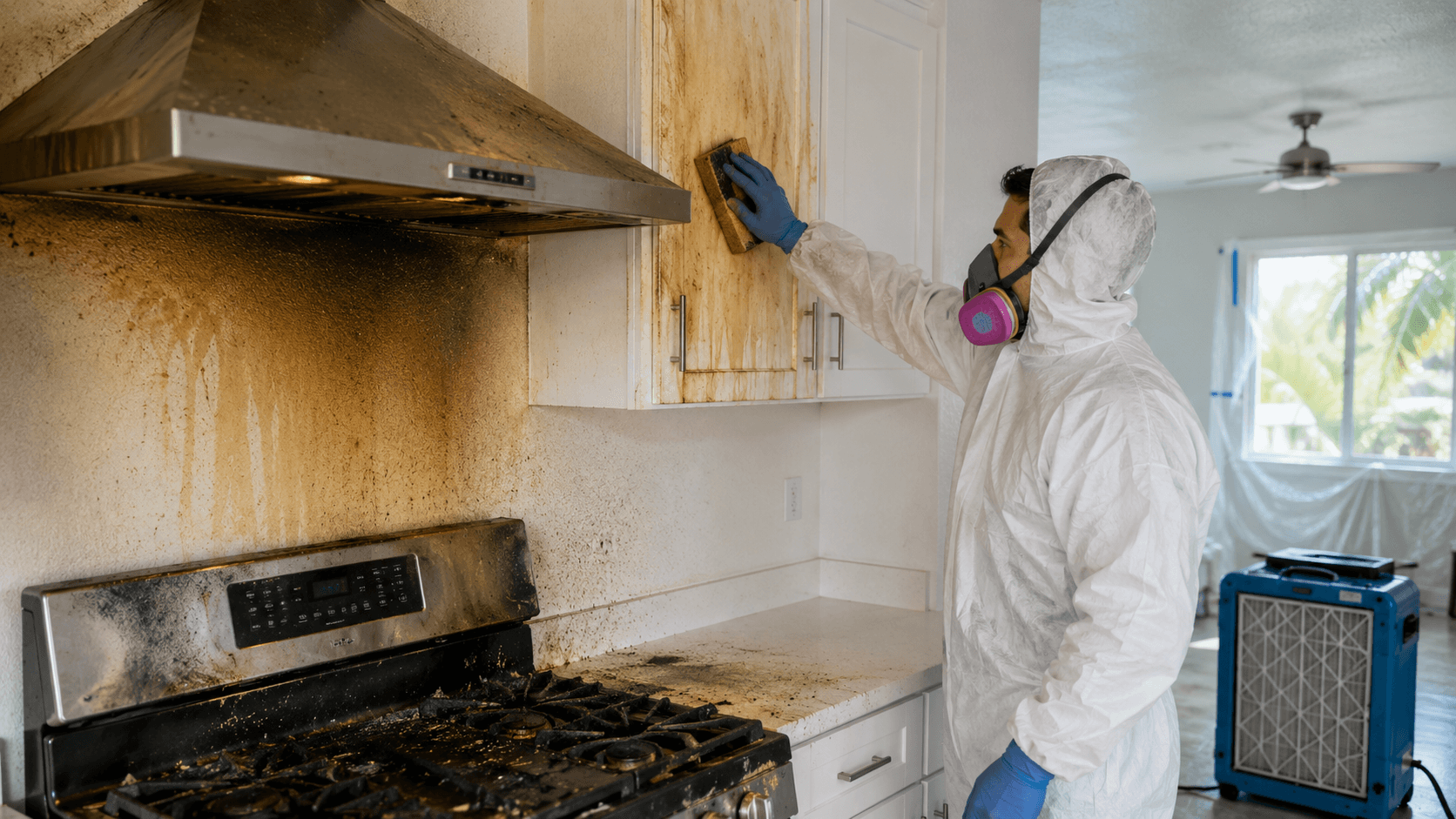
A small grease fire on the stove. A toaster oven that caught fire. A pot left too long on a burner. Most kitchen fires are extinguished quickly — by the homeowner, a fire extinguisher, or the smoke alarm prompting fast action. The actual fire damage is often contained to a small area. But the smoke and soot that came off that fire have already traveled throughout the home, settled on every surface, and started doing damage that's not visible at first glance.
Homeowners often think a small fire is a small cleanup. It's not. Smoke and soot are sneaky — they coat walls and ceilings far from the fire, get into HVAC ducts and spread to every room, settle on contents in cabinets and closets that weren't even near the fire, and produce a smell that doesn't go away with simple cleaning.
This guide is for Miami, Fort Lauderdale, Boca Raton, and Palm Beach homeowners who've had a small kitchen fire and want to understand what cleanup actually involves, what insurance covers, and when to call a professional.
The 3 categories of smoke and soot damage
1. Dry smoke. From fast-burning, high-temperature fires (paper, wood). Powdery residue. Easier to clean. 2. Wet smoke. From low-temperature, smoldering fires (plastics, rubber, synthetic fabrics). Sticky, smeary, hard to remove without professional methods. 3. Protein smoke (the kitchen fire's worst category). From burning meat, oils, and food. Often nearly invisible but produces an intense, persistent odor and yellow-brown discoloration on cold surfaces. Protein smoke is the most difficult to remediate.
Most kitchen fires produce protein smoke. A small grease fire on the stove can fill the entire home with protein smoke residue that requires professional cleaning to fully remove.
Where smoke and soot actually travel
Within minutes of a kitchen fire: smoke rises to the ceiling and spreads laterally; through HVAC return vents, smoke enters the duct system; through duct supply vents, smoke distributes to every room; smoke settles on cold surfaces (windows, exterior walls, tile floors) leaving residue; smoke penetrates fabric (curtains, upholstery, clothing); smoke gets into closed cabinets, drawers, and closets through air gaps; soot deposits on the inside of ceiling light fixtures.
A homeowner who only cleans the visible area near the stove leaves behind 80% of the actual damage. The smell returns. Surfaces continue to discolor. The home doesn't fully recover.
DIY vs. professional
DIY appropriate when: the fire was tiny (single burner, contained quickly); smoke was minimal (cleared with open windows in 30 minutes); no visible soot deposits beyond the immediate fire area; no smell once initial smoke is cleared; no HVAC involvement.
Call a pro when: soot deposits visible on walls or ceiling away from the fire; smell persists after 24 hours of ventilation; HVAC was running during the fire; multiple rooms have any smoke smell; soot got into cabinets, closets, or stored items; insurance is involved; contents need cleaning.
What a professional cleanup involves
1. Assessment. Restoration company walks the home, identifies all affected areas, tests for soot deposits, documents extent for insurance. 2. Containment if needed. 3. HVAC inspection and cleaning — filters changed, ducts cleaned, air handler interior cleaned. 4. Air filtration — HEPA air scrubbers run continuously. 5. Dry cleaning — sponge cleaning, dry sponges, HEPA vacuum to remove surface soot before any wet cleaning. 6. Wet cleaning — specialized chemical cleaners applied to walls, ceilings, hard surfaces. 7. Odor neutralization — thermal fogging, ozone treatment, or hydroxyl generators. 8. Contents cleaning — pack-out, off-site cleaning. 9. Affected materials replacement. 10. HVAC final cleaning and filter change. 11. Post-remediation verification.
A typical small-kitchen-fire restoration runs $3K–$15K depending on home size and smoke spread. Larger or smolder-type fires run $15K–$50K+.
What insurance pays for
Florida homeowners insurance typically covers: the fire damage itself; smoke and soot damage throughout the home; HVAC cleaning if affected; contents cleaning (pack-out and pack-back); replacement of items that can't be cleaned; additional living expenses if you can't stay in the home; loss of food in refrigerator/freezer.
Generally not covered: damage from intentional acts; damage from grossly negligent acts; repair of the appliance that caused the fire.
What you should NOT do
Don't try to clean walls and ceilings with water (water + soot creates a permanent stain). Don't run the HVAC (spreads soot through every room). Don't operate appliances that were near the fire until inspected. Don't move contents around the home before they're cleaned. Don't paint over soot without proper preparation. Don't accept just a deodorizer treatment — surface cleaning + neutralization is what actually removes the smell.
Prevention
Working smoke alarm in or near the kitchen, tested monthly. ABC-rated fire extinguisher in the kitchen, within reach. Never leave cooking unattended with hot oil. Keep flammables (towels, paper) away from the stovetop. Maintain the stove and exhaust — grease accumulation feeds fires. Have your HVAC ductwork inspected every few years.
When to call RestoFlo
If your South Florida home had a kitchen fire of any size and you need professional smoke and soot remediation, call us. We respond 24/7, document everything for your insurance carrier, perform full restoration scope including HVAC cleaning and contents cleaning, and work directly with your carrier without AOBs. 24/7 emergency line: (754) 289-4815.