Published September 6, 2026
Yes. Electronics can be affected by heat, soot, smoke residue, and firefighting water even when a device was not burned and still looks normal. Do not power on, charge, or test a smoke-exposed device until the property is cleared and the item has been evaluated for its specific exposure. Photograph it in place, record the model and serial number, and separate data recovery, cleaning, electrical safety, and insurance decisions instead of treating “it turns on” as proof that it is safe or undamaged.
A television in the next room, a laptop inside a closed office, or a refrigerator across the kitchen may escape direct flame contact and still be part of the fire-loss scope. Smoke travels through doorways, return-air paths, ceiling cavities, and open rooms. Fine residue can settle on cases, ventilation openings, wiring, boards, motors, fans, contacts, and connectors. Heat and water can add separate problems.
The first question is not “Can I wipe it off?” It is “What was this item exposed to, and who is qualified to decide whether it should be tested, cleaned, repaired, recovered for data, or replaced?” This guide gives South Florida homeowners a safe, documentation-first framework without promising that a particular device is salvageable.
What should you do first with smoke-exposed electronics?
Use this order:
- Wait for official clearance. Do not enter a fire-damaged structure until the fire department or appropriate authority says it is safe.
- Do not reconnect utilities yourself. Ready.gov specifically warns against reconnecting utilities after a fire without clearance.
- Leave questionable devices off. Do not power on, charge, or repeatedly test an item that was exposed to smoke, soot, heat, water, or damaged wiring.
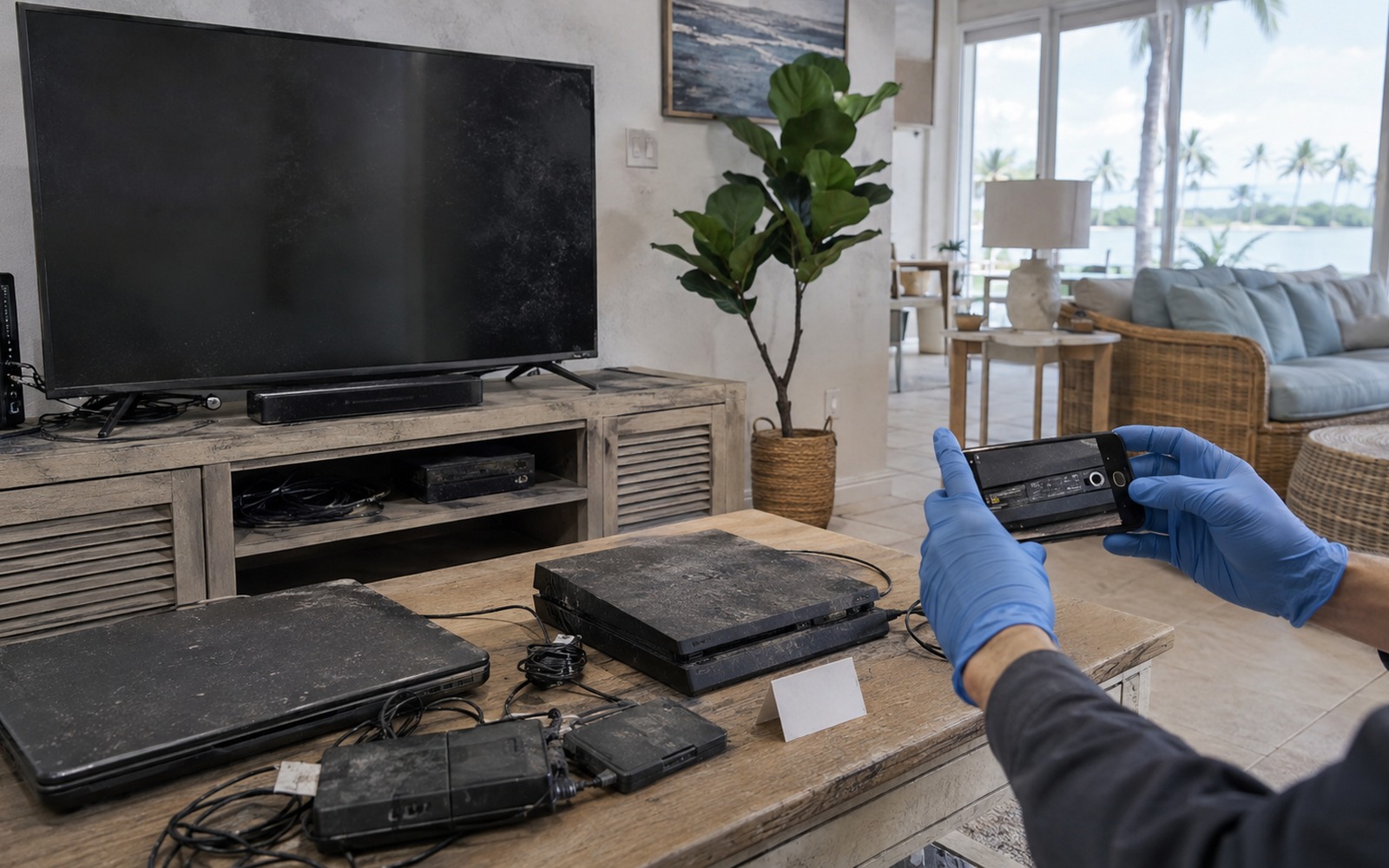
- Document before moving or cleaning. Photograph the item, its location, nearby residue, visible heat effects, cord and plug, model, serial number, accessories, and storage devices.
- Ask for the correct evaluation. A contents-restoration specialist, appliance technician, electronics specialist, electrician, manufacturer-authorized service provider, or data-recovery company may each have a different role.
- Coordinate with the insurer without assuming coverage. Ask what documentation, inspection, estimate, or preauthorization the policy and carrier require before disposal or repair.
This sequence protects safety, evidence, and options. It also prevents a well-intended cleanup from spreading soot into vents or erasing the condition that an evaluator needs to see.
Why can smoke affect electronics that were not burned?
The U.S. Fire Administration explains that items not directly damaged by flames may still be ruined by smoke or soaked by water used to fight the fire. Electronics deserve special caution because they are assemblies of cases, vents, fans, electrical conductors, circuit boards, batteries, displays, insulation, adhesives, motors, and connectors.
Smoke residue is not one uniform material. Its amount and behavior depend on what burned, how hot the event became, how long smoke moved through the property, ventilation, distance from the source, and whether water or cleaning products were introduced. A light-looking film does not reveal what is inside a vented device. A strong odor also does not, by itself, determine whether an item can be restored.
South Florida conditions can complicate the recovery environment. Warm outdoor air and high humidity can enter after windows, doors, roofing, or air-conditioning systems are damaged. That does not prove that every electronic will corrode or fail. It does mean the property and contents should be stabilized promptly and evaluated rather than left in an uncontrolled damp environment.
Does turning on prove an electronic device is safe?
No. A device powering on answers only one narrow question at one moment. It does not establish that internal components are clean, dry, undamaged by heat, or suitable for continued service. It also does not address the outlet, branch circuit, cord, charger, battery, or connected equipment.
Avoid “just checking” a television, computer, gaming system, appliance, or charger when the exposure is unknown. Applying power can add heat and electrical stress to a device that may contain residue, moisture, damaged insulation, or compromised components. Repeated testing can also make later diagnosis harder.
A qualified evaluator should decide the testing sequence. Depending on the item, that may involve exterior inspection, controlled opening, residue assessment, moisture or insulation testing, manufacturer guidance, bench testing, cleaning, and a written recommendation. RestoFlo’s role is the smoke-damage and property-restoration scope; functional certification or electrical repair should be performed by the appropriate qualified specialist.
What kinds of electronics need the closest attention?
Prioritize items by safety, exposure, data value, replacement difficulty, and connection to the building system.
Battery-powered devices
Phones, tablets, laptops, cordless tools, backup batteries, power banks, e-bikes, and other rechargeable devices may contain lithium-ion batteries. A swollen case, unusual heat, hissing, popping, leaking, discoloration, puncture, or deformation is a reason to keep distance and contact emergency or qualified hazardous-material guidance. Do not charge a questionable battery to see whether it still works.
Appliances and equipment connected to building power
Refrigerators, ranges, microwaves, washers, dryers, air handlers, pool equipment, smart panels, and built-in controls involve both the device and the property’s electrical system. Fire, heat, water, damaged cords, tripped breakers, or smoke residue can create overlapping concerns. The American Red Cross advises disconnecting and checking appliances for water damage before use and involving a qualified electrician when electrical problems may be hidden.
Computers, servers, and storage devices
These items may contain irreplaceable data. The correct first move may be preservation and professional data recovery—not ordinary cleaning or powering on. Record passwords or recovery keys only in your own secure system; never hand credentials to a restoration company unless a clearly defined, trusted service requires them.
Televisions, audio equipment, gaming systems, and smart-home devices
Large vents and cooling fans can move room air through a device during normal operation, so exterior appearance alone may not represent internal exposure. Photograph cables and port connections before disconnecting anything. Keep accessories, remotes, power supplies, and serial numbers associated with the correct item.
Medical, mobility, security, and life-safety devices
Do not rely on uncertain smoke-exposed equipment for critical needs. Contact the manufacturer, healthcare provider, monitoring company, or qualified service organization for replacement or inspection guidance. Smoke alarms, carbon-monoxide alarms, security panels, powered mobility equipment, refrigeration for medication, and communication devices may require immediate priority, but each has different authority and testing requirements.
How should you document smoke-damaged electronics?
Ready.gov advises conducting an inventory and not throwing away damaged goods before they are documented. A useful electronics record includes:
- room and exact location;
- item type, brand, model, and serial number;
- purchase date or approximate age when known;
- accessories, cables, remotes, mounts, and power supplies;
- visible soot, staining, melted areas, water marks, or deformation;
- whether the item was operating during the fire;
- distance and barriers between the item and the fire source;
- whether sprinklers, hoses, roof openings, or suppression water affected the area;
- whether it was powered on, charged, cleaned, or moved after the event;
- photos of the item in place and close details;
- the proposed action: inspect, test, clean, recover data, store, replace, or dispose; and
- the person or company making the recommendation.
Save estimates, inspection notes, cleaning records, data-recovery reports, manufacturer guidance, and disposal receipts. Coverage, valuation, depreciation, repair authorization, and replacement decisions depend on the policy and carrier; no restoration contractor can guarantee an insurance outcome.
Should you clean soot from electronics yourself?
Avoid opening or wet-cleaning smoke-exposed electronics as a routine DIY step. Household vacuums, compressed air, brushes, wipes, and liquid cleaners can push residue deeper, create static or moisture problems, damage coatings, or make the original condition harder to document.
FEMA and the Smithsonian’s post-fire salvage guidance notes that soot and ash can be abrasive and that handling can grind residue further into damaged items. That guidance is directed broadly at treasured objects rather than electronic repair, but the documentation-first principle applies: reduce unnecessary handling, photograph the condition, and get item-specific advice.
If the property has only light airborne smoke and no fire, heat, soot deposition, suppression water, or electrical damage near a device, manufacturer cleaning instructions may be sufficient for the exterior. Do not extend those instructions to internal cleaning. When exposure is uncertain, pause and ask the manufacturer or a qualified electronics specialist.
What determines whether an electronic can be cleaned, repaired, or replaced?
There is no responsible yes-or-no rule for every device. The decision may consider:
Heat exposure
Melted plastics, warped cases, blistered labels, discolored connectors, brittle insulation, or deformation suggest more than a surface-cleaning problem. Distance from flames alone does not measure peak heat at the item.
Soot and smoke-residue exposure
Residue amount, composition, location, and access matter. A sealed item and a fan-cooled item may have different exposure. A device that was operating may have moved contaminated air through itself.
Water and moisture
Sprinklers, hose streams, roof openings, wet ceilings, and cleanup can expose electronics to water independently of smoke. Water source, duration, and drying conditions matter. Do not assume that an exterior that feels dry means internal areas are ready for power.
Electrical-system condition
The device cannot be evaluated in isolation when the outlet, circuit, cord, charger, surge protector, or building wiring may be damaged. Property electrical clearance and device testing are separate gates.
Battery condition
Physical battery damage or unusual behavior changes the safety response. Follow fire-department, manufacturer, and local hazardous-waste guidance rather than placing a questionable battery into ordinary trash.
Data and functional importance
A damaged laptop may be economically replaceable while its data is not. A refrigerator may be replaceable but urgently important for food or medication. A custom controller or business server may require specialist recovery planning before movement.
Manufacturer support and parts
Some products can be opened, cleaned, tested, and repaired through authorized channels. Others are sealed, unsupported, or uneconomical to service. Warranty terms and manufacturer guidance may also affect the path.
Cost, policy, and documentation
Cleaning cost, diagnostic fees, repair uncertainty, replacement availability, policy terms, and carrier requirements all affect the final decision. A written recommendation should state the observed condition, proposed procedure, limits, and acceptance test instead of promising a guaranteed result.
Who should evaluate smoke-damaged electronics?
Match the item to the right authority:
- Fire department or local authority: structural entry and immediate scene safety.
- Licensed electrician: building wiring, outlets, panels, branch circuits, and electrical clearance.
- Manufacturer-authorized appliance technician: major appliance inspection and repair.
- Qualified electronics-restoration or electronics-repair specialist: internal evaluation, cleaning, bench testing, and repair recommendations.
- Professional data-recovery provider: storage-media preservation and data extraction.
- Battery or hazardous-waste authority: damaged rechargeable batteries and disposal instructions.
- Restoration contractor: smoke-residue mapping, property surfaces, contents documentation, cleaning scope, coordination, and reconstruction boundaries.
- Insurer or adjuster: policy process, documentation requirements, approvals, valuation, and coverage decisions.
One company should not claim every role automatically. Ask who performs each evaluation, what qualifications apply to that item, what test will be documented, and who assumes responsibility for placing it back into service.
What should a professional scope include?
For electronics and appliances, a clear smoke-damage scope can identify:
- the item inventory and location;
- the observed fire, smoke, heat, soot, and water exposure;
- scene and electrical prerequisites;
- the recommended evaluator for each item class;
- pack-out, transport, storage, and chain-of-custody steps;
- data-security requirements;
- exterior versus internal cleaning boundaries;
- testing method and acceptance criteria;
- items recommended for replacement or specialist review;
- photos, serial numbers, reports, and receipts;
- insurer authorization requirements; and
- responsible disposal or electronics-recycling path when needed.
EPA notes that electronics may require special handling and points consumers toward local programs and certified electronics recyclers. Disposal should follow local requirements; do not place damaged batteries or electronics into ordinary waste without confirming the accepted route.
How does the restoration process fit around the electronics?
Electronics are one part of a larger fire-and-smoke recovery plan. The property may also require soot assessment, odor-source removal, structural cleaning, HVAC evaluation, water extraction, drying, selective demolition, and reconstruction. These tasks should be sequenced so that cleaned or tested contents are not returned to an uncontrolled environment.
RestoFlo provides smoke damage restoration and fire damage restoration in South Florida. For a broader view of odor-treatment options and limitations, read Should You Use an Ozone Generator for Smoke Odor After a Fire?. To understand estimate boundaries, review what a professional fire-damage restoration estimate should include.
A responsible plan separates:
- property clearance and electrical safety;
- stabilization and moisture control;
- contents inventory and documentation;
- electronics, appliance, and data specialist decisions;
- cleaning and odor-removal scope;
- storage and return of contents; and
- reconstruction.
That separation makes the work easier to verify and helps prevent a device from being labeled “cleaned” when it was never functionally evaluated.
A practical South Florida checklist
After the property is cleared for the appropriate professionals to enter:
- Keep smoke-exposed devices off and unplugged when this can be done safely.
- Do not charge questionable batteries.
- Photograph every item before cleaning or disposal.
- Record serial numbers and associated accessories.
- Flag devices containing important data.
- Separate medical, mobility, security, refrigeration, and business-critical equipment for priority decisions.
- Ask whether the building electrical system is cleared.
- Ask who is qualified to inspect each device class.
- Obtain written cleaning, testing, replacement, and data-recovery recommendations.
- Coordinate insurer requirements before destructive testing or disposal.
- Keep cleaned contents away from uncontrolled smoke, soot, moisture, and reconstruction dust.
- Use an accepted electronics-recycling or hazardous-waste path for items that will not be retained.
When to call RestoFlo
If smoke, soot, or firefighting water affected your South Florida home or business, RestoFlo can assess the property’s fire-and-smoke restoration scope and help define the next steps around affected surfaces, contents, moisture, and reconstruction.
Call (754) 289-4815 or request a free assessment through RestoFlo.com. If electronics or appliances were exposed, mention the rooms involved, whether the items were operating, and whether heat, soot, or water reached them. Do not power on a questionable device while waiting for evaluation.
Frequently Asked Questions
1. Can smoke damage a TV or computer that was in another room?
Yes. Smoke can move beyond the room of origin and settle on surfaces or enter vented equipment. The amount of exposure depends on distance, doors, airflow, operating fans, what burned, heat, duration, and cleanup water. Do not assume an item is unaffected because there are no burn marks. Photograph it, keep it off, and obtain item-specific evaluation.
2. Should I turn on smoke-exposed electronics to see if they work?
Not until the property and electrical conditions are cleared and a qualified evaluator says testing is appropriate. Powering on answers only whether the item starts at that moment; it does not prove internal cleanliness, dryness, or continued safety. If important data is stored on the device, ask a data-recovery professional about preservation before testing.
3. Can soot be vacuumed or wiped off electronics?
Do not open or wet-clean electronics with ordinary household methods. Vacuums, compressed air, brushes, and liquids can move residue, introduce static or moisture, damage components, or alter evidence. Follow manufacturer instructions for minor exterior dust only when the exposure is clearly limited. Otherwise use a qualified electronics or appliance specialist.
4. Are smoke-damaged electronics covered by homeowners insurance?
Coverage varies by policy, cause, item, valuation method, deductible, exclusions, and carrier decisions. Document the item, location, model, serial number, visible condition, and proposed action before disposal or repair. Ask the insurer what inspection, estimate, testing, or preauthorization is required. RestoFlo cannot promise claim approval or payment.
5. Can data be recovered from a smoke-damaged laptop or drive?
Sometimes, but the outcome depends on the storage device, heat, water, soot, electrical damage, encryption, and prior testing. Do not repeatedly power on an exposed computer. Tell the restoration and insurance teams that the data is important, then consult a professional data-recovery provider about preservation, transport, security, and recovery options.
6. Where should damaged electronics and batteries be disposed?
Use local electronics-recycling or household hazardous-waste guidance rather than ordinary trash when special handling is required. Damaged rechargeable batteries need particular caution. EPA recommends checking local programs, manufacturer or retailer take-back options, and certified electronics recyclers. Confirm the accepted route before transport and follow any fire-department or battery-manufacturer instructions.
Sources