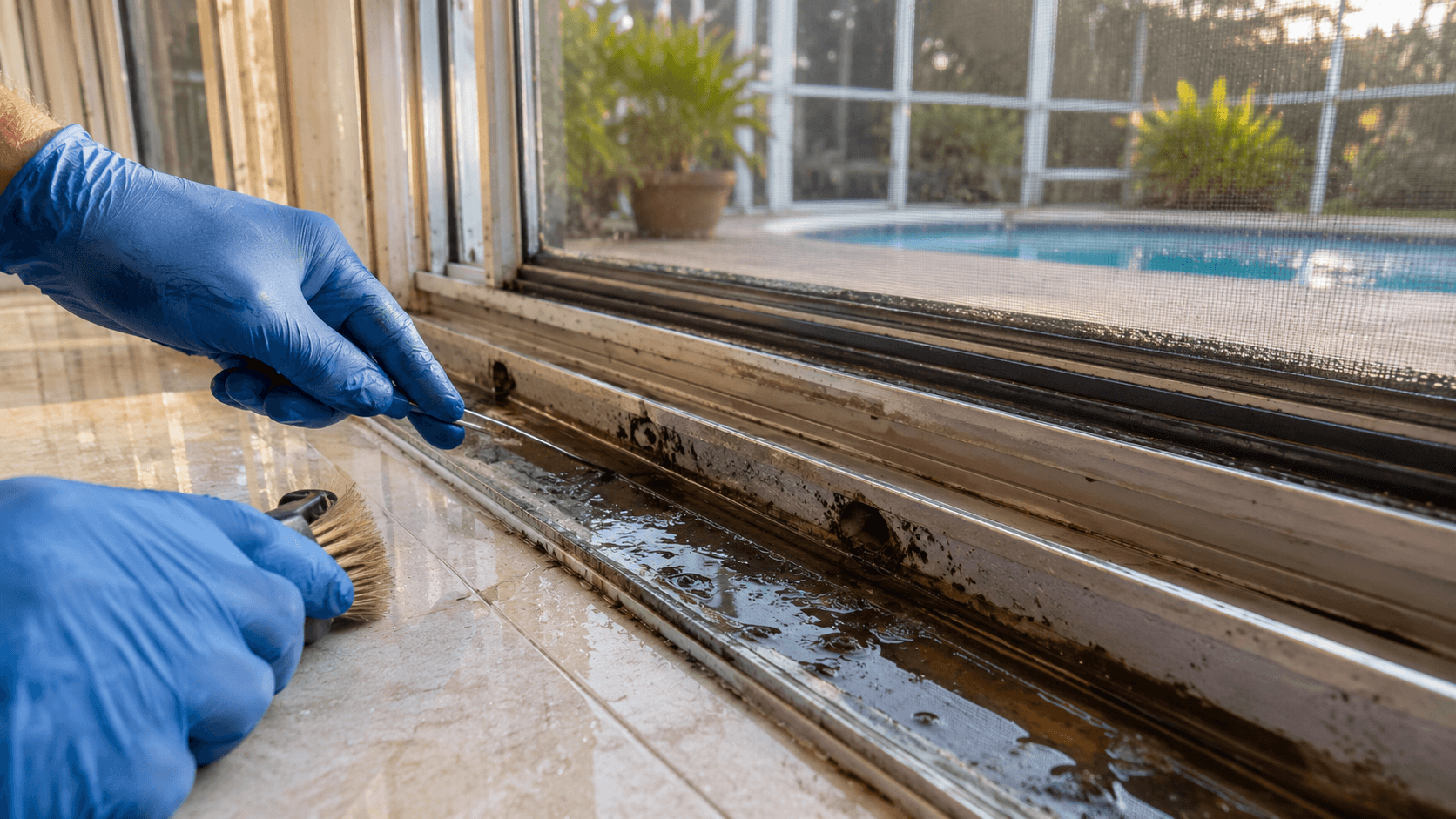
Sliding glass doors are the signature feature of South Florida homes. They open onto the pool deck, the lanai, the beach view. They flood the interior with natural light. And they're a common water intrusion point that homeowners often don't understand until wind-driven rain from a summer thunderstorm — or worse, a hurricane — pushes water through them and onto the interior floor.
Homeowners assume that if the door itself is closed and sealed, water shouldn't come through. But water isn't necessarily coming through the door — it's coming through the weep system, the small drainage channels built into every sliding door track that are supposed to let water out of the track when heavy rain drives it in.
When the weep system works, water enters the track, drains out the bottom, and never gets past the door seal. When it fails, water pools in the track, rises above the door seal, and flows onto the interior floor.
How sliding door weep systems work
A typical South Florida sliding glass door has: the door track at the bottom (a metal channel the door slides in); weep holes at intervals along the outside bottom of the track (usually covered by a small flap that pivots outward when water needs to exit); a rubber gasket between the door and the track; interior finished floor just inside; exterior finished floor or deck just outside.
When rain drives against the door, some water inevitably gets into the track. The weep holes let it drain out to the exterior side. The rubber gasket prevents any water in the track from getting past the door. When the weep holes clog, the water in the track has nowhere to go. It fills the track, rises to the level of the seal, then flows over onto the interior floor.
The 6 common weep system failures
1. Clogged weep holes. Dirt, debris, dead insects, or salt residue block the outlet. Most common cause. 2. Covered weep holes. Painted over, sealed with caulk, or blocked by landscaping. 3. Sealed weep holes. Some homeowners mistake weep holes for defects and seal them intentionally. Wrong move. 4. Damaged weep hole flaps. Small covers can break or fall off. 5. Failed rubber gasket. Gasket has aged, torn, or shifted. 6. Improper installation. Door installed out of level so water pools in one section instead of draining.
The 5 signs your weep system may be failing
1. Water on the interior floor near sliding doors after heavy rain. 2. Standing water in the sliding door track after a rain event. 3. Water staining on the interior floor near sliding doors. 4. Musty smell near sliding doors after wet weather. 5. Visible mold on the door frame or adjacent baseboards.
If you see any of these, your weep system needs inspection.
How to inspect the weep system
1. Open the sliding door fully. 2. Locate the weep holes on the outside bottom of the track (1/8" to 1/4" openings). 3. Check each weep hole for blockage. 4. Push a wire, small brush, or toothpick into each hole to clear debris. 5. Test drainage by pouring water into the track from the interior side — water should flow out through the weep holes onto the exterior deck. 6. Inspect the rubber gasket. 7. Check that the door is level and closes properly.
DIY cleaning and maintenance
Quarterly: vacuum the door track thoroughly; clear each weep hole; rinse the track with water and confirm drainage; inspect the gasket. Annually: deep clean the track (use white vinegar for salt residue); replace any damaged weep hole flaps; silicone lubricant on the rubber gasket. Before storm season: full inspection; clear all weep holes; test drainage.
Homeowners in coastal areas (within 1 mile of the ocean) should do this more frequently because of salt accumulation.
When the fix requires more than cleaning
Broken weep hole flaps: replacement covers from manufacturer. $10–$30 each. Damaged rubber gasket: replacement gaskets from manufacturer. Difficult DIY. $100–$300 for parts. Door out of level: requires door adjustment or shimming. Professional. $200–$500. Old or damaged track: track replacement. Major job. $1K–$3K. Damaged door frame: frame or full door replacement. $2K–$10K+.
What happens when water enters the home
When the weep system fails and water enters the home: wet carpet or warped hardwood or water-stained tile grout; wet baseboards; wall cavity; under-floor substrate; furniture near doors.
Restoration scope: water extraction and drying; baseboard removal and drying of wall cavity; flooring assessment; mold remediation if established (48-hour window); reinstallation of baseboards and repair. Total cost: $2K–$10K depending on affected area.
Insurance considerations
Florida homeowners insurance on sliding door weep failures: water intrusion from a sudden weep failure during a covered storm (hurricane, named storm) typically covered for resulting interior damage; water intrusion from routine heavy rain typically not covered (maintenance); long-term chronic weep failure not covered; the weep system repair itself not covered (maintenance).
Storm preparation for sliding doors
Before a hurricane: clean the tracks thoroughly; clear the weep holes; test drainage; check the gasket; add towels or absorbent material on the interior side just before the storm; consider hurricane shutter or impact-rated door coverage; photograph the doors and tracks for insurance documentation.
Standard non-impact sliding doors are vulnerable to wind-driven rain even with functional weep systems. Impact-rated doors provide additional protection.
When to call RestoFlo
If your South Florida home has had water intrusion from a sliding door — whether from a storm, weep system failure, or ongoing issue — call us. We assess the actual damage, mitigate before mold establishes, work directly with your insurance carrier under your direction (no AOBs), and coordinate with door professionals on the source repair. 24/7 emergency line: (754) 289-4815.