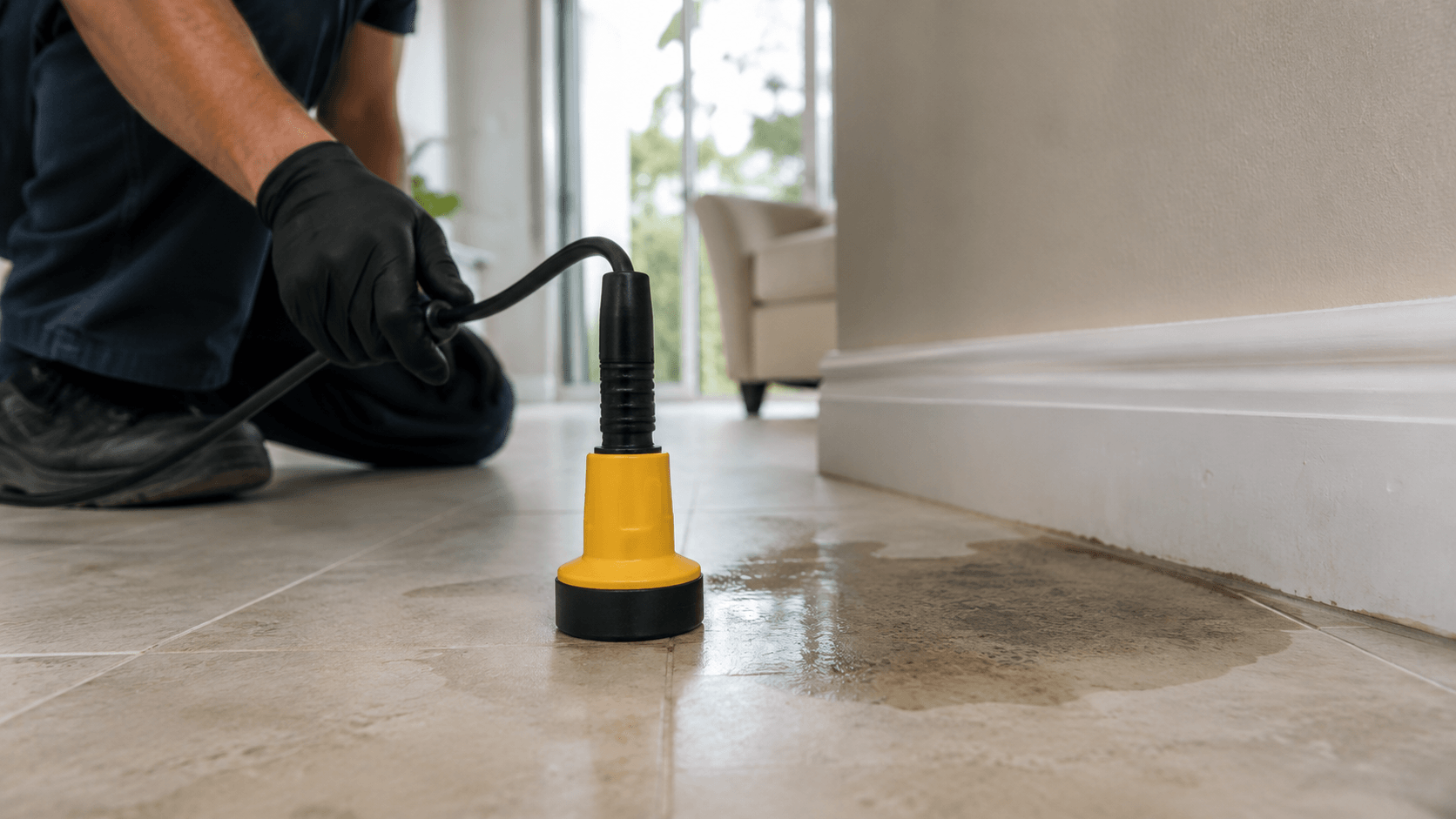
A slab leak is the worst kind of water damage in a South Florida home, because it happens where you can't see it. Your home's water and drain lines run through the concrete slab the house sits on. When one of those lines fails — pinholes in copper, separated PVC, a cracked drain — the water leaks under the slab, into the soil and stem walls, and eventually pushes its way up through your flooring. By the time you see a wet spot, you've usually been leaking for weeks or months.
We respond to slab leaks every week in Miami, Fort Lauderdale, Boca Raton, and Palm Beach. Most of them got missed early because the homeowner didn't know the warning signs. This guide walks through how slab leaks happen here, how to spot one before it ruins your floors, and what professional detection actually looks like.
Why slab leaks are common in South Florida
A few reasons we see more of them down here than in much of the country:
- Aggressive soil chemistry. South Florida soil and groundwater are corrosive to copper. Copper supply lines in slabs from the 1980s and 1990s, especially Type M (thinner-wall), develop pinhole leaks at a much higher rate than the same pipe in drier inland soils.
- High water pressure. Some neighborhoods see municipal pressure spikes above 80 psi. That accelerates pinhole formation in already-thin pipe.
- Older homes with original plumbing. Most slab homes built before 2005 were plumbed in copper. A 30-year-old copper line in our climate is on borrowed time.
- Tree roots and ground movement. Live oaks, banyans, and ficus root systems pressure underground drain lines. PVC drain lines develop separations at fittings; cast-iron drain lines corrode through.
- Settled foundations. Even small differential settlement of a slab cracks rigid plumbing inside the concrete.
If your home is more than 25 years old and still has original copper supply lines under the slab, the question isn't if a slab leak will happen — it's when.
The 8 most common signs of a slab leak
These are the ones we see homeowners miss most often:
- The sound of running water when no fixtures are on. Stand in a quiet room — a hallway or bedroom on the slab level — and listen. A faint constant hiss or trickle that doesn't stop when you close every valve in the house is a slab-leak red flag.
- A water bill that jumped without obvious cause. A continuous slab leak adds 5,000–30,000 gallons a month to your usage. Check your last 6 months of bills against the same months last year.
- A warm spot on the floor. A leak in a hot water line warms the slab above it. Walk barefoot through the house in the morning before the AC has cooled the floor — a noticeably warm patch on tile or LVP is a strong signal.
- A wet spot or dark stain on your flooring. Often along baseboards or grout joints first. Especially clear on dark grout.
- Foundation cracks that grow. Slab leaks under-cut foundations and create new diagonal cracks in stucco, drywall corners, and tile. Existing hairline cracks that suddenly widen are worse than always-there cracks.
- Mildew smell from carpet, baseboards, or low cabinets. Slab moisture wicks up into the bottom plates of walls and into anything porous near the floor.
- Reduced water pressure. A significant slab leak can drop pressure throughout the house, especially in fixtures farthest from the main.
- The water meter dial moves with no fixtures running. Find your water meter at the curb. With every fixture in the house off, watch the meter dial. If it spins, you have a leak somewhere — and if you've already shut off all the fixtures, that somewhere is in your supply system, possibly in the slab.
A homeowner with two or more of these signs has a slab leak until proven otherwise.
How professional slab leak detection works
A real detection workflow uses three or four overlapping methods:
1. Pressure testing. A plumber isolates segments of your supply lines and pressurizes them to identify which run has the leak. This is the highest-confidence first step — it confirms whether the leak is in the supply system at all.
2. Acoustic detection. Sensitive microphones placed on the slab listen for the characteristic high-frequency hiss of pressurized water escaping. Acoustic detection narrows location to within a foot or two when the leak is active.
3. Tracer gas (helium or hydrogen-nitrogen mix). The supply line is depressurized, dried, and filled with low-pressure tracer gas. The gas escapes through the leak and is detected at the surface with a sensitive sniffer. Pinpoints leaks that acoustic methods can't.
4. Thermal imaging. Especially effective for hot-water leaks. The thermal signature of the heated water shows up clearly through the slab and any tile or LVP above it.
5. Camera (for drain leaks). Slab leaks aren't only supply lines — drain lines also fail under the slab. A sewer-line camera run through cleanouts identifies cracks, separations, and root intrusions in PVC or cast iron.
A combination of these methods locates a leak to within a foot, which is the difference between a 12-inch concrete cut and a destructive search across a whole floor.
Repair options once the leak is found
Three options once a slab leak is located:
- Spot repair. Concrete is cut over the leak, the affected pipe section is cut out and replaced, the concrete is patched. Cheapest if the leak is a one-off and the rest of the supply line is in good shape.
- Reroute. The failed line is abandoned in place and a new line is run overhead through the attic to the same fixtures. Avoids further concrete work but introduces overhead plumbing that can leak in the future.
- Whole-home repipe. All slab supply lines are abandoned, new PEX or copper is run through the attic, and the whole house is replumbed. Expensive but the right call for older homes with corroded copper that's likely to keep failing in new locations.
For a home that's already had one slab leak in old copper, a repipe is usually the right long-term answer. We've seen homeowners spot-repair three or four leaks before accepting that the underlying pipe is at end of life.
What happens if you ignore it
A slab leak that's been running for months does the following damage:
- Soaks the slab itself — concrete absorbs moisture and releases it slowly for weeks even after the source stops.
- Wicks moisture up the bottom plates of every framed wall on the slab.
- Saturates carpet pad, drywall, and baseboards.
- Feeds mold growth in wall cavities.
- Undermines soil under the foundation, causing differential settlement and structural cracking.
- Wastes thousands of gallons of water a month.
We've responded to slab leaks where the visible damage was a corner of stained tile and the actual scope, after demolition, was 1,400 square feet of contaminated flooring, mold remediation in three rooms, and replacement of three sections of bottom plate. The cost differential between catching it at sign #1 and catching it after six months is usually 10x.
Will insurance cover a slab leak?
In Florida, the answer is depends on the policy and the cause:
- Resulting water damage to flooring, drywall, and contents: typically covered if the leak was sudden and accidental.
- The cost to access the leak (cut concrete, lift flooring): typically covered.
- The cost to repair the pipe itself: usually NOT covered — that's a plumbing expense.
- The cost to re-finish the concrete and reinstall flooring: typically covered.
- Mold: capped at $10K on most policies unless you bought a higher mold endorsement.
- A whole-home repipe to prevent future leaks: not covered.
The most-disputed part is whether the leak was sudden and accidental versus long-term seepage. A homeowner who can document that the leak appeared suddenly (water bill, photos of a sudden floor stain, a recent acoustic detection report) has a much smoother claim.
When to call RestoFlo
If you suspect a slab leak — high water bill, warm floor, mildew smell, hissing sound — call us before the visible damage gets bad. We coordinate detection, demolition, drying, mold remediation if present, and reconstruction, and we work directly with your insurance company.
24/7 emergency line: (754) 289-4815.