A pet urine accident on the carpet seems like a cleaning problem. Most homeowners run a carpet cleaner, blot the spot, apply an enzymatic cleaner, and move on. For a one-time accident on a sealed carpet pad, that often works. But for repeated accidents in the same spot, for long-term cat or dog use of an area, for urine that's soaked through carpet into pad into subfloor — the cleaning approach isn't enough, and the damage extends much further than the visible stain suggests.
This guide is for Miami, Fort Lauderdale, Boca Raton, and Palm Beach homeowners who've discovered that pet stains have done more than surface damage and want to know when cleaning is enough and when demolition is required.
How pet urine actually damages floors
Pet urine is acidic when fresh (pH 5–6) and becomes alkaline as it ages (pH 10–12). This pH shift, plus the nitrogen content, makes urine particularly damaging to materials.
Carpet — fibers absorb the urine, then the dried residue traps the smell. Many carpets can't be fully restored. Carpet pad — the foam underlayment absorbs and stays saturated. Even a brief accident soaks in deeply. Subfloor wood — plywood, OSB, or solid wood subfloor absorbs urine through carpet and pad. Once saturated, the wood is permanently affected. Tack strips and baseboards — wood elements adjacent to the affected zone also wick urine. Joists — in severe cases, urine has soaked through the subfloor and damaged the joists below. Adjacent walls — urine wicks up into wall cavities, damaging baseboards and lower drywall.
The visible stain on the carpet is often only 20–30% of the total damage zone.
The 6 levels of pet stain damage
Level 1: Surface only. Fresh single accident on sealed flooring. Visible stain, no smell at the source after cleaning. Resolution: clean and move on.
Level 2: Carpet and pad penetration. Accident penetrated carpet and pad. Smell persists. Resolution: replace pad, deep-clean carpet, apply enzymatic treatment.
Level 3: Subfloor surface affected. Urine wicked into subfloor wood surface. Wood is stained but structurally sound. Resolution: replace carpet and pad, sand and seal subfloor, apply odor sealant, replace carpet.
Level 4: Subfloor saturated. Subfloor is wet, smells, possibly mold growth on underside. Resolution: subfloor demolition and replacement plus full restoration scope.
Level 5: Joists or framing affected. Urine has soaked through subfloor and damaged framing below. Resolution: structural demolition, framing repair, mold remediation, rebuild.
Level 6: Lateral migration. Urine has migrated into walls, adjacent rooms, or subfloor far beyond the visible stain. Resolution: major restoration project.
For most homes with significant pet stain issues, we see Level 3 or 4. For long-term older pets with mobility issues, Level 5 or 6.
How to diagnose what level you're dealing with
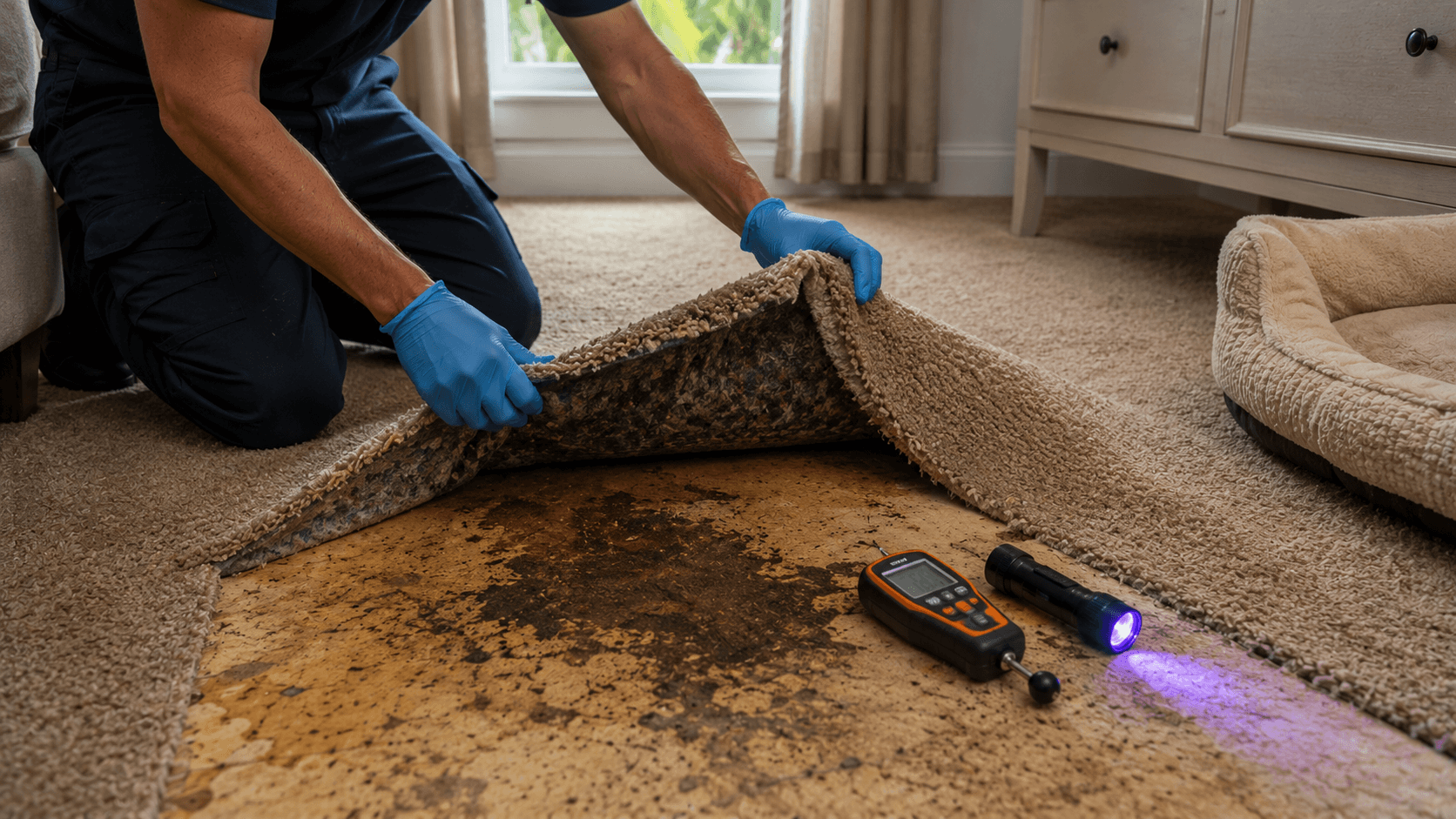
Test 1: Visual inspection. Lift the carpet at the stain. Look at the back of the carpet and the pad. Both stained? Probably Level 2+. Test 2: Smell test. Smell the pad. Smell the subfloor (lift pad). Strong ammonia smell = Level 3+. Test 3: Moisture meter. Read the subfloor moisture. Elevated reading = water/urine is still in the wood. Test 4: Black light test. A UV black light makes urine fluoresce. Walk the area at night. Test 5: Visible staining of subfloor. Yellow or brown staining indicates wood absorption. Test 6: Inspect joists or floor below from a crawlspace or basement if accessible. South Florida slab homes don't have this option.
A professional restoration assessment ($200–$400) includes all of these tests and produces a recommended scope.
What enzymatic cleaners actually do
Enzymatic cleaners contain enzymes that break down the proteins in urine. They work on carpet fibers, carpet pad surface, and sealed hard floor surfaces. They don't work on wood that's absorbed urine (the enzymes can't penetrate fully), concrete or masonry that's absorbed urine, or areas where the urine has dried into a sub-layer.
Enzymatic cleaners are a useful first response. They are not a complete solution for Level 3+ damage. Many homeowners treat the visible carpet, but the urine in the subfloor or pad continues to smell, attract repeat accidents (cats especially mark previously-marked spots), and feed mold growth.
The actual restoration scope
For Level 3+ pet stain damage, the typical restoration: removal of carpet and pad in the affected area, plus a safety buffer (usually 2–3 feet beyond the visible stain); removal of tack strips and baseboards affected; assessment of subfloor with moisture meter and visual inspection; subfloor treatment — light: sand, seal with odor blocker (KILZ or equivalent), apply moisture barrier; moderate: cut out affected section, replace; severe: full room or area subfloor replacement; drying and decontamination if subfloor is removed and joists exposed; mold remediation if mold has established; subfloor replacement and sealing; new pad and carpet installation; replacement of baseboards and any affected wall surfaces.
A typical Level 3 scope runs $2K–$5K. A Level 4–5 scope runs $8K–$20K+. Pack-out for contents in the affected area adds.
When to consider hard flooring instead
For homes with significant pet history, converting from carpet to hard flooring (luxury vinyl plank, tile) often makes sense going forward: easier to clean repeat accidents; no pad to absorb the urine; subfloor better protected (still seal properly); no fiber traps for smell.
The conversion is typically done after the restoration scope is complete. Many South Florida homeowners eventually move toward luxury vinyl plank (LVP) which is waterproof, durable, and pet-friendly. Cost: $7–$12 per square foot installed.
Insurance considerations
Florida homeowners insurance on pet stain damage: pet stain damage is almost always excluded from coverage. Most policies have specific exclusions for damage caused by household pets. Resulting mold from pet stains typically also excluded. Structural damage from long-term pet accidents treated as maintenance.
This is one of the few residential damage categories where insurance doesn't help. The cost of restoration is borne by the homeowner. The single exception: if a pet accident caused a covered event (e.g., dog knocked over a vase that broke a pipe), the resulting water damage may be covered.
Prevention checklist
For households with pets: crate training and bathroom routines for puppies and rehomed pets; litter box management for cats (at least one box per cat plus one, kept clean); vet checkups for older pets — house-soiling often signals UTI, kidney issues, or arthritis; pet-resistant flooring in high-risk rooms; moisture barriers under carpet pad in pet rooms; enzymatic cleaning of every accident within 24 hours; black light periodic inspection to catch stains before they soak in deeply.
DIY vs. professional
DIY (Level 1–2): fresh, surface-only accidents on a sealed carpet pad; single isolated incidents; no subfloor involvement; smell goes away with cleaning.
Professional (Level 3+): repeated accidents in the same area; smell persists after enzymatic cleaning; visible subfloor staining when carpet lifted; suspect mold growth; multiple rooms affected; older pet with progressive damage.
A homeowner who tries to DIY a Level 4 situation often spends more on multiple unsuccessful cleanings than the professional restoration would have cost.
When to call RestoFlo
If you've discovered subfloor pet stain damage in your South Florida home, call us. We assess the actual scope, perform the demolition and remediation, address mold if present, and rebuild. Most pet damage is out-of-pocket for the homeowner, so we work with you on scope and cost to keep the project in budget. 24/7 emergency line: (754) 289-4815.