Published September 5, 2026
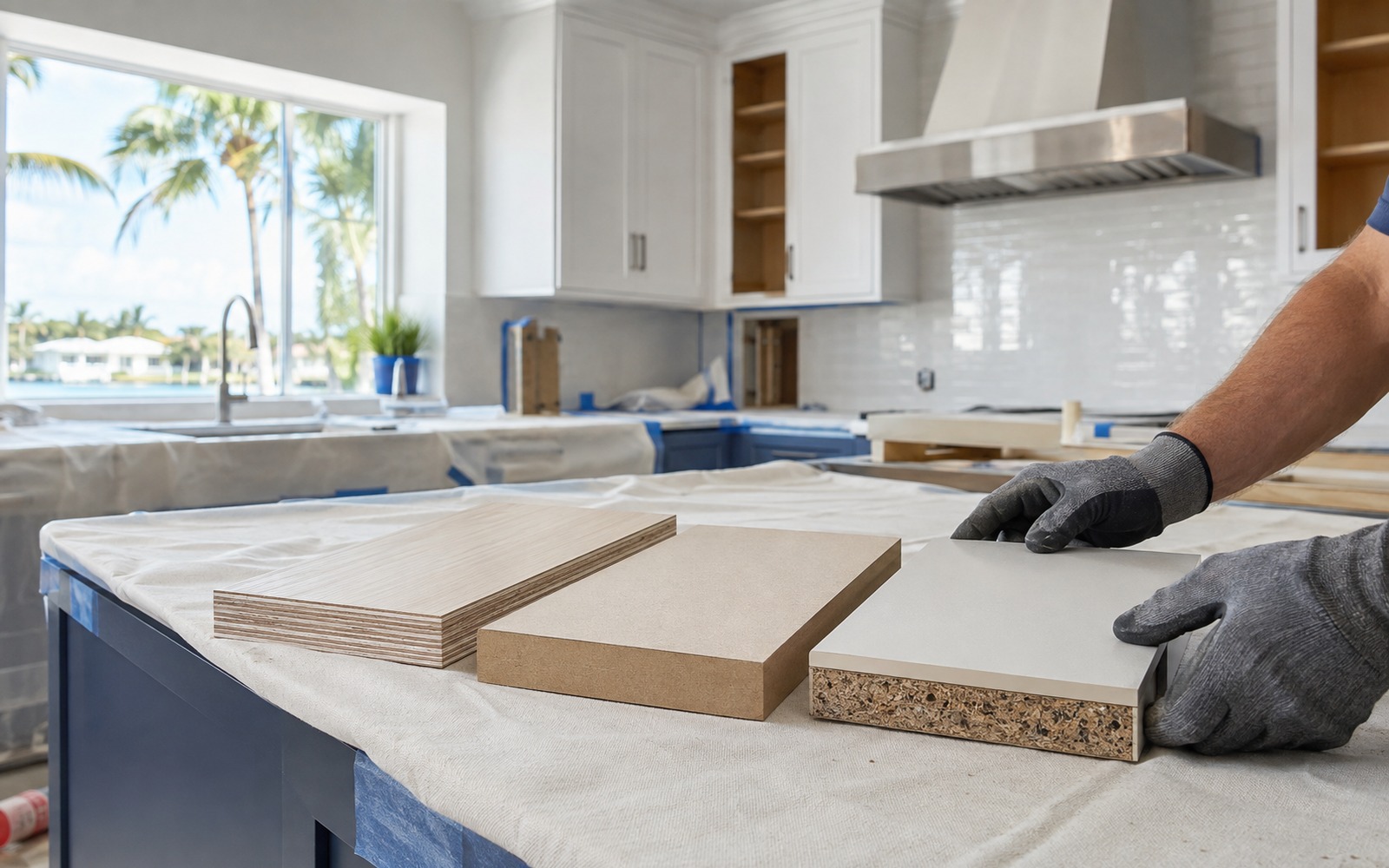
For many South Florida kitchen remodels, a well-built plywood cabinet box is a strong all-around choice where moisture resistance, fastener holding, and long service matter. MDF can be excellent for smooth painted doors, and quality particleboard can perform well when it is fully finished and kept dry. No cabinet material is waterproof. Panel grade, edge sealing, joinery, finish, ventilation, installation, and protection around sinks and appliances matter as much as the material name.
Choosing kitchen cabinets by door color alone can hide the decisions that determine how the kitchen performs. Two cabinets can look almost identical from the room yet use different box panels, door cores, edge treatments, backs, joinery, hardware, and finishes.
That distinction matters in South Florida. A kitchen may be air-conditioned most of the day while warm, moisture-laden outdoor air enters through doors, windows, construction openings, or ventilation. Cooking adds localized moisture. Sinks, dishwashers, refrigerators, plumbing connections, and exterior walls add their own risks. The goal is not to find a magically “humidity-proof” cabinet. It is to select a complete cabinet system that fits the room, budget, design, and realistic moisture exposure.
This guide compares plywood, medium-density fiberboard (MDF), particleboard, and solid wood; explains what product labels do and do not tell you; and gives homeowners a practical pre-order checklist for a South Florida kitchen remodel.
What is the best cabinet material for a humid South Florida kitchen?
There is no single best material for every component. A practical high-performance specification often combines materials rather than choosing one for the entire kitchen:
- Plywood boxes are a strong default when durability, screw holding, and better tolerance of short-term moisture exposure are priorities.
- MDF doors or panels can provide a smooth, stable surface for painted finishes when edges and cutouts are properly sealed.
- Quality furniture-grade particleboard can be a reasonable value choice for cabinet boxes when surfaces and edges are fully finished, the installation is kept dry, and plumbing risk is managed.
- Solid wood is most commonly useful for face frames, doors, drawer fronts, and trim rather than every cabinet-box panel.
The most important qualification is simple: none of these wood-based products should be expected to survive a continuing leak or standing water without damage. A cabinet selection should be evaluated as a system—panel, finish, edge banding, joinery, hardware, installation, ventilation, and water-risk details—not by the panel name alone.
Why humidity changes the cabinet decision
Wood and wood-based panels exchange moisture with the surrounding air. The USDA Forest Products Laboratory Wood Handbook explains that wood moisture tends toward equilibrium with surrounding relative humidity. As moisture content changes, wood and wood products can change dimension. Coatings slow moisture movement, but they do not eliminate it.
For a finished kitchen, that can show up as door movement, joint lines, finish stress, edge swelling, or hardware misalignment when products are poorly manufactured, stored, installed, or maintained. Daily humidity changes are not automatically a failure event. The larger risks are prolonged dampness, unsealed edges, repeated wetting, direct leaks, condensation, and products installed before the room and materials are conditioned.
The U.S. EPA homeowner moisture guide recommends keeping indoor relative humidity below 60 percent when possible, ideally between 30 and 50 percent. That guidance is not a cabinet warranty; it is a useful reminder that moisture control protects building materials and helps limit conditions that support indoor mold growth.
In a South Florida remodel, ask how the cabinet package and the room will handle:
- humid outdoor air entering the conditioned space;
- cooking steam and heat near upper cabinets;
- a sink-base leak or slow supply-line drip;
- dishwasher and refrigerator connections;
- condensation near cold plumbing or ductwork;
- exterior-wall and window exposure; and
- material storage during demolition and construction.
Plywood cabinet boxes: strengths and limits
Cabinet-grade plywood is built from thin wood veneers bonded in alternating directions. That layered construction gives the panel useful strength and dimensional stability. Plywood edges show the veneer layers, so exposed edges normally need finishing or edge treatment.
Where plywood is strong
Plywood is often selected for cabinet boxes because it can provide good stiffness and screw holding for hinges, drawer hardware, shelves, and joinery. It generally tolerates brief moisture exposure better than standard MDF or particleboard, especially when faces and edges are properly finished. It can also be useful in wide cabinet spans or heavily used kitchens where box rigidity is important.
What plywood does not guarantee
The word “plywood” does not define veneer quality, thickness, number of plies, core voids, adhesive, face grade, or finish. A poorly made plywood cabinet is not automatically better than a well-engineered composite cabinet. Plywood can warp, stain, delaminate, or support biological growth when it remains wet. Raw edges, sink cutouts, penetrations, and damaged finishes are still vulnerable.
When comparing plywood cabinets, ask for the actual box specification rather than accepting a broad label. Confirm panel thickness, back construction, shelf thickness, joinery, exposed-edge treatment, finish, and whether the sample matches the ordered product.
MDF cabinet doors: strengths and limits
Medium-density fiberboard is made from refined wood fibers combined with resin and formed into a dense, uniform panel. Its consistent surface makes it popular for painted cabinet doors, especially profiles where a smooth finish matters.
Where MDF is strong
MDF does not have natural grain direction, knots, or the same seasonal movement pattern as a solid-wood frame. A properly manufactured and finished MDF door can provide a smooth painted appearance with crisp profiles and consistent panels. It can be a practical choice for painted slab doors, center panels, decorative end panels, and other finish-critical parts.
Where MDF needs protection
Standard MDF can absorb water quickly at raw edges, machining cuts, damaged finish areas, and hardware penetrations. When it takes on water, it may swell and lose its original shape. “Moisture-resistant MDF” is a product category, not a promise that the panel is waterproof. Confirm the manufacturer’s intended use, finish system, edge treatment, and warranty conditions.
MDF can work well in a South Florida kitchen when it is used in the right location and kept protected. It is less forgiving where a sink-base floor, dishwasher edge, or recurring plumbing exposure is likely to get wet.
Particleboard cabinet boxes: strengths and limits
Particleboard is made from wood particles bonded into a panel. Furniture-grade particleboard is commonly covered with laminate, melamine, wood veneer, or another finished surface. It is generally flat, consistent, and cost-effective, which is why it appears in many factory cabinet systems.
Where particleboard can make sense
A quality particleboard cabinet can provide good value when the panel density, thickness, joinery, edge banding, hardware, and finish are designed as a complete system. Factory machining can produce accurate, repeatable parts. A finished interior surface is easy to clean, and the cabinet may meet a tested performance standard regardless of the material used.
The KCMA A161.1 performance standard is intentionally material-neutral. It evaluates how factory-manufactured kitchen and vanity cabinets perform rather than requiring one box material. That is useful because construction quality cannot be judged from “plywood” or “particleboard” alone.
Where particleboard is vulnerable
Unsealed particleboard edges can swell when water gets past laminate, edge banding, seams, fastener holes, or damaged surfaces. A long sink leak or dishwasher connection failure can cause localized expansion and loss of strength. Repairs after swelling may be difficult because the panel does not return to its original thickness when it dries.
If particleboard is part of the cabinet package, pay close attention to edge banding, sink-base protection, plumbing penetrations, toe-kick exposure, back panels, joint construction, and the written water-damage exclusions in the warranty.
What about solid-wood cabinet doors?
Solid wood remains a popular choice for frames, doors, drawer fronts, and trim. It brings natural grain and can be refinished in ways that many factory films cannot. It also responds to changing moisture conditions. A well-designed solid-wood door allows controlled movement; a poor design or unstable indoor environment can contribute to warping, joint movement, or finish lines.
Species, grain orientation, drying, construction, finish, door width, and room conditions all affect performance. Solid wood is not automatically more moisture-resistant than a properly engineered panel. It simply behaves differently. For painted doors, MDF may produce a smoother, more uniform face. For stained doors, solid wood or veneered construction may better deliver the intended appearance.
The cabinet details that matter more than a material label
1. Edge sealing and edge banding
Panel faces are usually better protected than raw edges. Inspect door edges, shelf edges, sink and plumbing cutouts, back-panel seams, toe kicks, and any field modifications. Ask how cut edges created during installation will be sealed.
2. Sink-base protection
The sink cabinet is the highest-priority water-risk zone. A removable waterproof tray or liner with a raised edge can help contain a small leak long enough for discovery. It does not replace leak repair, but it can limit direct contact with the cabinet floor. Keep valves and connections accessible rather than burying them behind fixed panels.
3. Appliance connections and service access
Dishwasher supply and drain connections, refrigerator water lines, disposals, filters, and instant-hot systems should remain inspectable. A beautiful installation should not make the most likely leak points impossible to see or service.
4. Backs, joinery, and hardware anchoring
Compare full-height backs with thin hanging rails, shelf support, drawer construction, fastener placement, and how wall cabinets transfer load. Ask which panels receive hinge plates and drawer-slide screws. The complete assembly determines how the cabinet feels and performs.
5. Finish performance
A factory finish protects the visible surface from everyday cleaning, spills, heat, and moisture. Ask for cleaning instructions, repair guidance, and the manufacturer’s finish warranty. Avoid assuming that a thicker-looking finish is automatically better; testing and documented performance are more useful.
6. Kitchen ventilation
Cooking adds moisture, heat, odors, and pollutants. The U.S. Department of Energy ventilation guidance describes spot ventilation in kitchens as a way to remove moisture and odors at the source and advises that kitchen exhaust vent outdoors. The correct hood size, duct route, make-up air, and combustion-safety requirements depend on the appliance, house, and applicable code. Those details should be designed and verified rather than guessed from a decorative hood cover.
7. Delivery, storage, and acclimation
Cabinets should not sit unprotected in a wet garage, open construction area, or damp room. The building should be dry, enclosed, and reasonably conditioned before installation. Follow the cabinet manufacturer’s handling and environmental requirements; different products and finishes have different limits.
How should you compare cabinet quotes?
A useful cabinet proposal should make the construction visible. Ask each bidder to identify:
- box-side, top, bottom, shelf, and back materials and thicknesses;
- door and drawer-front construction;
- finish type and exposed-edge treatment;
- drawer-box material and bottom thickness;
- hinge and drawer-slide manufacturer or performance class;
- wall-cabinet attachment and load path;
- sink-base liner or tray options;
- field-cut sealing procedure;
- ventilation and appliance-clearance coordination;
- written warranty, water-damage exclusions, and care instructions;
- whether the displayed sample is the exact ordered construction; and
- any third-party cabinet performance certification.
This checklist makes prices easier to compare because it separates appearance from structure. A lower quote may use a different back, shelf, drawer, finish, or hardware system. A higher quote should explain the measurable differences rather than relying on vague words such as “premium.”
Is KCMA certification worth asking about?
The Kitchen Cabinet Manufacturers Association’s A161.1 program is a performance certification for factory-manufactured cabinets. The standard covers areas such as structural integrity, door and drawer operation, finish durability, heat exposure, and interior-surface water holdout. Certification does not make a cabinet waterproof, and it does not guarantee that a particular installation will avoid damage.
It is still a useful comparison question because it asks whether the cabinet system has been tested as an assembly. Verify that the exact product line—not merely the manufacturer’s name—carries the certification being represented. Site-built custom cabinetry may use other quality controls, so lack of KCMA certification does not automatically mean poor construction; it changes the evidence you should request.
What should happen before cabinets are ordered?
A durable cabinet decision starts with the room, not the catalog.
- Inspect for active plumbing leaks, staining, swelling, or damp materials.
- Confirm that prior water damage has been addressed and affected areas are dry.
- Document appliance specifications, utility locations, and ventilation routes.
- Decide which cabinet zones face the greatest water exposure.
- Confirm measurements after demolition when hidden conditions could change the plan.
- Coordinate permits and inspections that apply to plumbing, electrical, ventilation, walls, or other scope.
- Lock the cabinet construction and finish specification in writing before approving the order.
If the existing kitchen already shows a swollen sink base, recurring odor, bubbling finish, or water staining, do not cover the condition with new cabinetry. The source and affected materials should be evaluated first. RestoFlo offers leak detection and water-damage restoration when a remodeling project uncovers a moisture problem.
For the broader remodeling service, visit RestoFlo’s kitchen remodeling page. You can also review the guide to condo kitchen remodeling approvals and logistics when the property is part of an association.
A practical South Florida cabinet specification
For many homeowners, the most balanced package is not “everything plywood” or “everything MDF.” It may be plywood cabinet boxes, MDF painted doors, solid-wood frames or accents, and engineered drawer components—each selected for what it does best.
Whatever the combination, prioritize:
- a documented cabinet construction specification;
- finished faces and sealed vulnerable edges;
- strong joinery and appropriate hardware anchoring;
- a protected, accessible sink base;
- inspectable appliance and plumbing connections;
- outdoor-ducted kitchen ventilation designed for the actual appliance;
- dry, conditioned storage and installation; and
- clear manufacturer care and warranty requirements.
That approach is more reliable than choosing cabinets from one material buzzword. It also gives the homeowner, designer, installer, and trades a shared checklist before the order becomes nonreturnable.
When to call RestoFlo
Planning a kitchen remodel in South Florida? RestoFlo can help evaluate the remodeling scope and identify moisture-related conditions that should be addressed before finishes are installed.
Call (754) 289-4815 or request a free assessment through RestoFlo.com. If you already see staining, swelling, or dampness near a sink, appliance, wall, or floor, mention those symptoms so the assessment can focus on the source as well as the visible finish.
Frequently Asked Questions
1. Is plywood always better than MDF for kitchen cabinets?
No. Plywood is often preferred for cabinet boxes because of stiffness, fastener holding, and better tolerance of brief moisture exposure. MDF can be an excellent choice for smooth painted doors and decorative panels. The best material depends on the component, product quality, finish, edge protection, installation, and expected exposure. A well-engineered mixed-material cabinet can outperform a poorly made all-plywood cabinet.
2. Can MDF cabinets work in South Florida humidity?
Yes, when the MDF is appropriate for the application, fully finished, properly installed, and kept away from continuing water exposure. MDF’s smooth surface is useful for painted doors, but raw edges and damaged finishes can absorb water and swell. Ask whether the product uses standard or moisture-resistant MDF, how edges and field cuts are sealed, and what the manufacturer’s warranty requires.
3. Is particleboard a bad cabinet material?
Not automatically. Furniture-grade particleboard can be flat, consistent, and cost-effective in a well-designed factory cabinet. Its performance depends on density, thickness, joinery, hardware, laminate or melamine coverage, edge banding, installation, and moisture protection. It is less forgiving when water reaches raw edges or seams, so sink, dishwasher, refrigerator, and plumbing details deserve extra attention.
4. Are any kitchen cabinets waterproof?
No wood-based cabinet should be treated as waterproof. Plywood, MDF, particleboard, solid wood, finishes, and edge banding can all be damaged by prolonged wetting or standing water. Moisture-resistant products can provide added tolerance, but leaks still need prompt correction. Protect vulnerable areas, keep connections accessible, and follow the manufacturer’s cleaning, environmental, and warranty requirements.
5. Should kitchen cabinet boxes and doors use the same material?
They do not have to. Different components benefit from different properties. Plywood may be selected for boxes, MDF for smooth painted doors, solid wood for frames or stained fronts, and engineered panels for shelves or drawer parts. Ask for a component-by-component schedule so the quote clearly states what material is used where, at what thickness, and with which finish and edge treatment.
6. What should I inspect before approving a cabinet order?
Confirm the exact box, back, shelf, drawer, door, finish, edge, hardware, sink-base, and installation specifications. Verify appliance dimensions, plumbing and electrical locations, ventilation, access, applicable approvals or permits, and manufacturer care requirements. Make sure active leaks or damp materials are addressed before installation. Ask whether the exact product line has a third-party cabinet performance certification and obtain the warranty in writing.
Sources