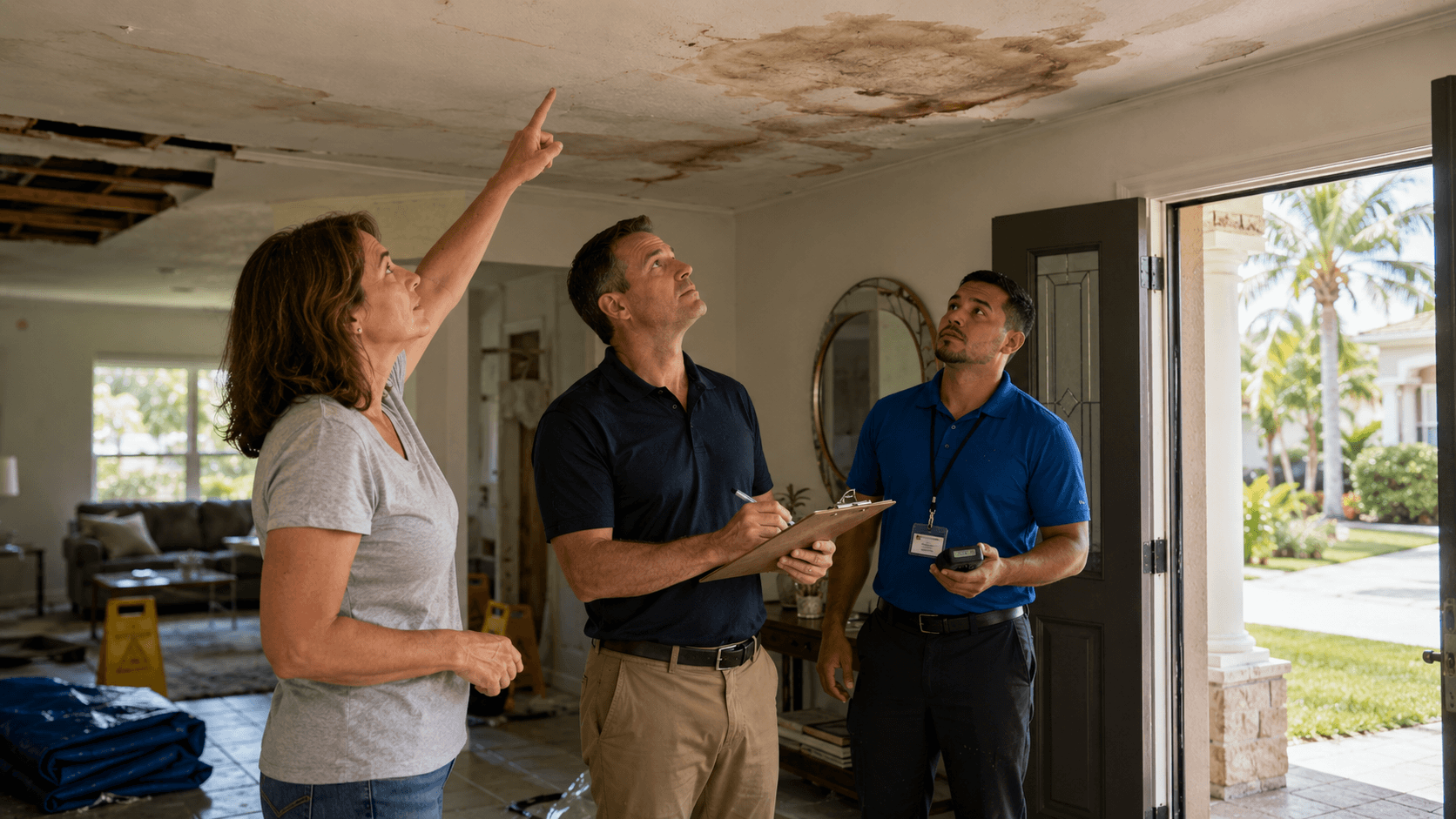
After a water event, fire, hurricane, or other covered loss, the insurance adjuster's visit is the most consequential single hour in your claim. What the adjuster sees, hears, and notes during that visit largely determines what the carrier pays for. A prepared homeowner with documentation, a clear damage walkthrough, and a restoration company on site for the visit often receives 30–50% more than an unprepared homeowner with the same actual damage.
This guide is for Miami, Fort Lauderdale, Boca Raton, and Palm Beach homeowners about to have an adjuster visit. It covers what to do in the hours and days leading up to the visit, what to point out during the walkthrough, what to never say, and how to position the claim for the best outcome.
What an adjuster actually does
The adjuster's job is to verify that a covered loss occurred, estimate the scope and value of damage, recommend a settlement amount, and negotiate (sometimes) with the homeowner or their representative. The adjuster works for the insurance carrier, not for the homeowner. Their incentive structure is to settle claims accurately — which often means efficiently. A homeowner who doesn't point out hidden damage often doesn't get paid for it.
Preparing for the visit
1. Document everything before any cleanup. Photos and video of every affected area. Wide shots, medium shots, close-ups. Date/time stamps. Save to multiple locations. 2. Make a damage inventory. Room, item, damage, estimated cost. 3. Save receipts for everything. Tarps, plywood, hotel stays, contractor work. Carriers reimburse mitigation under the "reasonable steps" requirement. 4. Get a restoration company involved. Have them walk through with the adjuster. 5. Know your policy. Coverage limits, deductible, mold endorsement, contents coverage, ALE. 6. Have the claim number ready. 7. Schedule the visit when you can be present.
What to point out during the walkthrough
The adjuster will note obvious damage but sometimes misses hidden damage. Point out: all affected rooms; ceilings, walls, floors in every room; behind furniture and inside cabinets; HVAC vents and registers; closets; the attic if relevant; pool area if damaged; outbuildings (covered under "other structures"); damaged contents.
Specifically mention: "Water came through here during the storm," "This was wet for X hours before we tarped," "Mold could be hidden here," "This is what we've moved temporarily."
What to never say
Insurance adjusters take notes. Don't say: "I didn't notice this leak for a while" (implies gradual damage, often excluded); "This stain was here before the storm" (eliminates the storm as the cause); "I think I can fix this myself" (reduces scope); "I might just throw this out"; "I was going to remodel anyway" (implies pre-existing); "I'm not sure if this was caused by the storm or just old"; "My buddy's going to do the repair for free".
Do say: "This is what we observed when we first inspected after the storm," "We've documented this and have photos," "Our restoration company can provide additional documentation," "Can you walk me through what's covered and what isn't?"
What documentation to have ready
Time-stamped photos of damage before any cleanup; time-stamped photos of mitigation steps taken; receipts for mitigation supplies; list of damaged contents with estimated values; photos of contents before disposal; pre-loss inventory if available; receipts for valuable items; receipts for any contractor work already done; estimates from restoration company; insurance card or policy summary; claim number; notes from prior carrier phone calls.
The restoration company's role
Having a restoration company on site for the adjuster visit is one of the highest-leverage moves a homeowner can make. They speak the same technical language as the adjuster, document scope items the adjuster might miss, provide written estimates that establish baseline pricing, negotiate scope details directly with the adjuster, identify hidden damage, and document the full extent of work needed.
After the walkthrough
Get a written estimate from the carrier within 1–2 weeks. Compare to the restoration company's estimate. Negotiate if scope is incomplete. Accept once both sides agree. Restoration work proceeds. Document changes during work and submit supplemental claims for hidden damage discovered during demo. Final payment at completion.
When the adjuster's scope is wrong
Request a meeting to discuss specific items. Provide additional documentation. Request reconsideration in writing. Request a re-inspection with a different adjuster. As a last resort: public adjuster (works for the homeowner, typically 10–15% of settlement) or property insurance attorney (typically contingency).
Common adjuster scenarios
Quick settle offer: often inadequate scope — verify with a restoration professional first. Partial denial: get written reason, decide whether to appeal. "We'll handle it from here": they want to manage your contractor selection — you have the right to choose your own. Cash settlement: sometimes appropriate for small claims; for larger ones, document actual repair scope first. Adjuster delays: document in writing — Florida law has timelines.
Insurance considerations
Florida law on adjuster visits and claims: carrier has 14 days to acknowledge a claim, 90 days to investigate and pay. Homeowner has the right to choose their own restoration contractor. Carrier cannot dictate who does the work. Carrier must provide written denial reasons. Public adjusters and attorneys are legal options for disputes.
When to call RestoFlo
If you have a pending or open insurance claim in South Florida and want a restoration company on site for the adjuster visit, call us. We document everything, walk through with the adjuster, provide written estimates that establish full scope, and work directly under your direction (no AOBs). We stay with the project through reconstruction. 24/7 emergency line: (754) 289-4815.