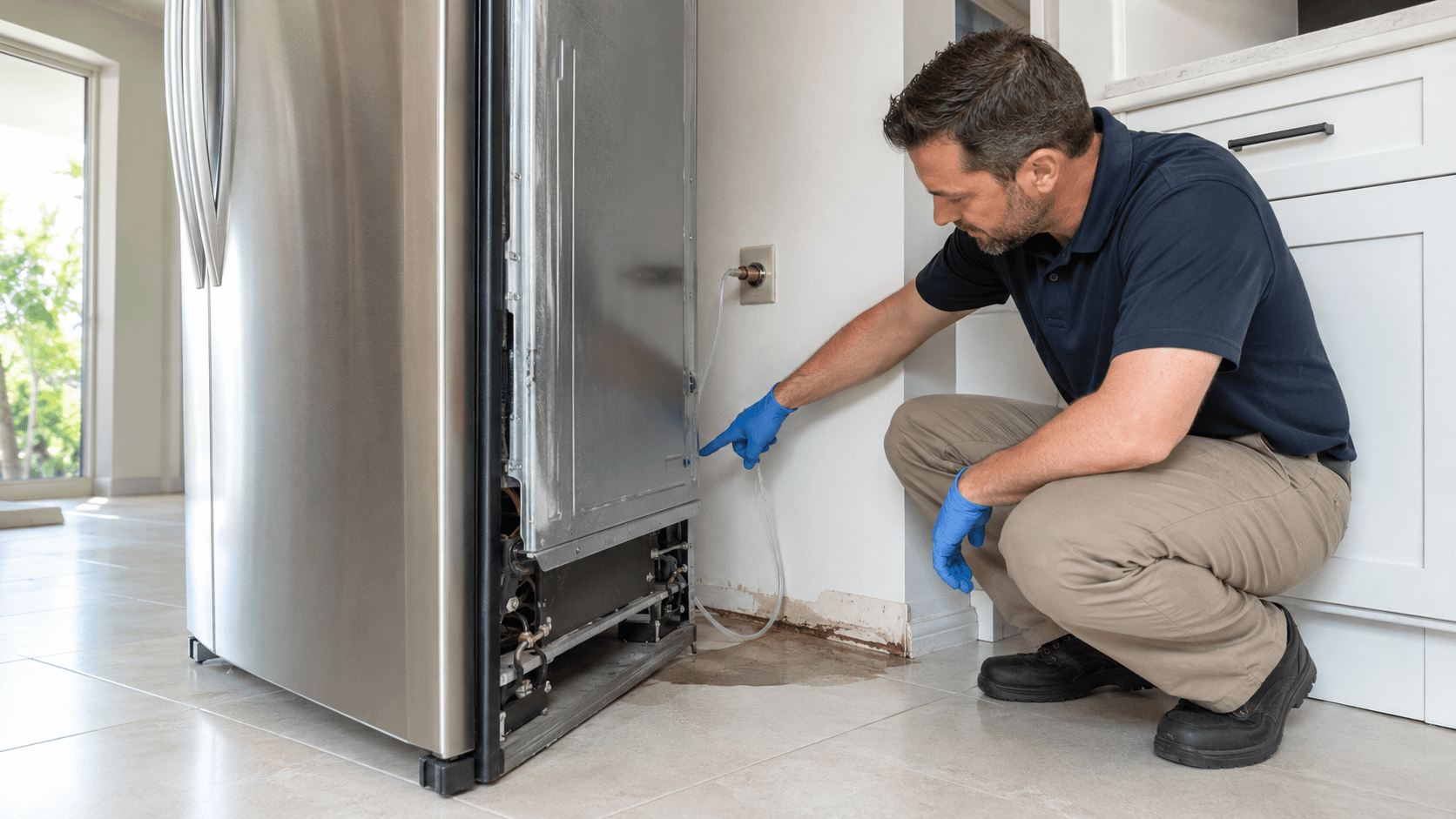
The 1/4-inch plastic water line running from your kitchen wall to the back of your refrigerator for the ice maker is one of the most reliable sources of catastrophic water damage in South Florida homes. Homeowners rarely think about it — until it fails.
When it fails, it fails badly. The line runs 24/7 under 40–80 psi of water pressure. It's routed behind the refrigerator where nothing is visible. When it develops a slow leak or bursts, water flows behind the fridge, into the subfloor and cabinet framing, and often across the kitchen floor. By the time it's discovered — sometimes days later after a return from vacation or weekend away — the damage is significant.
This guide is for Miami, Fort Lauderdale, Boca Raton, and Palm Beach homeowners understanding the ice maker line as a leak source, how to prevent it, and what to do if it fails.
Why ice maker lines fail
Plastic degradation over time: standard 1/4-inch plastic tubing (typically polyethylene) becomes brittle with age. UV exposure, heat cycles from the compressor, and simple age reduce flexibility. Older lines (10+ years) are much more failure-prone. Sharp bends and kinks: any place the tubing was bent tightly during installation becomes a stress point. Fitting failures: where the tubing connects to the shutoff valve and to the refrigerator, threaded or compression fittings can loosen or leak over time. Refrigerator movement: every time the refrigerator is pulled out for cleaning, the tubing gets stressed. Freezing damage: even in South Florida, an unheated garage refrigerator can freeze during a cold snap, cracking the line. Physical damage: objects placed behind the refrigerator can pinch or damage the tubing. Water quality: hard water and mineral buildup can crack or weaken plastic tubing joints over time.
The 6 warning signs
1. Water visible behind the refrigerator when pulling it out. 2. Ice production issues (less ice, slower, or crushed rather than cube). 3. Warped flooring in front of or beside the refrigerator. 4. Musty smell coming from behind the refrigerator. 5. Unexplained water bill increase — a slow ice maker line leak can add 5–20%. 6. Visible moisture at the shutoff valve under the sink or wherever the ice maker line originates.
The 5-step inspection
Every 6 months: Pull the refrigerator forward slowly and carefully. Look behind and under for moisture, staining, or damage to the tubing. Inspect the tubing along its full length from shutoff to refrigerator connection. Check for kinks, damage, discoloration. Check both fittings where the tubing connects at each end for moisture, mineral deposits, or looseness. Look at the flooring on both sides of the refrigerator and in front for warping, discoloration, or soft spots.
If tubing looks marginal or is 10+ years old, replace it preemptively.
The 3 best preventive fixes
1. Replace plastic tubing with braided stainless steel or reinforced polyethylene. More resistant to kinks and physical damage. Roughly $30–$50 for a 6-foot line. Under 30 minutes to install. 2. Install a leak sensor behind the refrigerator. WiFi-enabled sensors alert your phone within seconds of moisture detection. $30–$50 per sensor. Places behind refrigerator, next to shutoff valve, and under sink. 3. Install a smart shutoff valve on the ice maker feed. Small automatic valve that closes when a sensor detects leak. $100–$200. Prevents any leak from becoming a flood.
What happens when the line fails
Slow leak (5–10 drops per minute): water accumulates behind fridge; slowly saturates the subfloor and cabinet base; cabinet base rots after 2–4 weeks; mold develops in subfloor after 3–5 days in South Florida humidity; flooring warps or swells; discovery when kitchen floor becomes visibly damaged.
Fast leak (fitting failure or line burst): water sprays or flows continuously; behind fridge, then across kitchen floor; discovery within hours (visible flooding); damage to cabinet base, subfloor, kitchen flooring, adjacent walls.
Undiscovered vacation leak: family away for a week; line fails on day 3; 4 days of continuous water flow; return to a flooded kitchen and living room; $30,000–$75,000 damage typical.
First response if you discover a leak
Turn off the water at the ice maker shutoff valve immediately. If the ice maker shutoff isn't accessible, close the main water supply to the house. Move the refrigerator carefully forward enough to see the water source and stop the flow. Photograph everything BEFORE you start cleaning. This is your insurance documentation. Remove standing water with towels and a wet vac. Move the refrigerator out and begin exposing the wet floor. Call a restoration company for professional drying if the leak was more than a few minutes. Do NOT try to dry it yourself if the leak lasted hours or days. Hidden moisture in subfloor and cabinet framing will cause mold if not properly addressed.
The kitchen restoration scope
Contents scope: refrigerator contents assessment (may need to be discarded if warm too long); under-sink and lower-cabinet contents evaluation. Structure scope: cabinet base — often unsalvageable, needs replacement; cabinet interior boxes — often need drying and rebuilding; flooring — may need to be pulled up for drying, sometimes replacement; subfloor — dry-in-place if possible, replace if compromised; drywall behind cabinets — replacement often required; insulation in walls behind cabinets — replacement if wet. Rebuild scope: cabinet base replacement or refacing; new flooring; fresh paint on adjacent surfaces; refrigerator re-installation with new water line.
Cost range: $8,000 (minor slow leak, quick discovery) to $75,000+ (major vacation-length undiscovered leak).
Insurance considerations
Sudden failure (line burst, fitting failure): damage typically covered under Florida homeowners policies. The line and refrigerator repair typically not covered (maintenance category). Slow, gradual leak (14+ days): damage often excluded under gradual damage clauses. Homeowner may pay out of pocket. Documentation matters: photos of pre-leak conditions; records of when the leak was first noticed; prompt action to mitigate (photos of towels, shutoff, restoration call).
The best preventive investment
Combined system: $200–$300 for a WiFi leak sensor + auto-shutoff valve. Sensor detects moisture at the first drop. Auto-shutoff closes the ice maker feed immediately. Alert to your phone in seconds. This system prevents 90%+ of ice maker line disasters and typically pays for itself the first time it activates.
When to call RestoFlo
If your ice maker line has leaked in your South Florida kitchen and caused water damage to cabinets, flooring, or adjacent structures, call us. We arrive 24/7, extract water and dry the affected area with commercial equipment, address any mold, coordinate with cabinet and flooring contractors on rebuild, and work with your insurance carrier on the claim. 24/7 emergency line: (754) 289-4815.