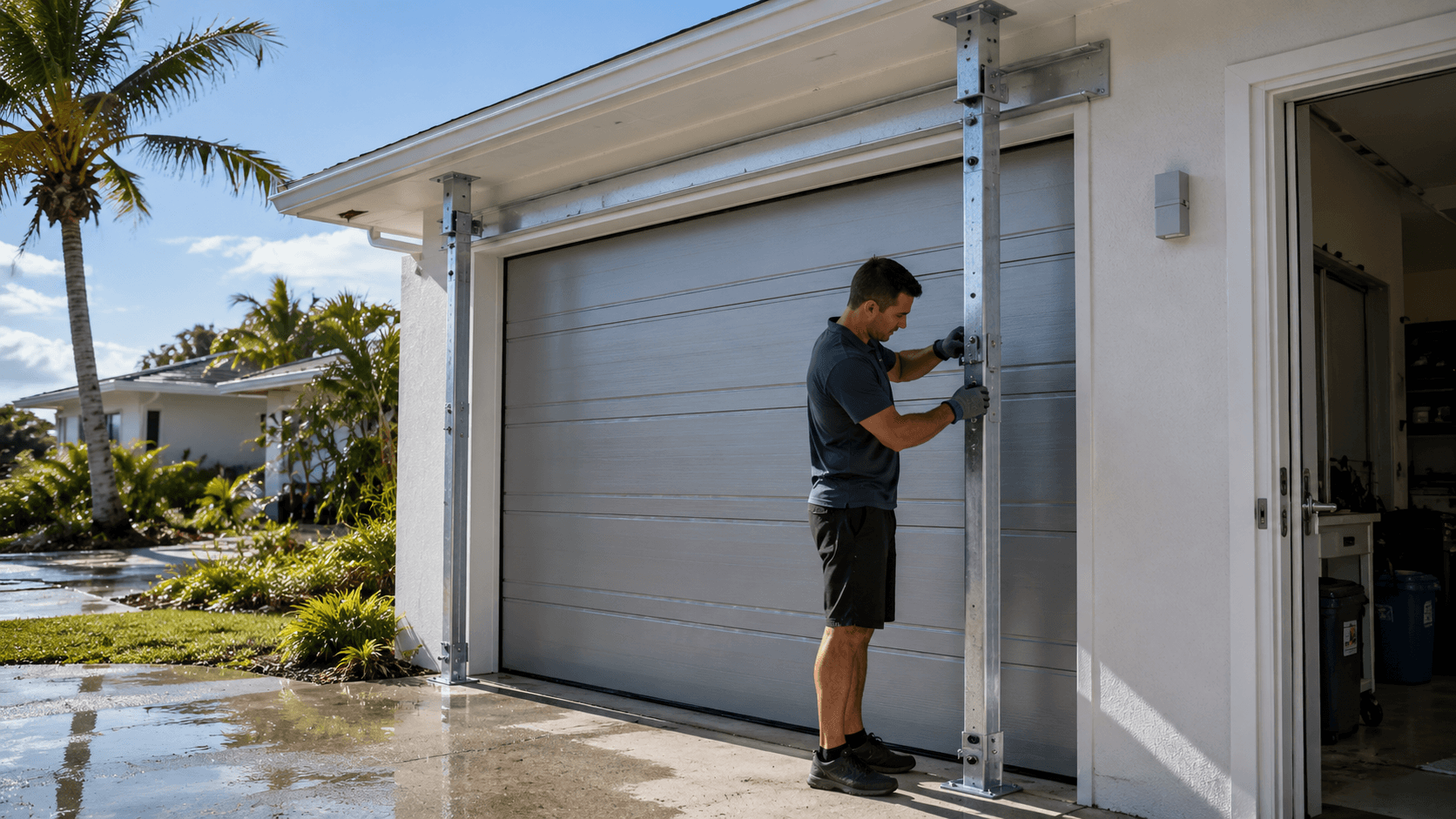
When a South Florida home suffers catastrophic hurricane damage — roof torn off, walls collapsed, total loss — the failure almost always starts in one place: the garage door. Engineers studying post-hurricane damage repeatedly find that homes lose roofs and walls because the garage door blew in first, allowing the hurricane's wind pressure to enter the home, lift the roof from below, and tear the structure apart from the inside.
The garage door is the weakest point of the building envelope in most homes. It's the largest opening. It often has the weakest reinforcement. And the wind loads it has to resist are enormous. When it fails, everything downstream of it tends to fail too.
This guide is for Miami, Fort Lauderdale, Boca Raton, and Palm Beach homeowners who want to understand why garage doors fail in hurricanes, how to prevent it, what to do if it happens, and the restoration scope that follows.
Why garage doors fail first
Three factors make garage doors the weakest hurricane point. Size: a typical two-car garage door is 16 feet wide by 7 feet tall — 112 square feet of pressure-loaded surface. A 130 mph wind exerts about 35 pounds per square foot of pressure. That's a 4,000-pound load trying to push the door inward. Construction: most pre-2002 South Florida garage doors are non-impact-rated. Thin metal or wood panels, light tracks, and weak hinges. Single failure point: once the door fails, the entire opening is exposed.
When the garage door fails in a hurricane: wind enters the home through the garage at full velocity, pressure builds inside the attached structure, the roof experiences pressure from below in addition to wind from above, the roof lifts off, walls separate from the foundation, catastrophic loss follows.
The 4 categories of garage door protection
1. Original non-impact door, no bracing. The default for many older South Florida homes. Worst protection. High failure rate.
2. Original non-impact door + temporary bracing. A bracing kit reinforces the existing door before a storm. Modest improvement at low cost.
3. Impact-rated replacement door (Florida product approval). Cost: $1,200–$3,500 for single-car or $2,500–$6,000 for double-car installed. Significantly stronger than original. Required for new construction in HVHZ.
4. Impact-rated door + interior bracing. Maximum protection. Used for direct-impact storm zones.
Bracing kits: how they work
A garage door bracing kit (Secure Door, Garage Door Brace, similar) consists of vertical steel posts that span from the garage slab to the header above the door, brackets that anchor to the door at the center and to the slab below, and a locking mechanism that allows the posts to be removed for normal use.
A typical kit is $300–$600 and takes 1–2 hours to install the anchor sleeves and 10–15 minutes per storm to deploy. Most kits work on standard 8' or 9' tall doors. This is one of the highest-leverage hurricane preparedness investments available.
The 6 signs your garage door is at risk
1. The door is more than 15 years old with no impact rating. 2. The door has visible damage — dents, separation between panels, rust, or loose hardware. 3. The hinges or track are loose when the door is operated. 4. No FBC product approval sticker anywhere on the door. 5. The tracks or rollers show wear. 6. There's visible daylight around the door perimeter when closed.
Any of these warrant either bracing or replacement before storm season.
The decision: brace, replace, or upgrade
Brace ($300–$600): right for budget-constrained homeowners with an older door that's still structurally sound. Replace with impact-rated ($1,200–$6,000 installed): right for homeowners planning to keep the home long-term. Solves the problem permanently. Adds insurance discount. Replace with impact-rated + bracing ($2,000–$8,000+): right for high-risk coastal homes or HVHZ owners wanting maximum protection.
For most South Florida homeowners with non-impact doors, impact-rated replacement makes the most sense given the catastrophic downside of failure.
What happens when the door fails
Immediate: wind enters the garage, pressure builds, garage contents become projectiles. Within minutes: the interior door between garage and home usually fails next, letting wind into the living space. Within hours: roof damage, wall damage, contents damage throughout the structure. Days after: massive water intrusion, mold growth, structural compromise.
The restoration scope for a hurricane-caused garage door failure can easily run $50K–$300K+, depending on the cascade of damage. A $4,000 impact-rated replacement door is the highest ROI hurricane prep investment a homeowner can make in most cases.
After the failure: what to do
Stay clear of the area until the storm passes and the wind subsides. Once safe, assess from a distance — look for downed power lines, structural damage, falling debris. Photograph everything for insurance before any cleanup. Mitigate further damage — tarp roof breaches, board up the garage opening with plywood, move contents to dry areas. Call your insurance carrier immediately. Get a restoration company on site fast — the 48-hour mold window is real. Plan for impact-rated replacement going forward.
Insurance considerations
Florida homeowners insurance on hurricane garage door damage: damage to the garage door from a covered storm is typically covered; resulting structural damage to roof, walls, and contents from garage door failure is typically covered; mold from the resulting water intrusion capped at the mold endorsement; impact-rated replacement typically covered up to the equivalent of the original door's value (upgrades often partially homeowner-funded); wind mitigation discount for impact-rated installation reduces premiums going forward.
When to call RestoFlo
If your South Florida home had hurricane-related garage door failure that caused structural or interior damage, call us. We respond 24/7, document everything for your insurance carrier, mitigate immediately to prevent mold, and coordinate with garage door professionals for impact-rated replacement. 24/7 emergency line: (754) 289-4815.