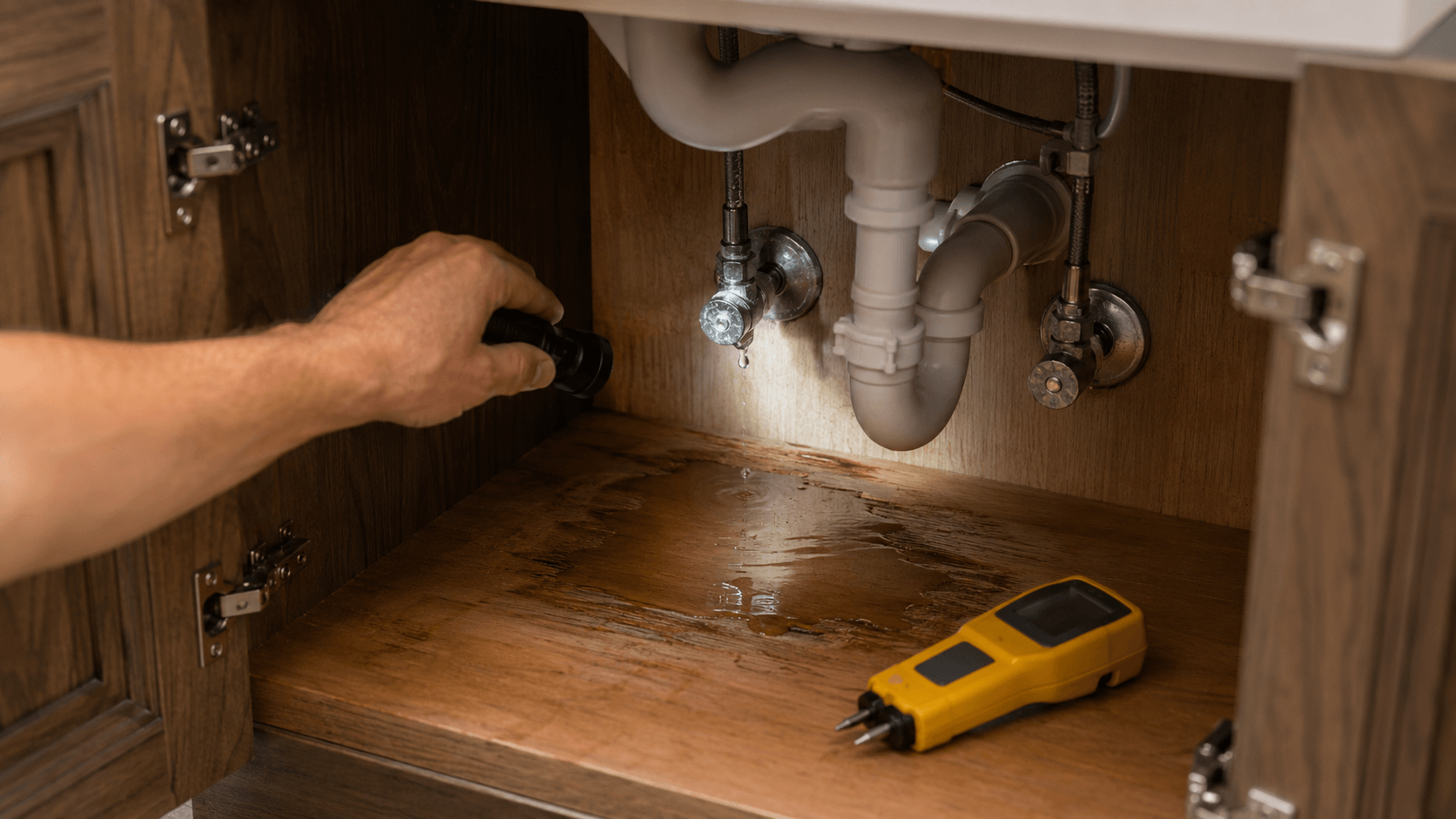
The most damaging water leaks in a South Florida home aren't the dramatic burst pipe events. They're the slow ones. A shower pan that leaks a few ounces per use over five years. A tub caulk joint that weeps into the wall. A toilet supply line that drips 15 drops per minute for months. By the time visible damage appears, the underlying structure is often catastrophically compromised.
Bathroom leaks are also the leaks most often not covered by insurance. When damage is classified as gradual — the standard language is "continuous or repeated seepage or leakage over a period of 14 days or more" — the claim is denied. Homeowners are left paying for the structural repair, mold remediation, and rebuild themselves.
This guide is for Miami, Fort Lauderdale, Boca Raton, and Palm Beach homeowners diagnosing slow bathroom leaks before they become five-figure restoration projects.
The 10 places bathroom leaks originate
1. Shower pan: the pan under the shower floor cracks or fails at joints. 2. Shower valve: behind-the-wall shower valve connections drip slowly. 3. Tub overflow: the overflow drain is often weakly sealed. 4. Tub drain seal: the gasket between the tub drain and shoe assembly can dry out. 5. Toilet wax ring: dries out or shifts, letting water and sewage past. 6. Toilet tank bolts: gaskets between tank and bowl leak. 7. Toilet supply line: the braided line from wall to tank fails at either end. 8. Sink supply lines: under-vanity supply lines fail slowly, especially older ones. 9. Sink drain slip joints: loosen and leak. 10. Caulking failures: around tubs, shower doors, sinks, vanities.
The 12 warning signs of a hidden leak
1. Higher-than-expected water bill (20%+ jump with no lifestyle change). 2. Water meter movement with all taps closed. Check at 10 PM when everyone is asleep. 3. Musty smell in the bathroom that doesn't go away with cleaning. 4. Warped baseboards near the tub or shower. 5. Discolored grout or caulk. 6. Loose tiles on the floor or wall near water sources. 7. Sagging or soft spots in the flooring near the toilet or under the sink. 8. Peeling paint on ceilings below a bathroom. 9. Ceiling stains below a bathroom on a two-story home. 10. Rust or mineral deposits on undersink piping. 11. Puddles or moisture in undersink cabinets. 12. Toilet that rocks slightly when you sit on it (wax ring likely failing).
Two or more of these = investigate immediately.
The 6-step diagnostic checklist
1. Isolate. Turn off water to the specific fixture. Wait 24 hours. Does the moisture pattern change? 2. Meter test. Turn off ALL fixtures and appliances. Read the water meter. Wait 30 minutes. Any movement means there's a leak somewhere. 3. Toilet dye test. Add food coloring to the tank. Wait 30 minutes without flushing. If color appears in the bowl, the flapper leaks. 4. Sink undercounter inspection. Feel along all joints for moisture, staining, or mineral deposits. 5. Shower/tub visual inspection. Look at grout, caulk, and drain areas. Darker grout may be wet. 6. Ceiling inspection below. Walk under a second-floor bathroom and look for any discoloration or texture change.
If steps 1–6 don't localize the source, professional leak detection with acoustic tools or moisture meters is the next step.
Why bathroom leaks are worst in South Florida
Humidity: our high indoor humidity means damage progresses faster to mold. Mold begins within 48–72 hours of persistent moisture. Slab construction: most South Florida homes are on concrete slab. Water reaches the slab and either sits or moves through the slab to distant locations. Slab moisture is much harder to detect and dry. Cast iron drain age: older homes (pre-1985) with original cast iron drains can have slow drain leaks that supplement the fresh water leak, adding contamination. Tile flooring: water under tile has nowhere to go and no visible signs at the surface until damage is well-advanced.
When a leak becomes a Cat-3 issue
Any leak that reaches these states is treated as Cat-3 (sewage/contamination): toilet leak that includes any sewage (wax ring failure with water at base); drain line leak carrying any waste water; slow leak present more than 48 hours in high-humidity conditions where bacterial growth is likely; fresh water leak that entered contaminated subfloor, insulation, or wall cavities.
Cat-3 remediation is significantly more expensive than Cat-1 — requires containment, PPE, and typically materials removal rather than just drying.
The repair path when you find a leak
Step 1: Stop the water — fix the specific leak (replace wax ring, tighten supply lines, replace worn valves, re-caulk problem joints). Step 2: Dry the affected area — this is where a restoration company adds value. Detecting hidden moisture, drying subfloor and cavities without opening walls unnecessarily, using injection drying where appropriate. Step 3: Assess damage extent — moisture meters, thermal imaging. Step 4: Address damage (wet drywall = remove and replace; wet insulation = remove and replace; wet subfloor = often dryable, sometimes replacement; wet joists = drying + antimicrobial + reinspection; mold present = licensed remediation). Step 5: Rebuild. New flooring, tile, cabinets, fixtures as needed. Step 6: Address underlying moisture to prevent recurrence.
Cost expectations
Simple leak, no damage: $200–$800 plumbing repair. Leak + minor drywall/subfloor damage: $2,000–$8,000 restoration. Leak + significant subfloor, joist, and mold damage: $15,000–$50,000+ full restoration. Undetected long-running leak with structural rot: $50,000+ potentially. Catching leaks early saves 10–100x the cost of finding them after damage.
What insurance covers vs. doesn't
Typically covered: sudden burst pipe (dishwasher supply line burst, water heater burst); sudden fixture failure; damage from a sudden overflow event. Typically NOT covered: damage from a leak present for 14+ days (gradual damage exclusion); damage from failure to maintain; mold from a slow-leak source; slab leaks over time. Disputed: whether a homeowner "should have known"; the line between sudden and gradual. Documentation of prior clean inspections and dated repairs supports sudden-cause arguments.
Prevention: the 4 tasks that catch 80% of leaks early
Monthly meter check: read the water meter at bedtime. If it moves overnight when nothing is running, investigate. Annual under-sink inspection: every bathroom sink cabinet, look for stains, mineral deposits, dampness. Toilet dye test every 6 months: catches slow flapper leaks and wax ring issues. Caulk maintenance: re-caulk tub and shower joints every 3–5 years.
When to call RestoFlo
If you've found or suspect a hidden bathroom leak in your South Florida home with any structural or mold damage, call us. We do proper moisture assessment, contain and dry the affected area, coordinate with plumbers on the source repair, address mold under the IICRC S520 standard, and rebuild. 24/7 emergency line: (754) 289-4815.