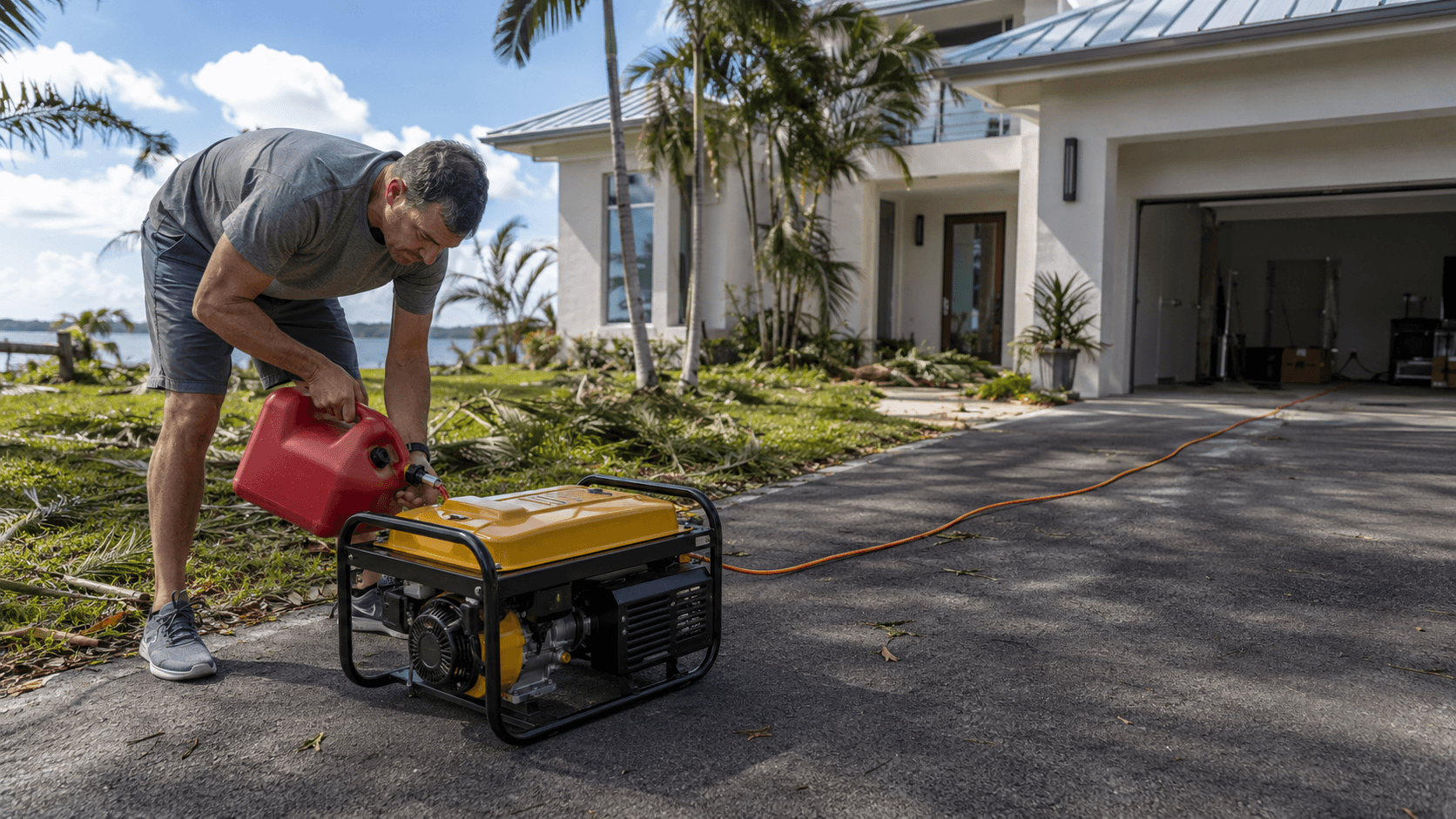
After every major hurricane that hits South Florida, the post-storm death toll keeps climbing for days. Most of the deaths aren't from the storm. They're from generators. Carbon monoxide poisoning from a generator placed too close to the house. Electrocution of a lineman from a generator backfeeding into the grid. House fires from improper fuel storage or running a generator inside a garage.
The Centers for Disease Control reported that after Hurricane Irma in 2017, more than 80% of Florida's post-storm fatalities involved generators. Hurricane Ian in 2022 produced a similar pattern. These deaths are nearly all preventable.
This guide is for Miami, Fort Lauderdale, Boca Raton, and Palm Beach homeowners who already own a portable or standby generator, or who are buying one before storm season. It covers the rules of CO safety, the wiring rules that keep linemen alive, the placement rules that protect your family, and the practical mistakes we see in restoration calls after the storm.
The CO problem: why generators kill silently
Generators run on internal combustion engines. They produce exhaust gases including carbon monoxide. CO is colorless and odorless (you don't smell or see it), heavier than air (sinks into low areas), lethal at low concentrations (800 ppm causes unconsciousness in under an hour), and accumulating (concentrations build up in enclosed spaces).
A single portable generator produces enough CO in one hour to fill an average home with lethal concentrations if placed indoors or in an attached garage. Open garage doors don't help — CO drifts back in through doorways and HVAC returns.
The 5 absolute rules of generator placement
1. Never run a generator inside a home, garage, basement, crawlspace, or any enclosed or partially enclosed space. Even with windows or doors open. Even with fans running. This is the rule that's killed the most people post-storm in South Florida.
2. Place the generator at least 20 feet from any door, window, or vent. The standard distance from the CDC and major manufacturers. Some recommend 25 feet for higher-output units.
3. Direct the exhaust away from the house. Generators have a clear exhaust outlet. Point it away from windows and doors.
4. Don't place under awnings, porches, or overhangs. These trap exhaust against the building. Open-air placement only.
5. Install CO detectors with battery backup on every level of the home. Especially near bedrooms. CO detectors save lives during generator use.
A common mistake we see: homeowner places generator on the back patio because it's covered. Within hours, CO migrates through the kitchen door, sliding glass door, or HVAC return. Family experiences headaches, confusion, nausea — and at higher exposure, loss of consciousness.
The backfeed problem: why generators kill linemen
A backfeeding generator sends power from your house back through the grid via your incoming service line. To a utility lineman working on what should be dead lines after a hurricane, this is lethal. The lineman is electrocuted because someone three blocks away didn't disconnect their generator from the grid before running it.
Two ways to prevent backfeed: install a properly licensed and permitted transfer switch — the right answer for any standby or larger portable generator. A licensed electrician installs a transfer switch (manual or automatic) at the main panel. The switch physically prevents the generator from feeding back to the grid while drawing from it. Cost: $500–$2,000 for parts plus $500–$1,500 for installation depending on permit and panel.
Or disconnect the main breaker before running a generator with extension cords. If you're using a portable generator with extension cords running into individual outlets, turn off the main breaker at the panel. Run extension cords directly from the generator to specific appliances. Don't plug the generator into a wall outlet (this is the backfeed path).
The single illegal practice that kills linemen: "suicide cords." A double-male extension cord with one end plugged into the generator and the other end into a wall outlet. This is illegal under Florida code, lethal to linemen, and a homeowner liability if it causes a death. Don't use one. Don't let anyone install one.
The 3 fuel storage rules
Use approved fuel containers. Red gas cans rated for the fuel. Don't use random plastic containers. Store fuel outside the home, away from ignition sources. A shed, a detached garage, or an outdoor cabinet rated for fuel storage. Never inside a home or attached garage. Fuel stabilizer is your friend. Add fuel stabilizer (Sta-Bil or equivalent) to stored gas. Properly stored stabilized gas lasts 12+ months. Without stabilizer, it goes bad in 2–3 months — which means it's worthless next storm season.
For propane and natural gas standby generators, supply is simpler — the gas line or propane tank handles supply. Verify your propane tank is full going into storm season.
Specific generator types and their rules
Portable gas generators (2,000–10,000 watts). Most common. Cheapest. Loudest. Highest CO risk because they're typically positioned closer to the house. Run them at least 20 feet from any door/window/vent. Use extension cords directly to specific appliances. Don't backfeed. Run for 4–8 hours, refuel, run again. Don't refuel a hot engine — let it cool 10–15 minutes.
Inverter generators. Quieter, more efficient, cleaner power. Better for sensitive electronics. Same 20-foot placement rule. Same fuel handling rules.
Standby generators (whole-home). Permanently installed on a concrete pad outside. Automatic transfer switch. Natural gas or propane fuel. Most expensive ($5K–$15K installed) but solves CO, backfeed, fuel, and convenience issues. Annual inspection required.
Solar with battery backup. Different category — zero CO, zero fuel. Useful for refrigerator, lights, communications. Limited capacity for AC. Significant up-front cost but no operating cost.
CO poisoning symptoms — when to act
If you or anyone in the home experiences during generator use: headache (the most common first symptom), dizziness, nausea or vomiting, confusion, shortness of breath, or loss of consciousness — get everyone outside immediately into fresh air. Call 911. Do not re-enter the home until ventilation has cleared. Do not assume "we're just tired from the storm." Carbon monoxide poisoning produces the same symptoms.
If a CO detector is alarming and you don't see immediate symptoms, ventilate the home immediately and shut down any combustion source. Get fresh air. The detector is your warning system — believe it.
Operating during storm conditions
Generators should not be run during the actual storm. High winds, wind-driven rain, and standing water all create electrical hazards. Wait for the storm to fully pass before starting the generator. Wait for any standing water around the generator pad to clear before starting.
Once the storm has passed: inspect the generator for debris, damage, or water in the housing; place it on level ground; 20+ feet from the home, exhaust pointed away; confirm CO detectors have working batteries; start it; run as needed; refuel only when cool.
When generator damage causes a restoration call
A few scenarios where generator use creates a restoration scope: fuel spill on a porch or in a garage — saturated wood or concrete becomes a fire and contamination hazard; generator overflow flooding from refueling; house fire from a generator placed too close to siding; CO contamination of HVAC system — after CO exposure, the home's air can be ventilated, but ducts, insulation, and contents have absorbed gases. Some restoration projects include HVAC and duct cleaning to remove residual CO and combustion byproducts.
Insurance considerations
Florida homeowners insurance on generator-related damage: damage from a sudden generator-caused fire is typically covered; CO-related medical or contents damage typically covered as resulting damage; maintenance issues with the generator itself are not covered; liability for a lineman injury or death from backfeed is a major risk. Personal liability coverage may not extend to electrical injuries caused by unpermitted electrical work.
Have a licensed electrician install a proper transfer switch with permit and inspection. That single step protects you legally and operationally.
When to call RestoFlo
If your South Florida home had a fire, fuel spill, or CO contamination event from generator use during or after a hurricane, call us. We document everything for your insurance carrier, mitigate, clean, and rebuild. 24/7 emergency line: (754) 289-4815.