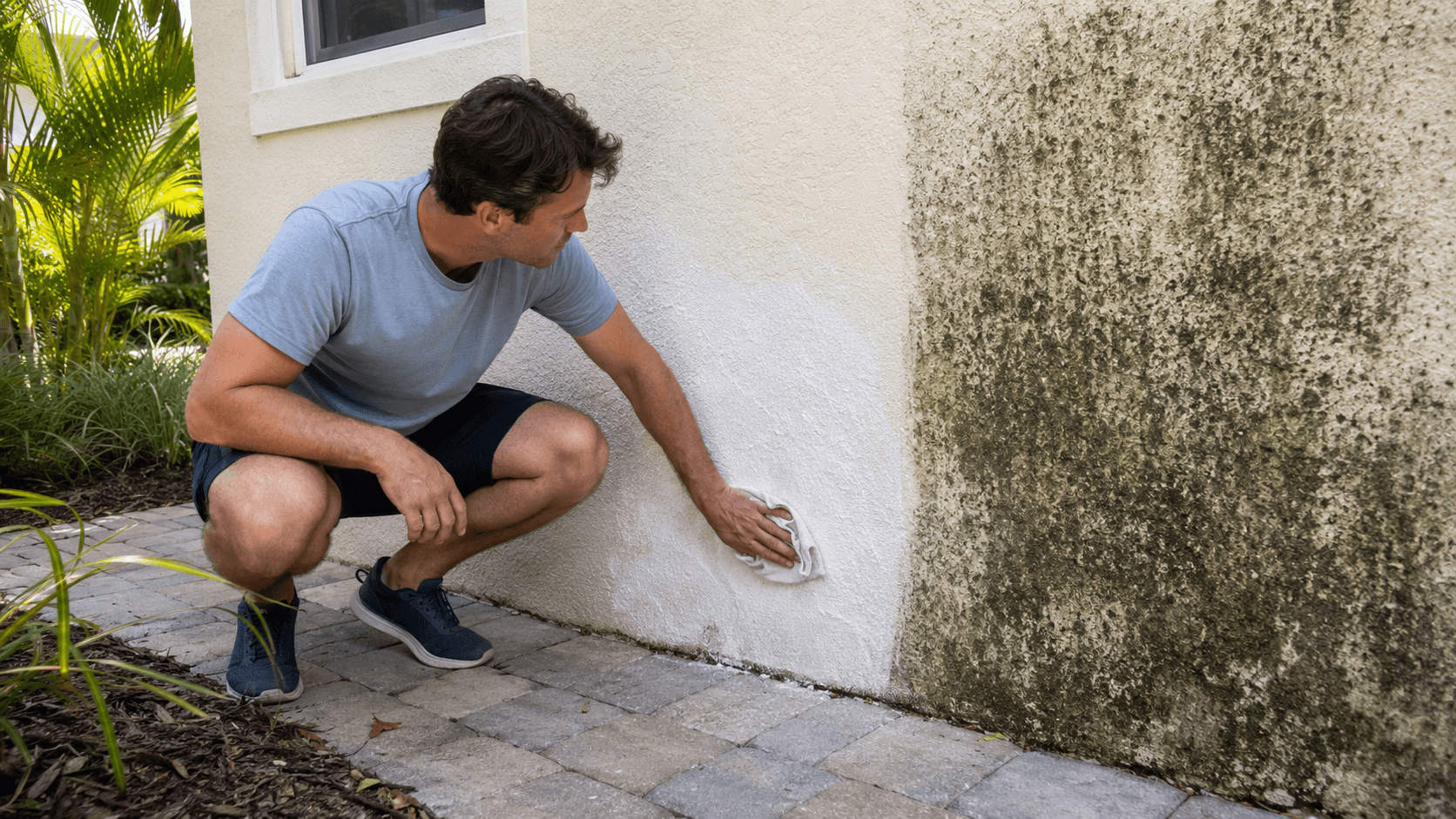
A homeowner in Miami notices a white powdery patch on the exterior stucco of their home. Or a fuzzy black spot on the interior stucco near a window. Their gut says mold. They panic, call a mold company, and start pricing remediation.
Sometimes it is mold. Sometimes it's efflorescence — a mineral deposit that looks similar but has completely different implications, costs, and remediation paths. Confusing the two is one of the most common — and most expensive — misdiagnoses in South Florida home maintenance.
This guide is for Miami, Fort Lauderdale, Boca Raton, and Palm Beach homeowners looking at a discoloration on stucco and trying to figure out what they're actually seeing.
What efflorescence actually is
Efflorescence is a mineral crystal deposit. When water moves through porous masonry (concrete block, stucco, brick, mortar), it dissolves calcium hydroxide and other minerals inside the material. When the water reaches the surface and evaporates, the minerals precipitate out as a white powdery or crystalline residue.
Key characteristics: white, cream, or occasionally colored crystalline powder; sits on the surface, wipes or brushes off (though it comes back); not biological — no health hazard; not structural damage per se — but it's a sign that water is moving through the wall; doesn't grow over time (though can accumulate); doesn't have a musty smell.
Efflorescence is the visible marker of a moisture problem. The efflorescence itself is harmless. What produced it may not be.
What mold on stucco actually is
Mold is a biological organism. Different species have different appearances: Cladosporium (black, dark green, brown; most common indoor mold; fuzzy or velvety texture); Aspergillus (white to green to black; often powdery; very common); Penicillium (blue-green; fuzzy texture); Stachybotrys (black mold) (black, slimy or dry; highly toxic; requires water saturation).
Key characteristics of mold on stucco: biological — living organism; textured (fuzzy, slimy, or matted); grows over time if moisture continues; has a distinct musty smell; presents a health hazard, especially for asthma, allergies, and immunocompromised individuals; requires Category 2 or 3 water conditions to establish.
The 6-test diagnostic
1. Wipe test. Take a damp cloth and wipe the area. Efflorescence wipes off, exposes bare stucco underneath. Mold stains, discolors even after wiping. 2. Water spray test. Spray the area with plain water. Efflorescence dissolves; mold doesn't (and often gets worse-looking with water). 3. Bleach test. Apply a diluted bleach solution to a small area. Wait 5 minutes. Efflorescence doesn't change color; mold typically bleaches lighter. 4. Smell test. Musty odor near the area? Mold. Odorless? Efflorescence. 5. Location and pattern test. Efflorescence appears at moisture exit points (near ground, at coping, around windows). Mold appears where moisture accumulates and stays (behind furniture, in cool corners, in bathrooms, around HVAC vents). 6. Growth-over-time test. Photograph the area today, wait 30 days, photograph again. Efflorescence stays approximately the same size. Mold expands.
If tests conflict, assume mold and call an assessor.
What causes efflorescence on South Florida homes
Efflorescence indicates moisture is passing through masonry. Irrigation contact: sprinkler heads spray directly on the stucco. Absorbed water dissolves minerals; efflorescence appears where it exits. Ground contact: stucco extends to the ground level (or below), absorbs soil moisture, deposits efflorescence at exit points. Failed weep or drainage: weep holes at the bottom of block walls are blocked, moisture backs up in the wall, exits at higher points. Poor grading: ground slopes toward the house, driving rain water against the base. Failed caulking or sealants around windows, doors, and penetrations lets moisture into the wall. Roof drainage issues: downspouts empty against the wall, driving water into the stucco. Interior humidity migrating outward: in some cases, indoor humidity from bathrooms or kitchens migrates through the wall and exits as efflorescence on the exterior. Recent construction: new masonry naturally releases moisture during curing; efflorescence in the first 1–2 years is often normal and diminishes.
What causes mold on South Florida stucco
Mold on stucco means water is contacting the surface faster than it evaporates. Interior — condensation: cool AC-conditioned interior stucco meets humid indoor air; condensation feeds mold. Common near AC vents. Interior — plumbing leak behind wall. Slow leak from a supply line or drain wets the interior stucco. Interior — roof leak ends up on the interior wall surface. Interior — shower splash zones with inadequate ventilation. Exterior — persistent shade + humidity. North-facing walls with no direct sunlight and constant humidity develop mold. Exterior — irrigation overspray. Same water source as efflorescence, but the surface stays wet enough for mold to establish. Exterior — organic matter. Leaves, mulch, or debris against stucco holds moisture; mold develops on the interface.
Remediation: efflorescence vs. mold
Completely different scope.
Efflorescence remediation: identify and fix the water source (irrigation adjustment, grading, weep hole cleaning, caulking); clean the efflorescence with plain water or diluted vinegar (mild acid dissolves the minerals); for stubborn deposits, use a masonry-safe efflorescence remover product; do not paint or seal the wall until the source is fixed — you'll trap moisture and cause bigger problems. Cost: DIY $50–$200 in supplies. Contractor $500–$2,000 depending on scope.
Mold remediation: by Florida law, mold assessment above 10 square feet requires a Florida Mold Assessor. Remediation above 10 square feet requires a Florida Mold Remediator. Containment during work to prevent spore spread. HEPA vacuuming and antimicrobial treatment. Source moisture fix is still required — mold comes back if the water source isn't addressed. Post-remediation testing to verify clearance. Cost: small area (under 10 sq ft) $500–$2,000 DIY; larger areas $2K–$10K+ professional remediation.
The most common misdiagnosis
We see homeowners spend $3K–$8K on "mold remediation" for what was actually efflorescence — because a mold company was called first, and the mold company confirmed the biased diagnosis. Cross-check the diagnosis before spending remediation money. If a mold company says it's mold and won't do the simple wipe/water/bleach tests to confirm, get a second opinion. Conversely, we also see homeowners spend $500 on efflorescence cleaner for what was actually mold — because they were relieved not to have mold and didn't confirm. That mold keeps growing, spreading, and creating health issues.
The moisture problem underneath
Whether the surface deposit is efflorescence or mold, the underlying issue is the same: moisture is contacting the wall in a way it shouldn't be. Fix the moisture source; the surface deposit stops recurring. South Florida homes have moisture challenges most other regions don't: high humidity year-round; hurricane rain events; irrigation running most weeks; ground moisture at unusually high levels; coastal salt spray on some homes; interior AC producing cold surfaces that condense humid air. A comprehensive moisture assessment of a South Florida home identifies all the water paths and prioritizes fixes.
Insurance considerations
Florida homeowners insurance treats these very differently. Efflorescence: not covered. Considered maintenance. Mold from a covered water event (burst pipe, hurricane damage, covered roof leak): typically covered up to the mold sublimit ($10K standard, higher with endorsement). Mold from long-term maintenance issues (irrigation neglect, ventilation failure, gradual leak): not covered. Mold from a plumbing leak that was addressed within a "reasonable time": covered. The categorization often becomes disputed. Documentation of when problems were first noticed, what was done to fix them, and how quickly professionals were engaged all matter.
When to call RestoFlo
If your South Florida home has a discoloration on stucco and you're not sure whether it's mold or efflorescence, call us. We do proper cross-checked diagnosis, identify the moisture source, coordinate remediation (mold or moisture) with the right specialists, and rebuild affected areas. We work directly with your insurance carrier if the issue is a covered event. 24/7 emergency line: (754) 289-4815.