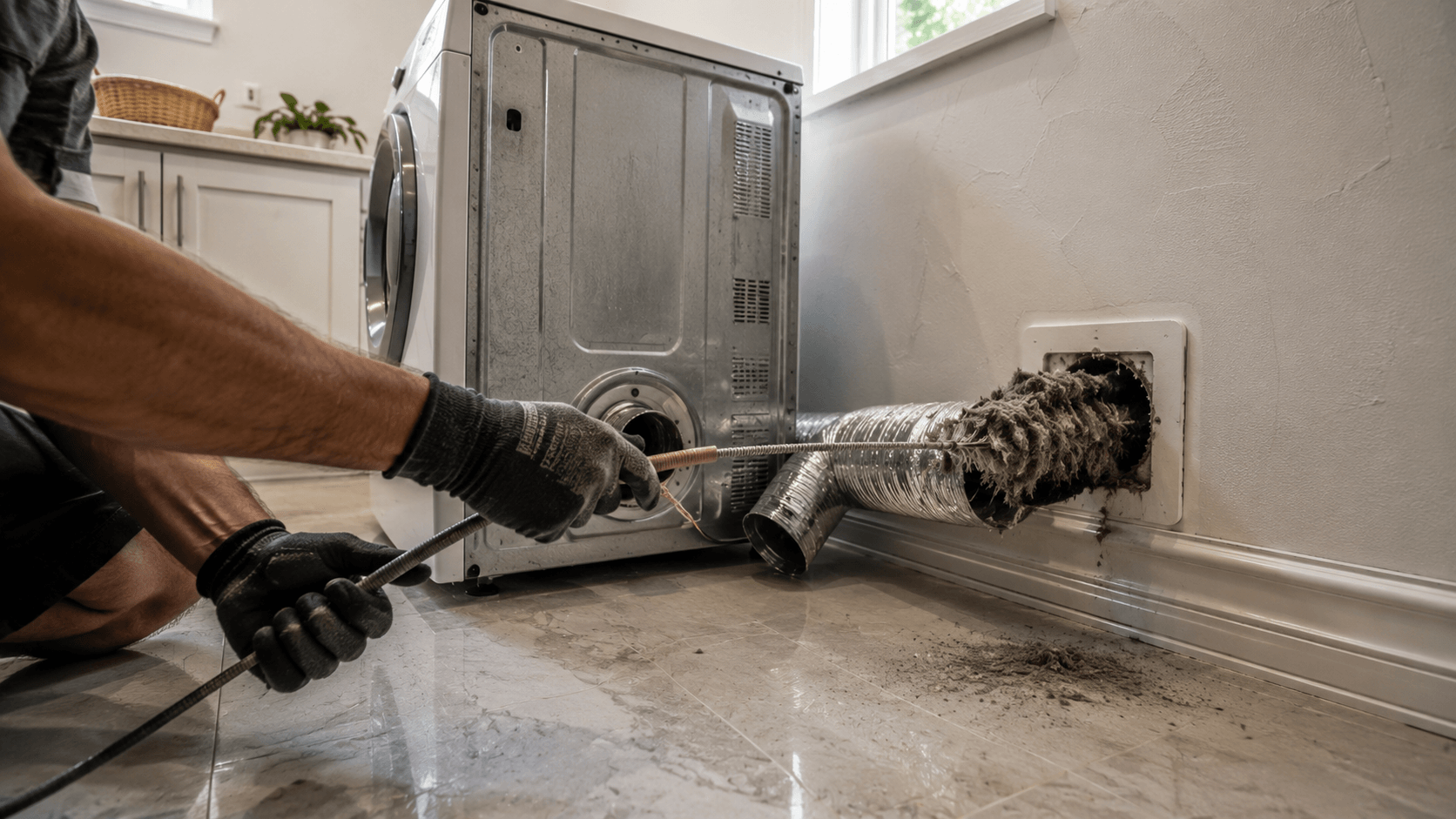
The U.S. Fire Administration reports about 2,900 home dryer fires per year, with hundreds of injuries and roughly $35 million in property damage. The leading cause: failure to clean the dryer vent. What that statistic doesn't capture is the second category of damage we respond to from the same root cause: water damage from blocked vents that back up humid air and condensation into the laundry room, the surrounding walls, and the cabinet structure.
In South Florida specifically, the dryer vent problem is amplified by two factors: extremely long vent runs (homes built with the laundry deep in the interior, venting through a long horizontal run to an exterior wall) and constant high humidity (water vapor that condenses anywhere the vent is even partially blocked). Both risk profiles — fire and water — are higher here than in most of the country.
This guide is for Miami, Fort Lauderdale, Boca Raton, and Palm Beach homeowners who want to understand both hazards and the practical maintenance that prevents them.
How a dryer vent fire actually happens
A dryer's job is to remove moisture from clothes. To do that, it heats air, blows it through the drum, and exhausts the warm humid air outside through the vent.
When the vent is clear, the process works. When the vent is partially or fully blocked by lint accumulation:
- Hot air can't escape efficiently.
- The dryer runs longer to dry the same load.
- Temperatures inside the dryer rise above design specs.
- Lint that's collected in the vent — and the lint catching at the heating element area — gets hot enough to ignite.
- A small fire starts inside the dryer or vent.
- The fire moves through the vent (lint is highly flammable, like a fuse).
- The fire reaches the laundry room or wall cavity where the vent runs.
The whole sequence often takes 30–60 minutes from dryer running normally to active house fire. Most dryer fires happen while the dryer is running but nobody is in the laundry room.
The 6 warning signs of a clogged dryer vent
These are the signs we look for when we respond to a dryer-related event:
- Clothes take longer than usual to dry. A load that used to take 50 minutes now takes 80+. Restricted airflow.
- The dryer or laundry room feels hot during operation. The exhaust isn't getting out, so heat builds up.
- The top of the dryer is hot to the touch during use. Same issue.
- A burning smell coming from the dryer. Could be lint at the heating element. Stop the dryer and inspect immediately.
- Lint accumulating around the dryer or vent opening. Lint visible inside the laundry room, around the back of the dryer, or piled up at the exterior vent termination — all indicate the vent system isn't carrying it out properly.
- Moisture or water damage on the wall behind the dryer. Humid exhaust that can't escape condenses inside the vent or back into the laundry room.
Any one of these means schedule a vent cleaning. Two or more means stop using the dryer until it's serviced.
The water damage angle homeowners miss
The fire risk is well-known. The water damage risk is not.
Here's what happens in a partially-blocked dryer vent in South Florida:
- Dryer exhausts warm, very humid air (just removed from clothes).
- The vent run is partially blocked.
- Some air doesn't make it out — it stalls in the vent.
- The warm humid air contacts the metal vent walls, which cool faster than the air.
- Condensation forms inside the vent.
- Water drips back into the dryer cavity, into the wall behind the dryer, or pools at low points in the vent run.
- Over weeks and months, this water:
- Rots the bottom of the wall plate behind the dryer.
- Feeds mold in the wall cavity.
- Damages flooring around the dryer base.
- Corrodes the dryer's interior and electrical components.
This pattern is invisible from the front of the laundry room. The homeowner sees a hot dryer and longer dry times. They don't see the rotted bottom plate of the wall behind the dryer or the mold colony in the cavity. Until we pull the unit out for restoration.
Vent runs in South Florida homes
The vent run is what determines difficulty of maintenance and risk of failure:
Short straight run (under 8 feet): A laundry room on an exterior wall with a direct vent through. Easy to clean. Low fire and water risk.
Medium run with 1-2 elbows (8-20 feet): Common in mid-century homes where laundry is in a hallway or interior closet. Moderate maintenance frequency.
Long run with multiple elbows (20-50+ feet): Modern open-plan homes where laundry is centrally located and vents through soffits, attics, or upper floors to an exterior wall. High maintenance frequency. High fire risk if neglected.
Vertical run through multiple floors: Two-story or condo installations. Hardest to clean. Lint settles at bottom of vertical sections.
The general rule: every 90-degree elbow is roughly equivalent to 5 extra feet of run for airflow purposes. A vent with 3 elbows over 25 linear feet has effectively a 40-foot run.
Florida Building Code generally requires a vent run no longer than 25 feet total equivalent, with adjustments for elbows. Many older homes have vent runs longer than what's now allowed.
What proper dryer vent maintenance looks like
Every load:
- Clean the lint screen inside the dryer.
Every 1-2 months:
- Vacuum around and behind the dryer.
- Check the exterior vent hood. It should open easily and not be clogged with lint or pest debris.
Once a year (minimum) for short runs:
- Pull the dryer out from the wall.
- Disconnect the flex hose from the dryer.
- Vacuum lint out of the back of the dryer and inside the wall vent.
- Use a vent brush kit (long flexible rod with rotating brush) to clean the vent from inside to exterior.
- Verify lint exits the exterior vent during a test run.
Twice a year (or annually if the run is long):
- Same as above plus consider hiring a professional vent cleaning service.
Professional cleaning ($100–$250):
- Recommended for any vent run over 15 feet.
- Recommended for homes with pets (more lint).
- Recommended for homes with multiple residents (more loads).
A vent that's never been professionally cleaned in 5+ years is at significant fire risk regardless of how diligent the homeowner has been with the lint screen.
What to do if you suspect a dryer fire is starting
Signs in real time:
- Burning smell from the dryer
- Unusual heat radiating from the unit
- Smoke or steam from the vent
- The dryer making unusual sounds
Immediate response:
- Stop the dryer immediately. Turn off the power at the dryer or unplug.
- Get everyone out of the room and the house. Close the laundry room door behind you (slows oxygen to a developing fire).
- Call 911. Even if you think it's small. Dryer vent fires can travel through the wall cavity and become structural before you realize.
- Don't open the dryer door if you suspect fire inside — oxygen accelerates combustion.
- Wait outside for the fire department. Do not try to fight a vent fire yourself — you can't see where the fire is moving inside the wall.
Insurance considerations
Florida homeowners policies typically cover sudden and accidental fire damage, including damage from a dryer vent fire. What gets disputed:
- Lack of maintenance. A homeowner with no records of vent cleaning and a vent obviously clogged with years of accumulation may face coverage reductions on grounds of failure to maintain.
- Code compliance. If the vent installation wasn't to code (wrong material, run too long, not properly secured), the carrier may dispute portions.
- Smoke damage scope. Smoke from a dryer fire often spreads into HVAC, requiring duct cleaning and content cleaning — scope items adjusters sometimes initially limit.
A homeowner with annual professional vent cleaning records is in a much stronger insurance position than one without.
When to call RestoFlo
If you've had a dryer vent fire, smoke event, or water damage from a clogged vent in your South Florida home, call us. We handle the fire/smoke restoration, water mitigation, mold remediation if present, and reconstruction. We work directly with your insurance carrier and coordinate with the appliance repair or replacement work.
24/7 emergency line: (754) 289-4815.