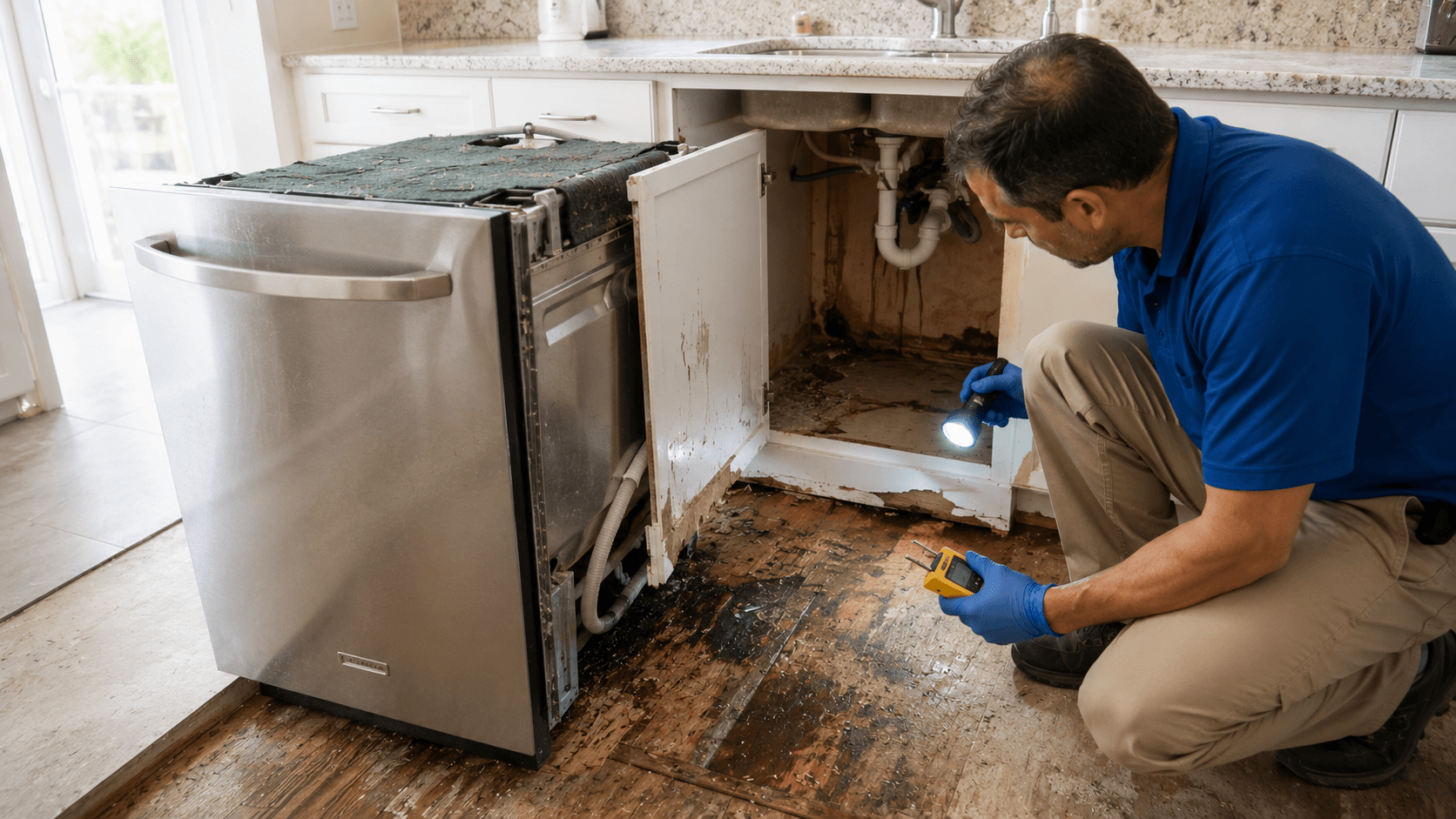
A homeowner opens the base cabinet under the sink to grab dish soap. The kick plate is buckled. There's a musty smell. The bottom shelf feels soft. They pull everything out. Water damage. Where did it come from?
The dishwasher. Specifically, a slow leak — either at the supply line connection, the drain hose, the door gasket, or the internal seals — that has been dripping water down and back under the dishwasher, wicking laterally into the base cabinet on either side, saturating the wood and the toe kick, and starting mold growth in the void behind the cabinet.
By the time the homeowner notices, the leak has been going for months. The dishwasher is still working. The visible water is minimal. The real damage is hidden.
This guide is for Miami, Fort Lauderdale, Boca Raton, and Palm Beach homeowners trying to catch dishwasher leaks before they turn into $10K+ kitchen restorations, and for those who've just discovered damage and want to understand what happens next.
Why dishwashers leak
Six potential leak points: 1. Supply line connection at the hot water valve behind the toe kick (loose or corroded fittings drip slowly — most common leak). 2. Drain hose connection at the disposal or drain fitting (rubber connections dry out and crack). 3. Door gasket around the perimeter (ages, tears, damaged by pods). 4. Internal fill valve (fails and dribbles into the machine). 5. Tub cracks in the plastic body (rare but possible in older units). 6. Pump seals in the recirculating pump.
Why dishwasher damage stays hidden
The dishwasher sits in a recess between base cabinets with about a 1/2 inch gap on each side and a toe kick strip below the front. The floor beneath is typically unfinished plywood or particleboard subfloor.
When water leaks from the dishwasher, it drips down behind or below the machine, the plywood subfloor absorbs it, water wicks laterally into the base of the adjacent cabinets on either side, the bottom of the cabinet gets wet from below, toe kick strips absorb water from the front, and the wall behind the dishwasher gets wet. None of this is visible from the top. The water damage is happening in a dark, sealed cavity where mold thrives.
The 8 signs of a hidden dishwasher leak
1. Musty smell when you open a base cabinet near the dishwasher. 2. Wet, soft, or discolored toe kick in front of the dishwasher. 3. Warped or buckled cabinet floor in cabinets adjacent to the dishwasher. 4. Visible water staining on cabinet interior walls, especially near the floor. 5. Loose or lifting toe kick strip. 6. Higher water bill without explanation. 7. Kitchen floor squishy or spongy near the dishwasher. 8. Water pooling on the floor around or behind the dishwasher.
If you see any of these, pull out the dishwasher for inspection immediately.
How to inspect properly
1. Shut off the water supply. 2. Disconnect power. 3. Disconnect the drain hose. 4. Loosen the mounting brackets at the top. 5. Pull the dishwasher out slowly. 6. Inspect the floor beneath for staining, warping, mold. 7. Inspect the sides of adjacent cabinets. 8. Inspect the wall behind the dishwasher. 9. Inspect the dishwasher — supply line, drain hose, pump area, door gasket. 10. Feel and photograph everything for insurance.
If you find water damage, do not put the dishwasher back until the leak source is repaired, the subfloor and adjacent cabinets are properly dried, and mold (if present) is remediated.
Common repair fixes
Loose supply line fitting: tighten or replace. $10–$50 in parts, DIY. Cracked drain hose: replace. $20–$40, DIY. Torn door gasket: replace. $30–$100, DIY. Failed fill valve: replace. $50–$150, DIY. Tub crack or pump seal failure: replacement dishwasher time. New unit: $500–$2,000+.
The dishwasher fix is the easy part. The restoration scope for the damage the leak caused is where the significant cost is.
The typical restoration scope
When a dishwasher leak has been running long enough to cause structural damage: mitigation (water extraction, containment, air movers, dehumidifiers); demolition (cabinet removal — typically base cabinet where dishwasher was + adjacent base cabinets, toe kick removal, sometimes flooring removal); subfloor assessment and replacement if warped or rotted; mold remediation if mold established (Florida-licensed); drying for days with moisture monitoring; wall repair (drywall behind cabinets often needs replacement); cabinet replacement (typically 2–3 cabinets minimum); countertop repair; flooring repair; dishwasher reinstallation or new dishwasher.
Total cost: $5K–$15K for a moderate scope. $20K+ for a scope that includes countertop replacement and multi-cabinet damage.
Prevention checklist
Every 3 months: pull the dishwasher toe kick off and inspect; look under the sink at the shutoff valve and supply line; check the drain hose connection. Every 6 months: full pullout inspection; check door gasket for tears or wear. Every 5 years: consider replacing supply line with braided stainless steel if it's the original; consider replacing drain hose. Always: never run the dishwasher with items blocking the door; use pods carefully; keep interior clean; place a leak sensor ($20–$40) under or near the dishwasher.
Insurance considerations
Florida homeowners insurance on dishwasher water damage: sudden leak from burst hose or valve failure typically covered for resulting damage; gradual leak that's been running for months typically not covered (maintenance); the dishwasher itself typically not covered; cabinets, subfloor, drywall from a sudden covered event typically covered; mold from a long-running gradual leak typically not covered.
The disputed item: sudden vs. gradual. Documentation matters. The longer the leak ran undetected, the harder the claim.
When to call RestoFlo
If you've discovered dishwasher water damage in your South Florida kitchen — warped cabinets, mold smell, wet subfloor — call us. We arrive 24/7, document everything for your insurance carrier under your direction (no AOBs), mitigate immediately, perform mold remediation under the IICRC S520 standard, and rebuild. 24/7 emergency line: (754) 289-4815.