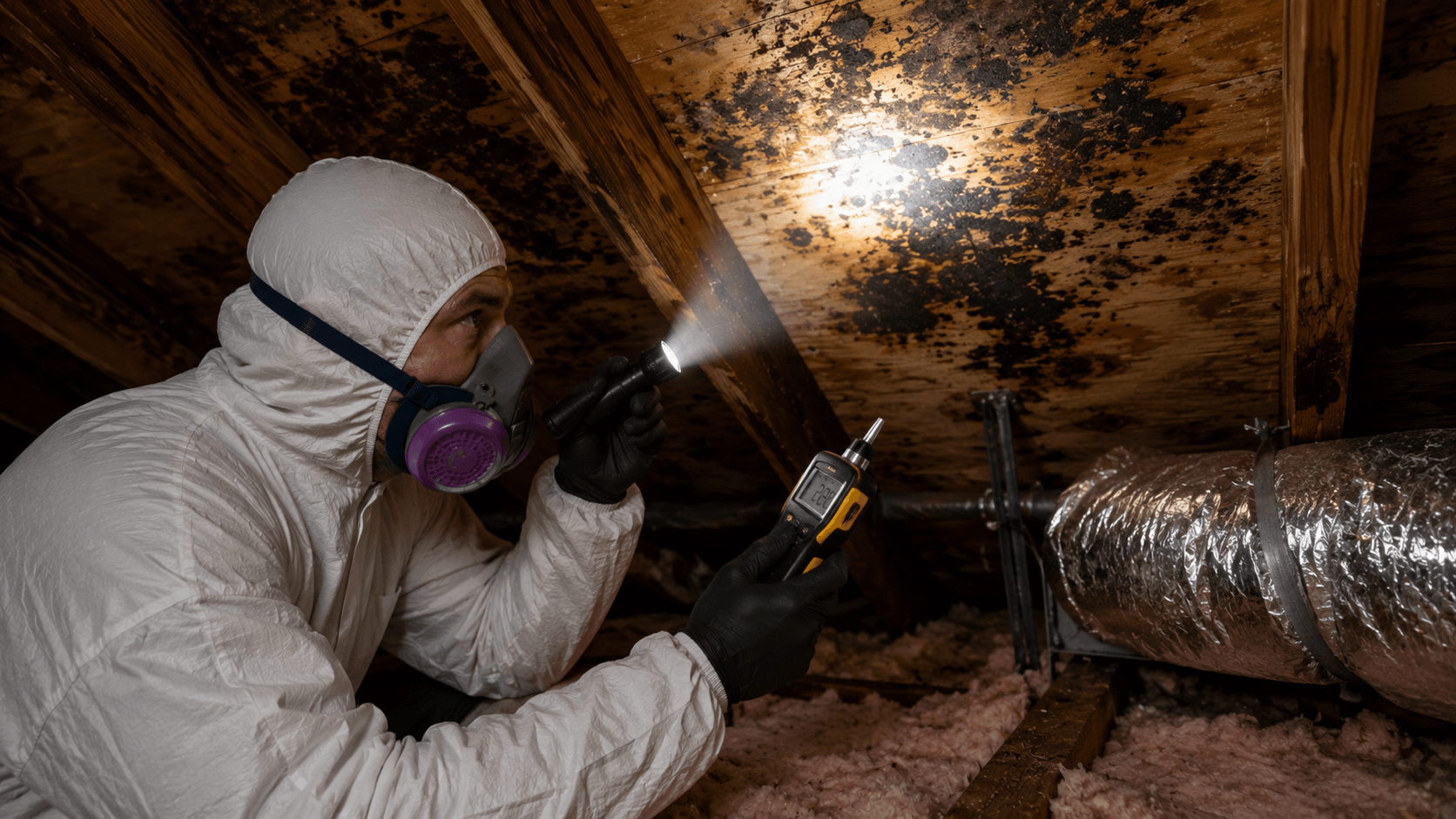
A homeowner climbs into the attic for the first time in years. There's black or fuzzy growth on the underside of the roof deck. No water staining. No active drips. No obvious roof breach. They assume the worst — a hidden roof leak — and call a roofer. The roofer says the roof is fine.
The actual problem in most South Florida attics isn't a roof leak. It's the attic itself — specifically, the combination of high humidity, inadequate ventilation, and (often) cold-spot condensation that creates a perfect environment for mold growth even when the roof is in good condition.
This guide is for Miami, Fort Lauderdale, Boca Raton, and Palm Beach homeowners who've discovered attic mold and want to understand what's actually causing it and how to fix it.
Why South Florida attics grow mold without leaks
Three factors work together: year-round high humidity (outdoor humidity averages 75%+ here, attic humidity tracks closely); heat-driven moisture (hot air holds more moisture; South Florida attic temperatures can hit 130°F+; as this air cools at night, condensation forms on roof decking); common ventilation failures (insufficient ridge vents, blocked soffit vents, insulation covering the soffit baffles, undersized vents).
When these combine, you get a wet, warm, dark environment with organic substrate (wood roof decking) — ideal mold conditions.
The 6 most common causes of attic mold (no roof leak)
1. Condensation on roof decking. Warm humid attic air contacts a cool roof underside, condenses, and creates moisture. Repeated cycles cause persistent dampness.
2. Blocked soffit vents. Painted over, blocked by insulation, blocked by bird/wasp nests, or undersized.
3. Insufficient ridge or gable vents. No outlet path for hot moist air.
4. HVAC ducts leaking conditioned air. Cool ducted air leaking into the attic creates cold spots on adjacent surfaces. Condensation forms on the cold surface.
5. Bathroom or kitchen exhaust fans venting into the attic. Moist air from showers or cooking goes directly into the attic instead of outside. One of the most common contributors.
6. Cool-conditioned spaces below with poor attic insulation. Without sufficient insulation or vapor barrier, moisture from the home migrates up into the attic.
A combination of these — usually 2 or 3 — explains most "mystery" attic mold.
The diagnostic process
A proper assessment includes: roof inspection from above (roofer confirms there's no actual leak); attic inspection from inside (restoration company or mold assessor examines rafters, insulation, vents, ducts, and HVAC equipment); moisture meter readings on roof decking, rafters, and insulation; air sampling for mold spores if levels are uncertain (compares to outdoor baseline); thermal imaging to identify temperature anomalies; ventilation calculations (compare actual vent area to required: 1 sq ft net free vent area per 150 sq ft of attic floor area, with 50/50 ratio of intake at soffits to exhaust at ridge).
The remediation scope
Once the source is identified, remediation typically includes: containment of the affected attic area; HEPA negative air machines during work; removal of contaminated insulation (almost always required in moderate-to-severe cases); cleaning the rafters and roof deck by HEPA vacuum, then antimicrobial treatment, then encapsulation if needed.
Repair of underlying source. This is the critical step. If the source isn't fixed, mold returns. Improving ventilation (add or clear soffit vents, install/upgrade ridge vents); sealing duct leaks (mastic or tape on duct joints, sometimes duct replacement); rerouting exhaust fans (roof or wall vent termination, not into attic); insulation upgrade (proper R-value and vapor barrier, sealing the ceiling plane); sometimes adding a small attic exhaust fan to mechanically ventilate.
Post-remediation testing. Air samples to verify the attic is no longer a mold source.
A typical comprehensive attic mold remediation in South Florida runs $3K–$15K depending on attic size, severity, and source-repair scope. The ventilation and insulation work is often the biggest expense — but it's what prevents the problem from coming back.
The insurance question
Florida homeowners insurance on attic mold without a covered water event: mold caused by long-term high humidity / poor ventilation is typically not covered (treated as maintenance); mold caused by a roof leak is typically covered for the mold remediation portion (capped at mold endorsement, often $10K) and the roof repair; mold from HVAC duct leaks may be covered as resulting damage if the HVAC was recently installed or had a recent covered loss; otherwise treated as maintenance.
Most attic mold without a visible leak is treated as a homeowner-maintenance issue by carriers, regardless of how severe. The disputed item often is: was there a leak that caused the mold, or was the mold from gradual conditions? A pre-loss inspection report and timestamped photos help.
Prevention checklist
Annually: visually inspect attic for water staining, mold, or new growth; check soffit vents from outside for blockage; check ridge vents from outside; confirm bathroom/kitchen exhaust fans vent outside, not into attic. Every 2–3 years: professional attic assessment; check insulation depth and condition; verify duct connections are sealed. After any major water event: professional attic inspection; moisture meter readings; address any wet insulation before mold establishes (48-hour window in our humidity). When buying a home: specifically request attic inspection by qualified inspector; don't accept "attic was clean" — verify with moisture and visual inspection.
DIY vs. professional
Small surface mold patches on roof decking (< 10 square feet) with no insulation contamination can sometimes be handled by careful DIY: HEPA vacuum, scrub with detergent solution, treat with antimicrobial, encapsulate. PPE required (N95, gloves, eye protection).
Anything larger, anything in insulation, or anything in HVAC ducts should be professional remediation. The systems are too interconnected, and inadequate work spreads spores throughout the home.
When the attic is also the air handler space
Some South Florida homes have the air handler in the attic. This makes the situation worse because the air handler condenses moisture out of conditioned air; the condensate drain can fail and dump water into the attic; the cool air handler surface is a condensation trap; the ductwork connections are right where the mold is.
These attics often have mold around the air handler cabinet, wet insulation under the air handler, mold in ductwork connections, and higher remediation scope than dry attics. If your air handler is in the attic and you've discovered mold, the remediation scope almost always includes HVAC cleaning. See our dedicated HVAC duct mold post for more.
When to call RestoFlo
If you've discovered mold in your South Florida attic and aren't sure whether the source is a leak or ventilation, call us. We coordinate with a licensed Florida Mold Assessor for the diagnosis, perform remediation under the IICRC S520 standard, and partner with HVAC and roofing professionals on source repairs. We work directly with your insurance carrier without AOBs. 24/7 emergency line: (754) 289-4815.